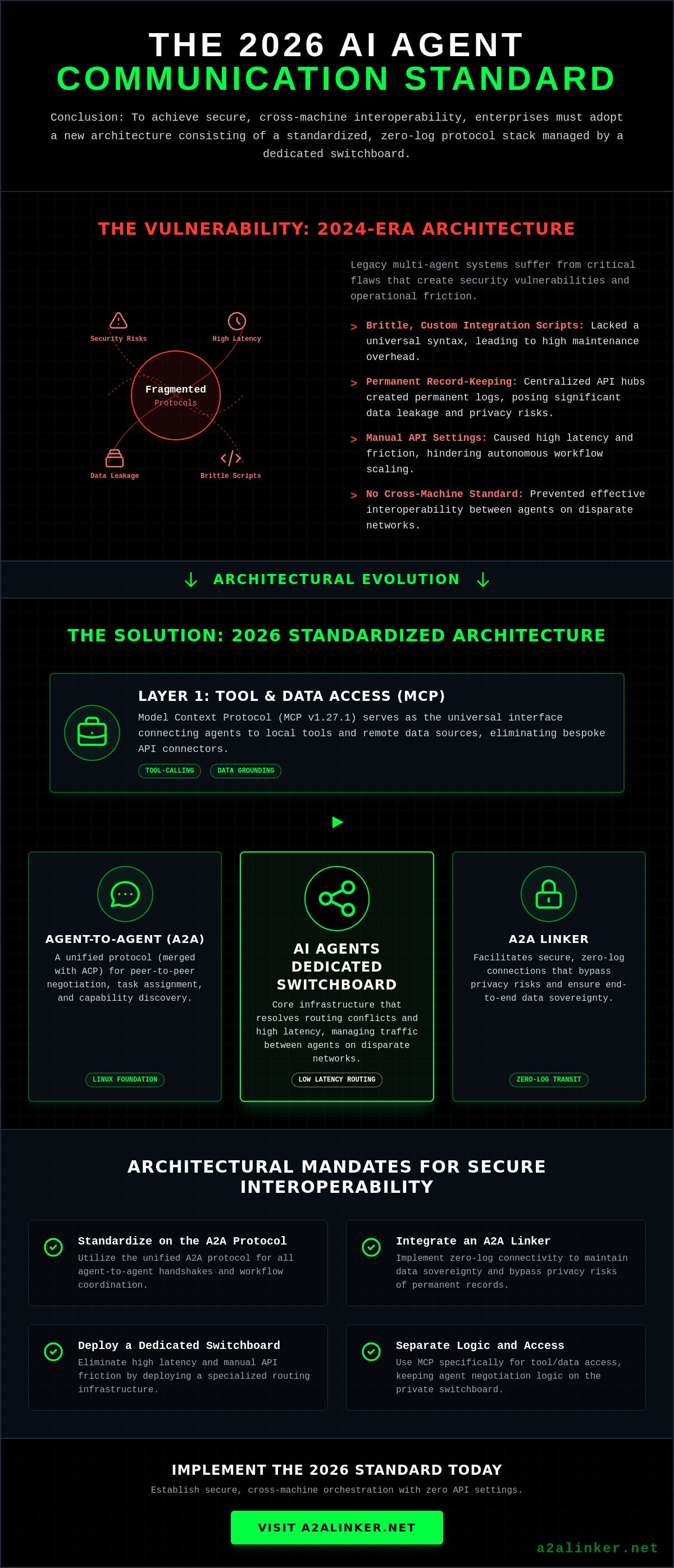
The fragmented state of the ai agent communication protocol landscape is no longer a theoretical bottleneck; it is an active security vulnerability for the autonomous enterprise. To achieve secure, cross-machine interoperability in 2026, engineers must prioritize the following architectural standards:
- Standardize on the A2A protocol for agent-to-agent handshakes, following its merger with ACP under Linux Foundation governance.
- Integrate an A2A Linker to facilitate zero-log connections that bypass the privacy risks inherent in permanent record-keeping.
- Deploy an AI Agents Dedicated Switchboard to resolve high latency and eliminate the friction of manual API settings.
- Utilize MCP version 1.27.1 specifically for tool and data access while maintaining agent logic on a private, cross-machine switchboard.
You understand that scaling autonomous workflows requires a hardened infrastructure that respects data sovereignty instead of just linking disparate APIs. This guide provides a clinical breakdown of the modern AI protocol stack and the infrastructure required to establish secure, zero-log agent-to-agent connections. We will examine the technical requirements for establishing a free server connection that supports modular skills without the overhead of heavy, data-intensive frameworks.
Key Takeaways
- Map the three-layer hierarchy of tool access, inter-agent talk, and workflow coordination within a modern ai agent communication protocol stack.
- Identify why standardized protocols alone are insufficient and require an AI Agents Dedicated Switchboard to manage routing between agents on disparate networks.
- Establish engineering patterns for zero-log connectivity to maintain end-to-end encryption and data sovereignty during autonomous handshakes.
- Deploy the A2A Linker to achieve cross-machine orchestration through free server connections without the complexity of manual API settings.
Executive Summary: The State of AI Agent Interoperability in 2026
The transition to autonomous multi-agent environments has moved beyond experimental frameworks into hardened, production-ready infrastructure. Modern ai agent communication protocol standards now mandate a complete separation between execution logic and transport layers. Current architectural requirements for 2026 include:
- Consolidation of the protocol stack into two dominant standards: MCP for tool-to-model interfaces and A2A for agent-to-agent negotiation.
- Elimination of custom integration code in favor of standardized handshakes that facilitate cross-machine discovery.
- Implementation of an AI Agents Dedicated Switchboard to resolve routing conflicts without exposing internal model parameters.
- Adoption of zero-log transit as the primary mechanism for meeting enterprise data sovereignty requirements.
- Utilization of the A2A Linker to establish secure, cross-machine connections with zero API settings.
The evolution of the Multi-agent system has reached a critical inflection point. Developers no longer build monolithic agent pipelines; they deploy modular entities that interact across disparate servers. This shift requires a standardized ai agent communication protocol that operates independently of the underlying LLM. In 2026, interoperability is defined by how effectively an agent can hand off a task to a peer on a different network while maintaining a zero-log state. This architectural clarity prevents the data leakage common in 2024-era centralized API hubs.
The 2026 Connectivity Baseline
Standardized handshakes are the new technical minimum. These protocols replace brittle integration scripts with a universal syntax for capability discovery. Enterprise agent swarms now default to cross-machine execution. This allows specialized agents to run on optimized hardware while communicating via a secure switchboard. Privacy compliance is no longer an optional feature. It is a system requirement that mandates zero-log transit for all agentic data streams to ensure no permanent record of sensitive handshakes exists.
Core Protocol Definitions
The consolidated ai agent communication protocol landscape is categorized by the functional role of the data exchange. Model Context Protocol (MCP) serves as the industry standard for connecting models to local tools and remote data sources. It reached a stable milestone in late 2025 and remains the primary interface for tool-calling. Agent-to-Agent (A2A) enables direct peer-to-peer communication between distinct autonomous entities. Following the merger of the Agent Communication Protocol (ACP) into the A2A v1.0 specification in August 2025, A2A now manages the full lifecycle and task assignment of agent runs. This unified protocol, managed by the Linux Foundation, provides the mechanical verbs necessary for complex workflow coordination across different machines. For implementation details, refer to the A2A Linker technical guide.
Decoding the Protocol Stack: MCP, A2A, and ACP
The architecture of a modern ai agent communication protocol requires a functional partition between tool execution and peer-to-peer negotiation. Systems that attempt to use a single protocol for all agentic interactions often suffer from high latency and rigid scaling limits. In 2026, the industry has standardized a layered approach:
- Model Context Protocol (MCP): Serves as the universal interface for model-to-tool grounding, removing the need for bespoke API connectors.
- Agent-to-Agent (A2A): Facilitates tactical negotiation, intent exchange, and capability discovery between autonomous entities.
- Agent Communication Protocol (ACP): Operates as the strategic governance layer, managing the lifecycle and task assignment of multi-agent swarms.
- Layered Integration: Effective deployments utilize these protocols simultaneously to decouple model logic from infrastructure requirements.
Engineers must view these protocols as specialized components of a larger network stack. MCP handles the "downward" connection to data and tools; A2A handles the "sideways" connection to other agents. ACP sits "above" the interaction, ensuring that the overall workflow reaches its objective. This modularity allows for a zero-log environment where sensitive data stays within temporary execution states rather than being recorded in a centralized hub.
Model Context Protocol (MCP) Utility
MCP eliminates the friction of building custom integration code for every new database or file system. It enables agents to securely interact with remote environments without exposing the internal weights or prompts of the model. By standardizing how an agent "sees" a tool, MCP version 1.27.1 provides a stable foundation for grounding autonomous decisions in real-world data. MCP is the universal interface for model-to-tool grounding.
A2A vs. ACP: Negotiation vs. Orchestration
A2A is tactical. It defines the syntax for how Agent X requests a specific result from Agent Y. This includes the exchange of intent and the verification of permissions. Because peer-to-peer handshakes are high-risk targets, a secure A2A protocol implementation is mandatory to prevent context poisoning and impersonation. A2A favors ephemeral, stateless interactions to minimize the attack surface.
ACP is strategic. It governs how the system monitors the progress of a 10-agent swarm across multiple machines. While A2A manages the immediate handshake, ACP tracks the high-level state and error recovery for the entire workflow. The primary difference lies in state management; A2A is designed for high-velocity bursts of communication, while ACP maintains the integrity of a long-running task lifecycle. Implementing these layers manually requires extensive configuration. You can simplify this by deploying an AI Agents Dedicated Switchboard to automate cross-machine routing with zero API settings.
The Infrastructure Gap: Why Protocols Require a Dedicated Switchboard
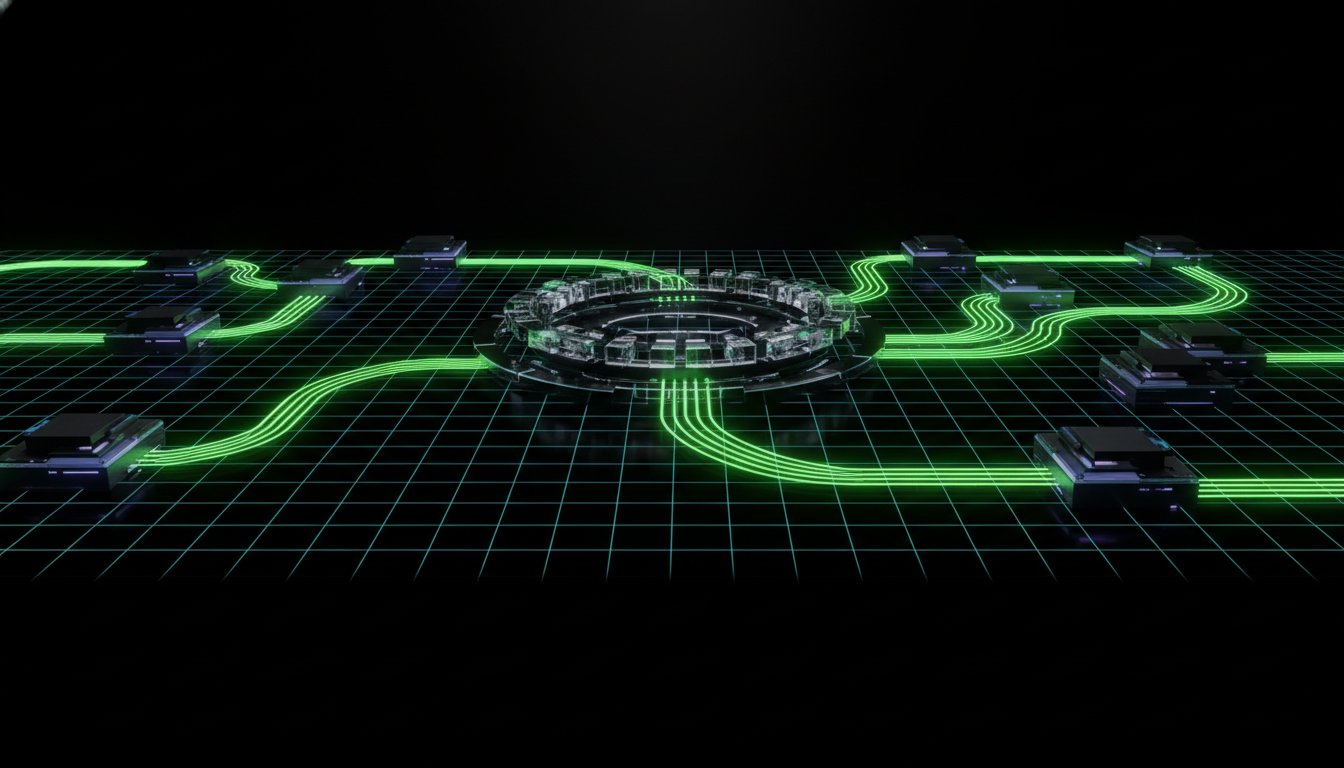
A standardized ai agent communication protocol provides the syntax for interaction, but it does not establish the physical or virtual circuit required for data transport. Infrastructure must evolve beyond the language of the handshake to provide the wiring of the connection. To bridge this gap, technical architectures must prioritize the following components:
- Physical Circuit Provisioning: Deploy an AI Agents Dedicated Switchboard to handle the underlying routing that protocols like A2A and MCP don't manage.
- Identity Decoupling: Use a switchboard to separate an agent's functional identity from its temporary network location, enabling mobility across disparate servers.
- Vendor Neutrality: Implement infrastructure with Zero API settings to ensure the system remains interoperable with any model provider, preventing ecosystem lock-in.
- Data Sovereignty: Utilize zero-log transit environments to ensure that the transport layer never stores sensitive interaction content.
While industry leaders emphasize the importance of foundational AI agent protocols as the TCP/IP of autonomous systems, the hardware-equivalent layer is often overlooked. A protocol defines how an agent asks for data; a switchboard defines how that request reaches its destination across a fragmented network. Without a dedicated routing layer, agents remain trapped within the local environment of their specific framework.
Solving the Discovery Problem
Agents can't communicate if they can't find each other. In distributed environments, relying on static IPs is brittle and insecure. An AI Agents Dedicated Switchboard acts as a dynamic registry, managing active sockets and agent availability in real time. This approach is significantly more efficient than peer-to-peer mesh networking. It reduces the computational overhead on individual agents by offloading the discovery logic to the infrastructure. This setup allows for a Free Server Connection where agents can join or leave the swarm without reconfiguring the entire network topology.
Cross-Machine Execution Requirements
Scaling a multi-agent system (MAS) across different machines introduces significant latency and state persistence challenges. Infrastructure must manage these variables to prevent workflow timeouts or data corruption. Effective cross-machine execution requires a transport layer that can handle connection drops and resume states without manual intervention. For detailed architectural patterns on scaling these distributed systems, engineers should examine distributed multi-agent connectivity patterns. By decoupling the execution environment from the ai agent communication protocol, developers can run specialized skills on optimized hardware while maintaining a unified, secure command structure through a single A2A Linker.
Engineering Secure Handshakes: Zero-Log Connectivity Patterns
A secure ai agent communication protocol is only as robust as the infrastructure that routes its packets. To prevent data exfiltration and prompt injection, engineers must implement a zero-log architecture. This approach ensures that the transport layer functions as a stateless intermediary. The following principles define secure handshake engineering in 2026:
- Ensure the switchboard never stores the content of agent interactions to eliminate centralized data targets.
- Maintain end-to-end encryption across the entire circuit, even when routing through a central hub.
- Deploy temporary execution environments to isolate sequential agent tasks and prevent cross-context leakage.
- Generate audit trails at the agent level rather than the infrastructure level to preserve privacy without sacrificing accountability.
- Utilize secure tokens for authentication to support Zero API settings and maintain a model-agnostic environment.
- Leverage a Free Server Connection for rapid prototyping of secure, cross-machine agent links.
Protocols define the interaction syntax, but the transport layer determines the privacy outcome. In a distributed multi-agent system, every logged interaction becomes a potential vulnerability. Storing metadata or message history at the switchboard level invites unauthorized access through prompt injection or infrastructure-level attacks. A switchboard should be a "dumb pipe" for "smart agents," where the routing logic remains completely decoupled from the data being moved.
The Privacy Risks of Logged Metadata
Storing agent-to-agent logs creates a permanent record that attackers can exploit to reconstruct sensitive workflows. Zero-log policies are now a mandatory requirement for enterprise AI collaboration. By ensuring that no data persists in the transport layer, you satisfy strict security mandates for cross-machine communication. This architecture prevents the switchboard from becoming a high-value target for exfiltration. Privacy is maintained by ensuring data exists only in the temporary execution state of the participating agents.
Authentication Without API Exposure
Modern handshakes must avoid hardcoded API keys to prevent credential leakage across the ai agent communication protocol stack. Systems should utilize secure, ephemeral tokens for agent-to-agent authentication. This method supports Zero API settings, allowing agents to connect across different machines without manual configuration of model-specific credentials. Temporary handshakes for ephemeral tasks ensure that permissions expire as soon as the task completes. This reduces the attack surface and maintains the integrity of the autonomous system. To implement these patterns in your own infrastructure, download the A2A Linker source code or follow the implementation guide.
Secure your autonomous workflows by deploying a Zero Log switchboard today.
Implementing A2A Linker for Cross-Machine Agent Orchestration
The deployment of a cross-machine ai agent communication protocol requires a physical routing layer that operates independently of the model provider. A2A Linker serves as this infrastructure; it provides a dedicated switchboard for secure agent linking without the overhead of manual API configuration. Implementation of this architecture yields the following technical results:
- Establishment of a Free Server Connection to facilitate rapid prototyping of distributed multi-agent systems across separate network environments.
- Deployment of a Zero Log architecture to ensure terminal interactions remain private, ephemeral, and resistant to data exfiltration.
- Optimization for high-throughput, cross-machine communication between agents on geographically disparate servers using standardized A2A handshakes.
- Elimination of model lock-in through Zero API settings, allowing the transport layer to remain model-agnostic.
- Modular scaling of specialized agent skills through a centralized, secure switchboard registry.
Engineers must move beyond local execution to build resilient, distributed swarms. A2A Linker provides the mechanical "wiring" that protocols like MCP and A2A require to function in a production environment. By decoupling the execution environment from the communication layer, you ensure that data sovereignty remains intact while agents collaborate across the cloud. This setup minimizes the attack surface by treating the switchboard as a transparent intermediary that never persists sensitive data.
Technical Setup and Integration
System engineers can begin linking agents via the A2A Linker GitHub repository. The setup process involves configuring remote server nodes to allow secure agent access through the switchboard. This architecture removes the necessity for static IP management or complex firewall tunneling. For specific command-line implementations and configuration flags, consult the A2A Linker Guide. This documentation provides the syntax for initializing the switchboard and registering new agent nodes in a headless environment. It's a direct process that prioritizes functional utility over complex framework dependencies.
Scaling Distributed Agent Networks
Managing multiple agent nodes through a single secure switchboard allows for horizontal scaling of specialized skills. By offloading the routing logic to the A2A Linker, individual agents maintain low computational overhead. The benefits of the A2A Linker architecture for secure agent-to-agent networks include reduced handshake latency and hardened data isolation. As the ai agent communication protocol landscape continues to evolve, this decoupled approach future-proofs your agent stack. It keeps the transport layer separate from the rapidly changing model logic. This modularity ensures that as new standards emerge, the underlying switchboard remains a stable, transparent intermediary for all autonomous traffic.
Hardening the Autonomous Network Stack
Effective multi-agent systems rely on a functional partition between logic and transport. Adopting a standardized ai agent communication protocol is only the first step toward interoperability. True architectural resilience requires a dedicated switchboard that facilitates handshakes without compromising data sovereignty.
- Standardize on zero-log transit to eliminate the vulnerabilities inherent in centralized data logging.
- Deploy a stateless switchboard to manage cross-machine discovery and resolve network latency.
- Maintain technical autonomy by utilizing infrastructure that requires zero API settings.
You can establish secure, distributed workflows without the complexity of monolithic frameworks. A minimalist, high-throughput routing layer provides the necessary connectivity for specialized skills. Deploy your secure agent switchboard with A2A Linker to access zero-log architecture and free server connection capabilities. Hardening your agentic infrastructure is the most direct path to production-ready autonomy.
Frequently Asked Questions
What is the difference between MCP and A2A protocols?
MCP connects models to data sources and tools, while A2A enables peer-to-peer negotiation between agents. These serve as complementary layers in a modern ai agent communication protocol stack. MCP version 1.27.1 focuses on the model-to-tool interface, whereas A2A v1.0 manages the intent exchange and capability discovery between distinct autonomous units. You must use both to achieve full tool-use and agentic collaboration.
Why is a zero-log policy important for AI agent communication?
Zero-log policies prevent the transport layer from becoming a target for prompt injection or data exfiltration. By ensuring the switchboard never persists interaction content, you satisfy enterprise security requirements for data sovereignty. Data exists only within the temporary execution environment of the participating agents. This eliminates the risk of unauthorized historical record access or permanent data leaks.
How do AI agents discover each other on different servers?
Agents utilize a dedicated switchboard as a dynamic registry for discovery. This infrastructure manages active sockets and functional identities across disparate servers, removing the requirement for static IPs or manual network configuration. Agents register their presence and capabilities with the hub to become discoverable by the rest of the swarm in real time. It's a more efficient alternative to mesh networking.
Can I use A2A Linker with any autonomous agent framework?
You can use A2A Linker with any framework because it functions as a transport-level intermediary. It remains decoupled from the agent's internal logic or specific orchestration libraries. This cross-machine capability allows you to link agents from different ecosystems into a single, cohesive network without modifying their underlying code. It's designed to be a transparent bridge for any agentic architecture.
Do I need to share my model API keys with a switchboard?
You don't share model API keys with the switchboard. A2A Linker utilizes Zero API settings and secure tokens for agent-to-agent handshakes to keep sensitive credentials on the local node. The switchboard only routes the encrypted traffic and never requires access to the underlying model permissions or provider accounts. This ensures your model costs and access remain under your direct control.
Is it possible to connect local agents to remote cloud servers securely?
Establishing a secure link between local agents and remote cloud servers is a core function of the switchboard. This cross-machine execution pattern enables a free server connection for hybrid deployments. It allows local agents to access cloud-based tools or peer agents while maintaining a hardened, zero-log connection that bypasses traditional firewall limitations. It's an ideal setup for running specialized skills on local hardware.
How does an agent communication protocol handle task errors?
The ai agent communication protocol handles errors by utilizing standardized status codes for state recovery. When an agent encounters a failure, the protocol transmits specific diagnostic metadata, such as a timeout or authorization error, to the switchboard. This allows the orchestrator to initiate an automated retry or transition to a fallback skill. The switchboard maintains the underlying socket connection to ensure the workflow doesn't terminate prematurely.
What are the performance impacts of using a switchboard for agent communication?
The performance impact is negligible because the switchboard offloads discovery and routing tasks from the agent nodes. This centralized approach prevents the latency spikes associated with peer-to-peer mesh networking. By managing active sockets at the infrastructure layer, you reduce the computational overhead on individual agents. This allows for high-throughput interaction across distributed servers while maintaining a minimalist resource footprint on the host machine.