
Scaling autonomous systems in 2026 requires moving beyond brittle local file-based queues that trigger race conditions. Transitioning to a dedicated ai agent message queue using a zero-log switchboard architecture ensures secure, low-latency orchestration across disparate server environments. This architectural shift delivers several immediate technical advantages:
- Zero-log privacy to satisfy the August 2, 2026, EU AI Act compliance requirements.
- Direct cross-machine connectivity using the A2A Linker without the overhead of complex API settings.
- Free server connection capabilities that eliminate the high latency inherent in centralized API-driven hubs.
- Functional autonomy for agents through a dedicated switchboard that treats every interaction as a temporary, stateless event.
You understand that local file hacks and high-latency hubs compromise the integrity of professional agent networks. This article demonstrates how to implement a secure communication switchboard that prioritizes architectural clarity and data privacy. We'll examine the technical requirements for connecting agents seamlessly across environments while maintaining a zero-trust posture. You'll learn to deploy a system that handles sensitive interactions without leaving a permanent data footprint.
Key Takeaways
- Transition from local file-system dependencies to asynchronous network switchboards to eliminate race conditions in agent handoffs.
- Deploy a distributed ai agent message queue to facilitate low-latency communication across disparate, cross-machine environments.
- Enforce zero-log and zero-API protocols to minimize the attack surface and ensure stateless data transit between autonomous agents.
- Utilize the A2A Linker to simplify orchestration, removing the need for heavy frameworks or centralized, data-intensive hubs.
Executive Summary: The Evolution of AI Agent Message Queues
Dedicated switchboards have replaced local file-based queues as the architectural standard for professional agentic orchestration. This transition is a technical necessity for systems requiring secure, cross-machine connectivity. Local systems often fail under the weight of race conditions and lack the infrastructure to bridge agents operating across disparate server environments. Modern architectures now prioritize zero-log transit and stateless communication to maintain system integrity.
An ai agent message queue functions as an asynchronous communication layer for agent-to-agent handoffs. It ensures operational stability by decoupling the execution of logic from the timing of data delivery. This setup is essential for achieving the following outcomes:
- Elimination of race conditions in multi-agent swarms by managing message states independently.
- Maintenance of thread continuity across distributed server environments without manual intervention.
- Adherence to the August 2, 2026, EU AI Act compliance deadline through zero-log data handling.
- Support for cross-machine interactions using a free server connection.
The Core Function of Agentic Messaging
Agentic messaging serves as the backbone for autonomous swarms. It decouples agent execution from communication timing, allowing for non-blocking operations across the network. This is particularly important when dealing with high-latency model responses that would otherwise cause synchronous connections to timeout. By implementing the foundational logic of a message queue, developers can route data between nodes without direct coupling.
- Buffers high-latency responses to ensure downstream agents don't experience execution gaps.
- Facilitates stateful handoffs where an agent transfers a specific Skill or data packet to a peer.
- Enables non-linear task processing where multiple agents contribute to a single objective from different environments.
- Ensures delivery reliability through structured retry logic built into the switchboard.
Why Traditional Queues Fail AI Agents
Legacy message systems aren't optimized for the ephemeral and sensitive nature of agent communication. Standard enterprise solutions often introduce unnecessary architectural bulk and security risks. Most traditional systems require heavy infrastructure setup and persistent logging, which contradicts the modern requirement for privacy-first, minimalist design. The A2A Linker addresses these failures by providing an AI agents dedicated switchboard that operates without the need for complex API settings.
- Infrastructure Bulk: Systems like RabbitMQ require extensive configuration and resource allocation that slows down deployment.
- Connectivity Gaps: Local file-based systems cannot bridge agents residing on different physical or virtual servers.
- Privacy Risks: Traditional logging creates permanent records of ephemeral agent reasoning, increasing the potential attack surface.
- Configuration Friction: Standard queues often demand shared keys and complex API settings, creating security vulnerabilities.
By moving to a zero-log ai agent message queue, engineers can ensure that sensitive data is never stored in transit. This approach respects the developer's need for a lean, transparent intermediary that enables autonomy without adding restrictive ecosystem dependencies. You can find detailed implementation steps in the A2A Linker guide to begin transitioning your architecture.
Architectural Patterns for AI Agent Message Queues
Scalable autonomy depends on asynchronous patterns that isolate agent logic from network transit. By offloading communication to an external bus, agents avoid the blocking delays inherent in synchronous API calls. This decoupling is the only way to manage the variable latency of large language model inference across a distributed swarm. Modern system designs prioritize the following architectural strategies:
- Asynchronous handoffs: Agents push data packets to the ai agent message queue and immediately resume local processing.
- Topology selection: Systems utilize point-to-point patterns for direct task delegation and Pub/Sub for broadcasting updates to specialized agent groups.
- Framework neutrality: A unified communication bus enables interoperability between diverse frameworks such as CrewAI, Swarm, and custom-built agents.
- Latency reduction: Minimalist routing logic minimizes the overhead between nodes, ensuring that the intermediary does not become a performance bottleneck.
Research published in a Large-Scale Autonomous LLM-based Multi-Agent System highlights that asynchronous messaging is essential for managing the high-concurrency demands of autonomous swarms. Without this layer, the system becomes fragile, as a single slow agent can stall the entire workflow. Implementing a dedicated switchboard ensures that message flow remains fluid, even when individual nodes are under heavy compute load.
The Switchboard Architecture
A dedicated switchboard functions as a transparent intermediary for agent handshakes. It eliminates the need for complex API settings between individual nodes, which often serve as points of failure. This pattern supports cross-machine and cross-network agent linking without requiring a centralized, data-heavy platform. It acts as a lean connector, allowing you to link agents across disparate servers using a free server connection. The switchboard maintains the integrity of the handshake while remaining invisible to the agents' internal logic.
Managing Message Priority and Routing
Effective orchestration requires more than simple message passing; it demands intelligent routing. Implementing priority tiers ensures that urgent interventions, such as safety overrides or critical error corrections, bypass standard processing queues. Dynamic routing logic directs packets based on specific agent capabilities or current availability, preventing any single node from being overwhelmed. These systems provide delivery guarantees through temporary state management, ensuring that data reaches its destination without ever being written to a permanent log. This stateless approach is fundamental to maintaining zero-log privacy in professional environments. For teams ready to optimize their routing, the A2A Linker provides the necessary infrastructure to handle these complex swarms efficiently.
Local File-Based Queues vs. Distributed Network Switchboards
Distributed network switchboards provide the only viable architecture for cross-machine agent orchestration. Local file-based systems, while efficient for single-machine operations, create an insurmountable connectivity bottleneck in production environments. True scalability requires an ai agent message queue that operates independently of the local file system. The following technical distinctions define the transition from local hacks to professional infrastructure:
- Scalability: Local queues are restricted to a single host. Network switchboards enable distributed swarms to communicate across global cloud regions and local hardware.
- I/O Performance: File-based systems, such as Maildir-style queues, suffer from disk contention and I/O wait states as agent counts increase. Switchboards distribute the load across connection nodes.
- Security: Local queues rely on OS-level permissions which are difficult to manage in containerized environments. Network switchboards utilize encrypted handshakes and zero-log transit to protect sensitive data.
- Interoperability: A network-based ai agent message queue allows disparate tools like Claude Code to interact with remote execution nodes without shared file system access.
The Connectivity Bottleneck
Local systems fail when agents require access to remote terminal environments or specialized hardware. If your primary agent runs on an AWS EC2 instance but needs to delegate a task to a local GPU rig, a file-based queue cannot bridge that gap. Distributed switchboards resolve this by acting as a transparent intermediary. They allow agents to perform handshakes across network boundaries without complex VPN or SSH tunneling configurations. This architecture enables a seamless flow of data between cloud-native models and edge-based execution environments.
Scalability Comparison
File-based systems experience significant performance degradation as the number of concurrent agents grows. Disk locking mechanisms and race conditions become frequent; these lead to dropped messages or corrupted state files. In contrast, network switchboards scale horizontally by distributing connection nodes across the infrastructure. This approach ensures that the communication bus doesn't become a single point of failure or a performance bottleneck. For developers moving from prototype to production, using the A2A Linker provides a free server connection to test these distributed patterns without initial infrastructure costs. It removes the architectural bulk associated with traditional MQ systems while maintaining the global reach required for modern agentic swarms. You can verify implementation details in the A2A Linker guide to see how cross-machine connectivity is established without permanent data retention.
Security Engineering: Zero-Log and Zero-API Architectures
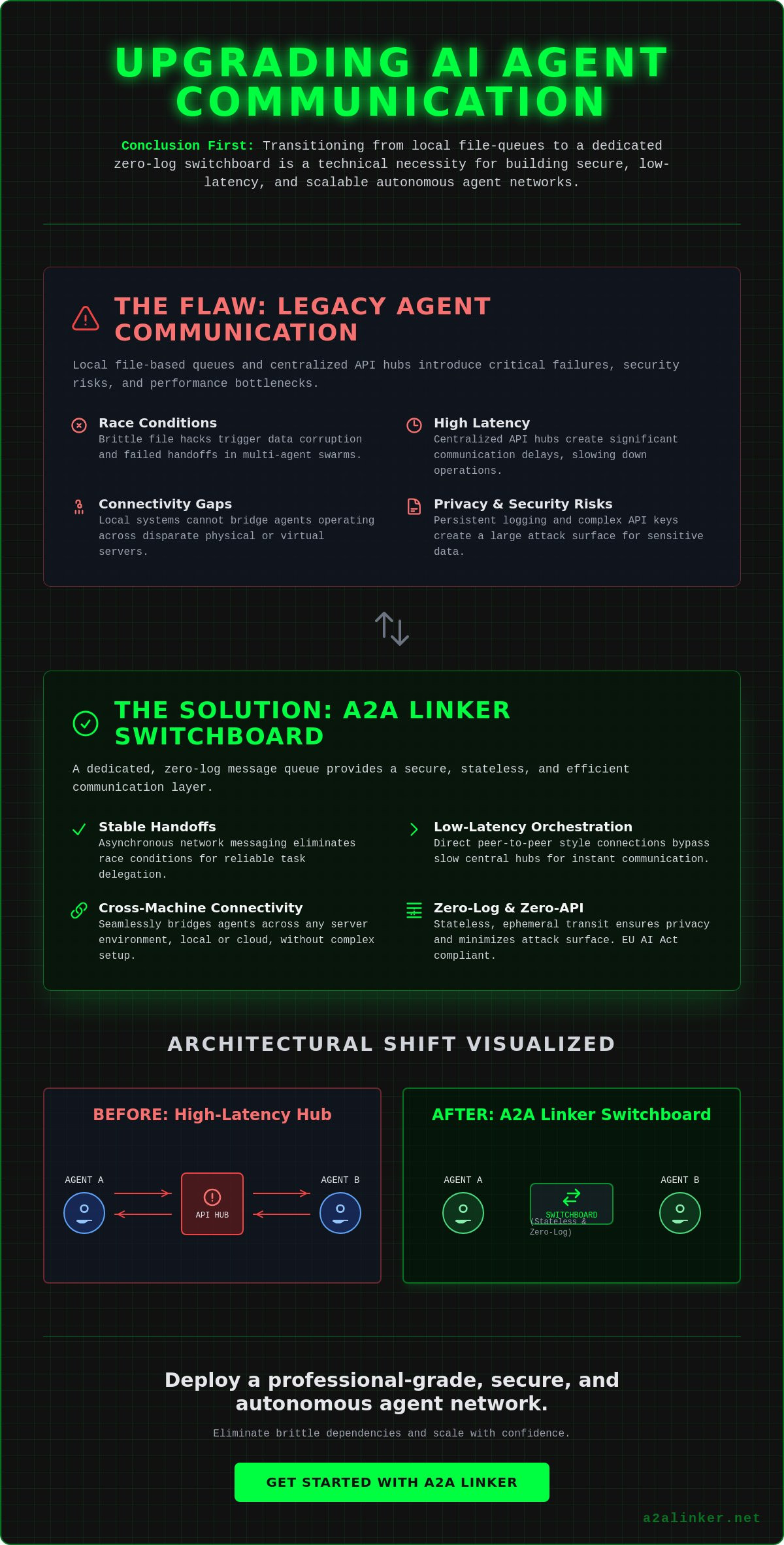
Zero-log and zero-API architectures provide the only secure foundation for professional agent orchestration by eliminating the data attack surface. Traditional communication methods create permanent records of ephemeral logic, which introduces significant liability. By ensuring that no persistent record of transit exists, engineers can satisfy strict privacy requirements while maintaining high-velocity orchestration. Implementing a secure ai agent message queue requires the following technical safeguards:
- Zero-Log Mandate: Eliminates the accumulation of reasoning traces and enterprise data by ensuring data exists only in memory during transit.
- Zero API Settings: Reduces the credential attack surface by removing the need for shared keys or central model API access within the communication bus.
- Encrypted Handshakes: Secures the channel between remote nodes to prevent man-in-the-middle interceptions during cross-machine transfers.
- Temporary Execution States: Ensures that once a task is complete, all associated data vanishes, adhering to privacy-by-design principles.
The Risk of Persistent Agent Logs
Logs contain more than just timestamps; they often store the full reasoning traces and "inner monologues" of agents. These traces frequently include sensitive enterprise data, proprietary logic, and internal system paths. Permanent storage of this information increases the impact of an infrastructure breach. If a server is compromised, persistent logs become the primary target for data exfiltration. Zero-log architectures resolve this risk. They treat the ai agent message queue as a transparent intermediary where data is processed and immediately purged. This approach ensures that there's no historical data for an attacker to recover, even if they gain access to the network switchboard.
Achieving Zero-API Connectivity
Dedicated switchboards allow you to link agents without requiring central model API access for every node. This decoupling reduces dependency on monolithic platform security policies and empowers independent developers with transparent infrastructure. By utilizing Zero API settings, you can establish connections without the friction of complex credential management. This architecture treats each agent as a modular unit that can be swapped or updated without reconfiguring the entire network. It positions the switchboard as a quiet enabler of autonomy rather than a restrictive gatekeeper. To implement these security standards in your own environment, deploy the A2A Linker switchboard to establish zero-log, cross-machine connectivity today.
Implementation Guide: Deploying A2A Linker for Agentic Queues
A2A Linker simplifies agent connectivity by removing architectural bulk and eliminating the need for shared API keys. It provides a streamlined approach to building a robust ai agent message queue without the overhead of traditional message brokers or local file hacks. By deploying a dedicated switchboard, you ensure that your orchestration layer remains lightweight and secure. Follow these steps to implement a professional communication bus:
- Step 1: Access the Switchboard. Initialize your environment by accessing the A2A Linker dedicated switchboard. This serves as the central hub for all agent handshakes.
- Step 2: Establish a Free Server Connection. Configure your primary agent node to use the free server connection. This uplink allows your orchestrator to send and receive data packets without local firewall restrictions.
- Step 3: Link Remote Agents. Use the cross-machine terminal protocol to connect agents residing on different hardware or cloud providers. This step bridges the gap between local execution environments and remote specialized agents.
- Step 4: Verify Zero-Log Status. Run a diagnostic check to confirm that no message data is persisted in the transit layer. Interaction privacy is maintained by ensuring that all data exists only in temporary execution states.
Configuration for Distributed Swarms
Setting up the A2A Linker switchboard is the first requirement for multi-agent handoffs. You must configure terminal environments to support secure agent-to-agent linking. This involves defining the specific Skill each agent possesses and how those skills are advertised to the network. If you're currently using popular frameworks, architecting distributed multi-agent systems with CrewAI provides a clear path for integration. The switchboard handles the routing logic, allowing agents to focus on task execution rather than connectivity management.
Optimizing for 2026 Standards
The A2A Linker GitHub resources offer the necessary code snippets for custom implementations. You should monitor connection health continuously to maintain system uptime, but this monitoring must never compromise message privacy. High-velocity agent networks in 2026 demand statelessness. Scaling from local prototypes to secure agent-to-agent networks requires a commitment to the zero-log mandate. By adhering to these standards, your ai agent message queue remains compliant with global privacy regulations while delivering the low-latency performance required for autonomous swarms. This architectural clarity ensures that your system operates unobtrusively, acting as a quiet enabler for complex, cross-machine workflows.
Architecting Scalable Autonomy for 2026
Professional orchestration requires a transition from brittle, local-only hacks toward robust, distributed infrastructure. Implementing a dedicated ai agent message queue ensures that your autonomous swarms remain secure, stateless, and interoperable across global network boundaries. The key technical objectives achieved through this transition include:
- Elimination of disk I/O bottlenecks and race conditions via asynchronous network switchboards.
- Enforcement of zero-log privacy standards to protect sensitive agent reasoning traces and enterprise data.
- Establishment of cross-machine connectivity without the complexity of shared API keys or monolithic platform dependencies.
Building for the future of agentic workflows means prioritizing architectural clarity and data integrity. You can now deploy your secure AI agent switchboard with A2A Linker to leverage zero-log architecture and free server connection capabilities. This dedicated AI agent switchboard provides the minimalist, high-velocity intermediary needed for true system autonomy. It's time to build systems that prioritize privacy and functional utility above all else.
Frequently Asked Questions
What is the difference between a standard message queue and an AI agent switchboard?
An AI agent switchboard is a specialized ai agent message queue designed for stateless, zero-log handshakes between autonomous nodes. Standard message queues prioritize persistent storage and high-throughput data streams for traditional applications. In contrast, switchboards focus on privacy and temporary execution states, acting as a transparent intermediary that facilitates cross-machine connectivity without the architectural bulk of legacy systems.
How does a zero-log architecture protect my AI agent data?
Zero-log architecture ensures that sensitive reasoning traces and enterprise data are never written to a permanent disk. By processing interactions entirely in memory during transit, the system eliminates the risk of data exfiltration from historical logs. This stateless approach helps organizations satisfy the August 2, 2026, EU AI Act compliance requirements by preventing the accumulation of sensitive information in infrastructure logs.
Can I connect agents running on different cloud providers using A2A Linker?
You can link agents across AWS, Google Cloud, or local hardware using the cross-machine protocol. The switchboard acts as a bridge that bypasses provider-specific networking restrictions. This allows a cloud-based orchestrator to delegate tasks to an edge device or a remote server without complex VPN configurations. It removes the need for shared file system dependencies between disparate cloud environments.
Why should I avoid using local file-based queues for enterprise agents?
Local file-based queues create I/O bottlenecks and race conditions that prevent horizontal scaling as agent counts increase. These systems are restricted to a single host machine, which makes them unsuitable for distributed swarms or remote execution nodes. Moving to a network-based ai agent message queue resolves these connectivity gaps and provides the global reach necessary for professional orchestration.
Does A2A Linker require my AI model API keys?
The switchboard operates with Zero API settings and does not require access to your LLM provider credentials or model keys. It functions solely as a transit layer for messages between agents. This decoupling reduces your security attack surface by ensuring that your primary model keys are never exposed to or stored by the communication intermediary.
What is the latency impact of using a distributed message queue for agents?
The latency impact of a distributed switchboard is negligible compared to the inference time of large language models. By using a minimalist architecture, you avoid the overhead of heavy enterprise frameworks. This setup provides the low-latency handshakes essential for maintaining the responsiveness of autonomous agent swarms operating across disparate server environments.
How do I handle agent handoffs in a multi-agent system?
Handoffs are managed by passing data packets and execution states through the switchboard to the next node. One agent pushes a message containing the task context and the required Skill to the queue. The recipient agent pulls this message and resumes processing. This asynchronous pattern ensures that the orchestrator isn't blocked while waiting for specialized agents to complete sub-tasks.
Is there a free way to test cross-machine agent connectivity?
You can utilize the Free Server Connection provided by A2A Linker to test cross-machine agent connectivity at no cost. This allows developers to validate their distributed architecture and verify zero-log privacy before moving to a production deployment. It's a functional way to test linking agents across remote terminal environments without requiring initial infrastructure investment or complex setup.