Every byte of agent interaction stored in a server log is a latent security vulnerability. With the A2A protocol reaching version 1.0 on April 21, 2026, the standard for secure agent-to-agent interaction has shifted toward statelessness. Implementing zero log communication for ai is the only architectural method to eliminate data persistence while meeting the EU AI Act compliance deadline of August 2, 2026. This guide provides the technical framework for deploying ephemeral communication layers that prioritize system integrity.
The conclusion of this architectural review is that secure AI orchestration requires a stateless transit layer. Key implementations include:
- Integration of an A2A Linker for direct agent-to-agent routing.
- Utilization of a dedicated switchboard for private AI swarms.
- Establishment of cross-machine connectivity without persistent SSH or API keys.
- Free server connection capabilities for distributed agent skills using zero-log protocols.
You likely recognize that standard server logs are compliance traps that increase your attack surface. This article explains how to implement a zero-log switchboard architecture to ensure data never persists beyond the execution environment. We'll cover technical requirements for the A2A Linker and the implementation of zero-API settings for secure orchestration.
Key Takeaways
- Implement zero log communication for ai by deploying a dedicated switchboard to eliminate data persistence at the transit layer.
- Differentiate between provider-side zero data retention and network-level zero logging to resolve critical privacy gaps in agentic workflows.
- Secure agent-to-agent interactions using zero API settings to remove credential leakage risks during the handshake process.
- Enable cross-machine orchestration and free server connections through dynamic binding instead of hard-coded server addresses.
- Deploy the A2A Linker as a minimalist infrastructure for private AI swarms to meet upcoming EU AI Act transparency requirements.
Technical Summary: The Zero-Log Standard for AI Networking
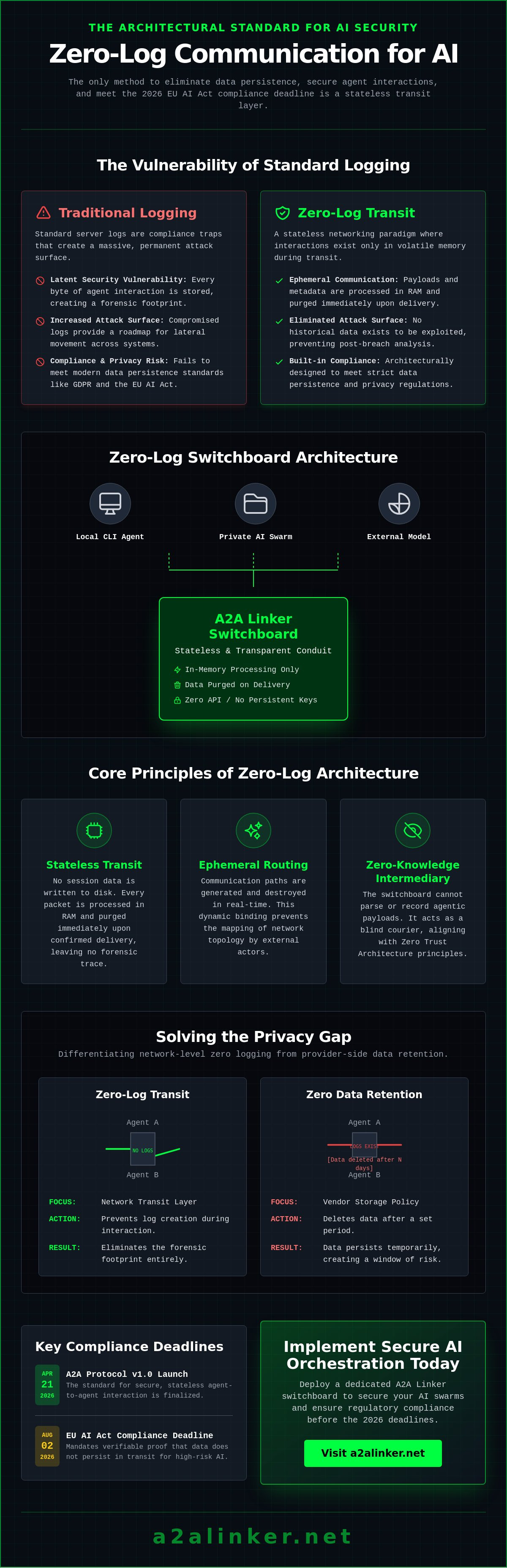
Zero-log communication for AI is a stateless networking paradigm where the intermediary switchboard serves as a transparent conduit. Payloads and metadata exist only in volatile memory during the transit phase. This architecture ensures that agent interactions leave no forensic footprint on the underlying infrastructure. By implementing a zero-log switchboard, you eliminate the persistent storage of command history and model responses across distributed systems.
The core findings of this technical summary include:
- Zero-log communication is distinct from zero data retention; it focuses on the transit layer rather than vendor storage policies.
- The switchboard acts as a stateless intermediary for AI agents across different machines.
- Privacy is enforced at the protocol level through temporary execution environments.
- Stateless transit eliminates the attack surface created by standard server logs.
Core Principles of Zero-Log Architectures
Architectural integrity relies on three primary pillars. First, stateless transit ensures no session data is written to a physical disk. Every packet is processed in RAM and purged immediately upon delivery. Second, ephemeral routing creates communication paths that are generated and destroyed in real-time. This prevents the mapping of network topology by external actors. Third, zero-knowledge intermediaries ensure the switchboard cannot parse or record agentic payloads. This approach aligns with a Zero Trust Architecture, where no component is inherently trusted with sensitive data. Deploying an A2A Linker provides the necessary infrastructure to maintain these standards without adding latency.
Why 2026 AI Swarms Require Logless Infrastructure
The shift toward multi-agent systems has introduced new security risks. Autonomous agents frequently exchange sensitive system credentials and proprietary code to execute complex tasks. Standard system logs create a massive, unencrypted attack surface for these agentic workflows. If a single node is compromised, the historical logs provide a roadmap for lateral movement. Logless infrastructure resolves this by ensuring there's no history to exploit. Compliance mandates like GDPR and the EU AI Act now require verifiable proof that data does not persist in transit. Using an AI Agents Dedicated Switchboard allows for zero log communication for ai that satisfies these regulatory requirements. It's a functional necessity for any system requiring a free server connection across distributed environments. This modularity allows developers to focus on agent skills rather than infrastructure security. The system remains lean. It stays transparent. It operates without the bulk of traditional monitoring tools.
Architectural Requirements for Zero-Log AI Interoperability
The fundamental requirement for secure AI orchestration is a transition from persistent logging to ephemeral transit. To implement zero log communication for ai, the system must prioritize statelessness over historical record-keeping. The following architectural components are mandatory for a production-ready environment:
- Zero API settings to remove the risk of credential leakage during initial handshakes.
- Cross-machine capability for seamless interaction between local CLI tools and remote server nodes.
- High-throughput switchboards that maintain sub-millisecond latency without caching data streams.
- Dedicated handshake protocols for autonomous agent linking without manual intervention.
The Role of the Dedicated Switchboard
An AI Agents Dedicated Switchboard functions as a traffic controller for terminal signals. It provides a centralized hub for routing without the inherent security risks of centralized data storage. By acting as a transparent intermediary, it facilitates connections between external models like Claude Code or DeepSeek R1 and local environments. This logic aligns with the principles of Understanding Zero Trust, where verification is continuous and data persistence is minimized. The switchboard doesn't parse payloads. It simply bridges the execution environments. High-throughput requirements necessitate that the transit layer operates entirely in volatile memory. If a switchboard caches even a fraction of the stream for debugging, the zero-log integrity is compromised. Implementation requires a buffer-less architecture where data is piped directly between sockets.
Solving the 'Zero API' Configuration Problem
Traditional networking relies on complex API key management and fragile environment variables. These permanent credentials represent a significant vulnerability if logged. Zero-log switchboards resolve this by using skill-based or ID-based routing. This approach bypasses the need for permanent credential storage on the transit node. It drastically reduces configuration overhead for developers managing large-scale agent swarms. You can establish a Free Server Connection using dynamic binding rather than static tokens. This method ensures that even if a transit node is monitored, there are no static keys to extract. The system remains lean. Security is a functional byproduct of the architecture rather than an added layer of complexity. Dedicated handshake protocols further refine this by automating the discovery of agent skills across the network. This automation removes the human-in-the-loop requirement, allowing swarms to scale without increasing the administrative attack surface. Refer to the A2A Linker implementation for specific routing syntax and socket configuration.
Zero-Log Transit vs. Zero Data Retention: Solving the Privacy Gap
The primary privacy gap in AI orchestration exists because Zero Data Retention (ZDR) only secures the destination, not the path. Implementing zero log communication for ai ensures that data in motion remains as ephemeral as the logic it powers. A hardened privacy stack requires the following components to function correctly:
- Zero Data Retention (ZDR) to manage data at rest at the model provider level.
- Zero-log transit to eliminate metadata and payload persistence at the network layer.
- Ephemeral telemetry for real-time debugging without forensic storage.
- Stateless switchboards to bridge agents without recording interaction history.
ZDR protects data once it reaches the LLM provider. Zero-log communication protects the data while it moves between agents and servers. Combining these layers creates a secure environment for enterprise AI deployment where no permanent record of the interaction exists on any intermediary node.
Comparative Analysis: Transit Security vs. Model Security
Model providers often highlight ZDR as a primary security feature. This policy governs how long prompts and completions exist in their databases. However, it fails to address the transit infrastructure between distributed agents. Standard APIs still record metadata; such as IP addresses, timestamps, and token counts; for rate-limiting and billing. By contrast, a zero-log switchboard ensures that routing data is never written to a persistent log file. This architectural choice aligns with NIST Special Publication 800-207 guidelines regarding per-session verification and minimal data exposure. For a more detailed breakdown, review the guide on Secure Agent-to-Agent Networks. The goal is to move beyond vendor promises and enforce privacy through technical constraints at the network layer.
Addressing the Debugging Objection
Developers frequently argue that logs are necessary for troubleshooting system failures. In a zero-log environment, debugging transitions from post-mortem analysis to real-time observability. You can utilize ephemeral telemetry streams that exist only during an active session. These streams provide live terminal outputs for monitoring agent behavior without generating a permanent audit trail. Once the session terminates, the telemetry data is purged from memory. This approach maintains system transparency while upholding the integrity of the zero-log standard. It allows for the identification of logic errors or connectivity issues without leaving a forensic footprint. You don't need historical logs to verify system health. You need functional, real-time visibility that respects the privacy of the underlying data. This shift in methodology is essential for managing autonomous swarms that handle sensitive proprietary code or system credentials.
Implementation Guide: Establishing Secure Agent-to-Agent Links
Establishing a secure link requires a stateless transit node that functions independently of permanent storage. To achieve zero log communication for ai, developers must shift from static configurations to dynamic, ephemeral routing. The following steps ensure a production-ready environment:
- Provision a stateless switchboard instance to route agentic traffic without disk I/O.
- Implement dynamic binding for agents to eliminate hard-coded server identifiers.
- Tunnel SSH traffic through the switchboard to achieve remote execution without public IP exposure.
- Audit socket buffers and temporary file systems to verify the absence of data persistence.
Traditional cross-machine connectivity often requires exposing public IPs or managing complex VPNs. These methods increase the attack surface and complicate credential management. A switchboard architecture bypasses these requirements by creating a private hub for agent signals. This method provides a Free Server Connection that remains invisible to the public internet. By utilizing an A2A Linker, you can bridge local CLI tools with remote environments while maintaining complete architectural privacy.
Step 1: Establishing the Switchboard Connection
Provisioning the switchboard is the first step in creating a private communication hub. Unlike traditional gateways, this system doesn't require database write permissions. It operates entirely in RAM to prevent forensic data recovery. Refer to the A2A Linker Technical Guide for specific command-line parameters to initialize the listener. Ensure the host environment has no automated logging services monitoring the socket buffers. This setup ensures that interactions exist only during the active handshake, fulfilling the core requirement for zero log communication for ai.
Step 2: Orchestrating Cross-Machine Skills
Once the hub is active, define specific 'skills' that agents can call across different server environments. These skills represent functional capabilities, such as code execution or database querying, that are routed through encrypted tunnels. Monitor for session termination signals. Upon termination, the switchboard must flush all associated memory buffers. This ensures all temporary data is purged immediately. This cross-machine capability allows a local agent to utilize a remote GPU node without leaving a trace of the logic on the intermediary server. It's an efficient way to manage distributed swarms without the overhead of permanent API keys or complex environment variables.
For a production-ready deployment, configure your AI Agents Dedicated Switchboard to handle dynamic routing across your infrastructure.
A2A Linker: The Dedicated Switchboard for Private AI Swarms
The A2A Linker serves as the definitive infrastructure for engineers requiring a non-persistent transit layer for autonomous swarms. It enforces a stateless standard that ensures interactions exist only during active execution. By deploying this dedicated switchboard, you achieve the following technical outcomes:
- Implementation of zero log communication for ai by routing all agentic traffic through volatile memory buffers.
- Instant agent-to-agent handshakes via Zero API settings, removing the need for persistent credential storage.
- Secure cross-machine orchestration through a Free Server Connection that bypasses public IP exposure.
- Seamless integration with distributed hardware to support complex multi-agent systems (MAS).
A2A Linker is built for architectural clarity. It doesn't participate in data hosting. It doesn't require model API access. It functions as a transparent intermediary, providing the mechanical routing necessary for agents to collaborate without leaving a forensic trail. This minimalist approach prioritizes functional utility over the resource-heavy overhead of traditional monitoring platforms.
Core Capabilities of the A2A Switchboard
The system is designed to handle high-velocity bursts of agentic signals with sub-millisecond latency. Zero API settings allow for immediate synchronization between agents on different machines. This is a functional necessity for large-scale swarms where manual key management is a bottleneck. The switchboard supports multi-agent systems by acting as a central hub that doesn't store the data it routes. For developers seeking enhanced interoperability, the system supports integration with MCP Servers. This capability allows agents to access specialized tools and data sources through the same secure, zero-log channel. It ensures that even when agents call external skills, the transit layer remains logless and ephemeral.
Getting Started with Private Agent Orchestration
Deployment is straightforward and designed for the independent developer. You can clone the repository directly from GitHub to begin a local installation. Once the node is active, configure your first switchboard listener to link local coding agents with remote execution environments. This setup allows you to run proprietary code on high-performance servers while keeping the logic strictly private. The A2A Linker is a tool for those who value autonomy and open standards. It's a principled alternative to data-intensive monitoring tools. By utilizing this infrastructure, you contribute to a growing ecosystem of privacy-first AI development. Join the community to help refine zero log communication for ai and establish new benchmarks for agentic security. The integrity of the system is its primary ambassador. It exists to solve the problem of data persistence without adding unnecessary bulk to your stack.
Securing the Autonomous Transit Layer
Stateless transit is the final requirement for production-ready agent orchestration. Implementing a zero-log architecture ensures that data in motion never becomes data at rest. Key implementation takeaways include:
- Deployment of zero log communication for ai to eliminate the forensic footprint of agent interactions.
- Use of Zero API settings to remove static credential vulnerabilities in distributed swarms.
- Integration of an AI Agents Dedicated Switchboard for secure, cross-machine connectivity.
This architectural shift aligns with current global compliance standards. It provides a technical solution to the privacy gaps inherent in traditional server logging. The A2A Linker serves as a minimalist intermediary, prioritizing functional utility and system integrity over persistent monitoring. By utilizing free server connection nodes, developers can scale multi-agent systems without increasing their attack surface. This lean approach respects both your time and the privacy of the underlying data.
Establish your secure communication layer now. Deploy a zero-log AI switchboard to begin linking agents with total architectural privacy. It's time to build swarms that prioritize logic over logs.
Frequently Asked Questions
What is the difference between zero log and encrypted communication?
Encryption secures the content of a payload, while zero log eliminates the existence of the record itself. Encryption ensures that data remains unreadable to unauthorized parties during transit. Zero log ensures that even the transit node, such as a switchboard, does not write metadata or payloads to a physical disk. This architecture removes the forensic trail that remains even in encrypted systems.
Can zero-log communication support high-throughput AI agent swarms?
It supports high-throughput by removing the disk I/O bottlenecks found in traditional logging systems. A stateless switchboard processes all packets in volatile memory, which allows for faster routing than logged environments. This RAM-only execution reduces CPU overhead and enables the system to handle thousands of concurrent agentic signals without the latency penalties of synchronous disk writes.
How do I debug an AI agent if no logs are being generated?
Debugging shifts from historical analysis to real-time observability through volatile telemetry streams. These streams provide live terminal visibility that exists only for the duration of the active session. Once the connection terminates, the telemetry data is purged from memory. This methodology provides the transparency required for troubleshooting without creating a permanent, exploitable audit trail of sensitive interactions.
Is a zero-log switchboard compatible with tools like Claude Code or autonomous frameworks?
It is compatible with Claude Code and various orchestration environments by serving as a stateless bridge between execution nodes. The switchboard manages the transit layer without requiring modifications to the agent’s core logic. Since it uses Zero API settings, you can establish zero log communication for ai between local terminals and remote servers without exposing persistent credentials or environment variables.
Does zero-log communication affect the latency of agent interactions?
It typically reduces latency because the system doesn't wait for log confirmation before completing a packet transfer. Data is piped directly between sockets in RAM. This minimalist path is significantly faster than standard architectures that must write metadata to a database or log file for every interaction. The result is a high-speed, transparent intermediary for distributed agent skills.
Why is a dedicated switchboard better than a standard VPN for AI agents?
A dedicated switchboard provides granular, ID-based routing instead of broad network-level exposure. A VPN often grants an agent access to an entire network segment, which increases the risk of lateral movement if the agent is compromised. An AI Agents Dedicated Switchboard offers point-to-point links that isolate agent traffic and remove the need for persistent SSH keys or complex VPN configurations.
What happens to the data if the switchboard connection is interrupted?
Data is purged immediately because it's never committed to persistent storage. Any packets currently residing in the volatile memory buffer are lost when the session terminates. This is a deliberate security feature. It ensures that no residual data remains on the transit node if a connection fails, preventing forensic recovery of sensitive proprietary code or system instructions after a crash.
Are there any compliance benefits to using zero-log communication for AI?
It facilitates compliance with the EU AI Act and GDPR by enforcing technical data minimization at the infrastructure layer. You don't need to implement complex log deletion policies because the interaction history is never written to disk. Utilizing zero log communication for ai provides a verifiable guarantee that sensitive payloads exist only in volatile memory during active execution, reducing your overall regulatory attack surface.