
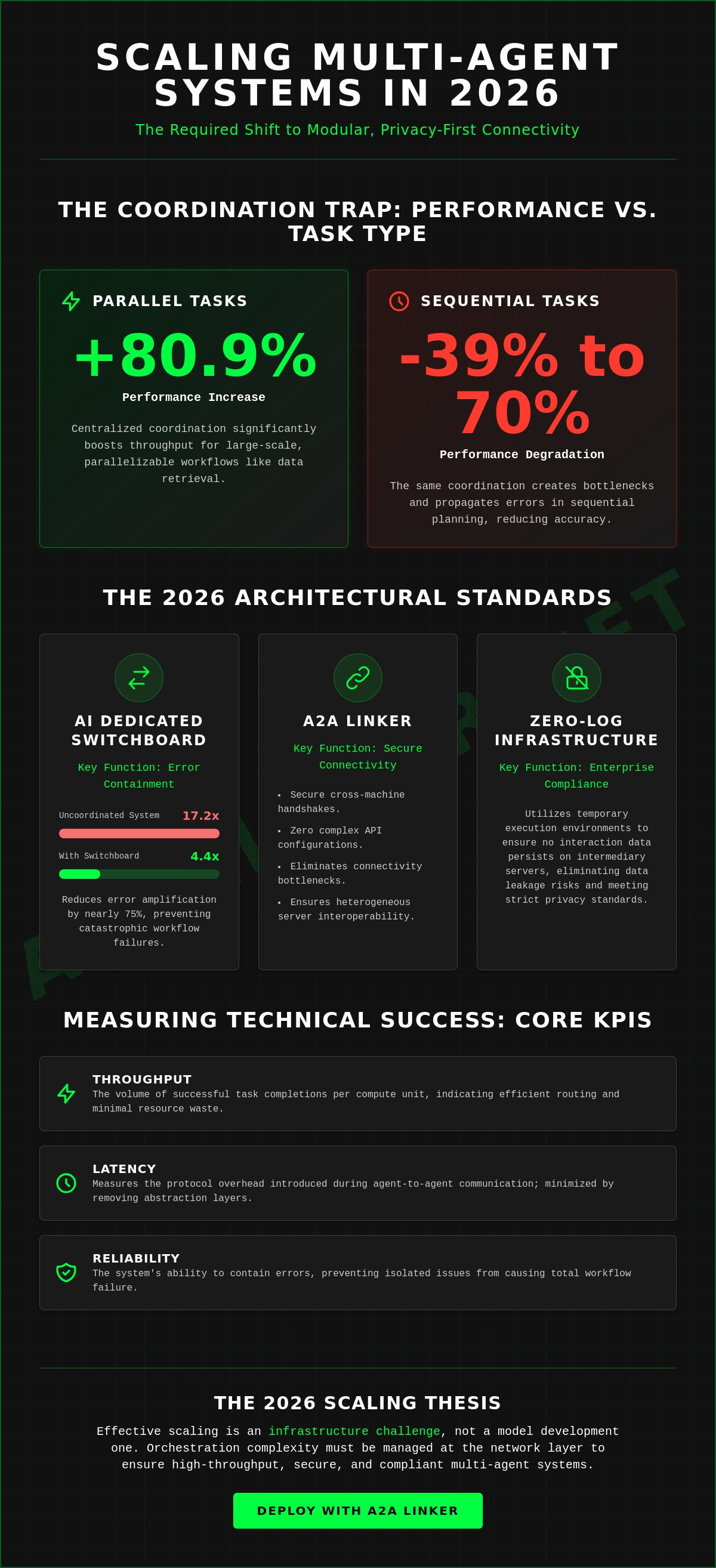
A 2026 Google scaling study of 180 agent configurations revealed that centralized coordination improves parallel task performance by 80.9%, yet degrades sequential planning by 39 to 70%. Effective scaling multi agent systems 2026 requires a shift from monolithic frameworks to modular, privacy-first connectivity. To maintain system integrity and minimize orchestration overhead, the following architectural standards are required:
- Implement an AI Agents Dedicated Switchboard to reduce error amplification from 17.2x to 4.4x.
- Utilize A2A Linker for secure, cross-machine connectivity without the need for complex API settings.
- Deploy zero-log infrastructure to ensure enterprise compliance through temporary execution environments.
You've likely observed that orchestration complexity grows exponentially as agent counts increase, often leading to sequential task degradation. This article provides the quantitative scaling laws and networking protocols needed to deploy high-throughput systems safely. We'll examine a predictive model for architecture selection and the specific requirements for secure, zero-log agent handshakes. The focus remains on functional utility and the logic of the system rather than resource-heavy frameworks.
Key Takeaways
- Transition from centralized orchestration to a dedicated switchboard model to prevent sequential task degradation and manage exponential orchestration complexity.
- Identify the Coordination Trap where increasing agent count reduces accuracy for non-parallelizable workflows, necessitating precise task decomposition.
- Deploy zero-log infrastructure to meet enterprise compliance standards when scaling multi agent systems 2026, ensuring no interaction data persists on intermediary servers.
- Eliminate cross-machine connectivity bottlenecks using the A2A Linker to establish secure server connection nodes with zero API settings.
Executive Summary: The Core Principles of MAS Scaling in 2026
Successful scaling multi agent systems 2026 depends on shifting from centralized application orchestration to decentralized, switchboard-based connectivity. Research shows that coordination efficiency is task-dependent; parallelizable workflows see significant gains while sequential tasks face steep performance penalties. To achieve enterprise-grade deployment, the following principles are mandatory:
- Decentralized Connectivity: Move orchestration to the network layer to prevent the 17.2x error amplification typical of independent systems.
- Task-Specific Architecture: Optimize for parallel tasks, which scale linearly with agent count, while isolating sequential planning to avoid the 39 to 70% performance drop observed in centralized coordination.
- Zero-Log Infrastructure: Eliminate data leakage during agent-to-agent handshakes by utilizing temporary execution environments that store no interaction data.
- Cross-Machine Interoperability: Ensure seamless communication across heterogeneous server environments using a dedicated switchboard rather than brittle API configurations.
The 2026 Scaling Thesis
Model capability sets the performance baseline, but connectivity determines the operational ceiling. In 2026, scaling multi agent systems 2026 is an infrastructure challenge, not a model development one. Orchestration complexity must be managed at the network layer. This prevents application-level bloat and ensures that agent interactions don't consume excessive compute resources. Interoperability across different server environments remains the key differentiator. Systems that rely on proprietary frameworks often fail when moved to distributed hardware. Understanding the core principles of MAS allows engineers to map task decomposability directly to network nodes. Developers can implement these nodes via the A2A Linker to maintain zero-log standards across all agent handshakes.
Key Performance Indicators for Multi-Agent Systems
System architects must prioritize functional utility over emotional appeal or marketing metrics. Technical success is measured through three specific indicators:
- Throughput: This represents the volume of successful task completions per compute unit. High throughput indicates efficient task routing and minimal resource waste.
- Latency: This measures the protocol overhead introduced during agent-to-agent communication. Minimal latency is achieved by stripping away unnecessary abstraction layers.
- Reliability: This is the system's ability to contain errors. Centralized systems can contain errors to a 4.4x amplification factor, whereas uncoordinated systems risk total workflow failure.
These KPIs ensure the system operates unobtrusively. The goal isn't to build complex frameworks but to provide a transparent intermediary for external models. Privacy advocacy is built into the logic of the system. By prioritizing these metrics, organizations can deploy high-throughput systems without compromising compliance or data integrity.
Quantitative Scaling Laws: Coordination vs. Capability
Effective scaling multi agent systems 2026 demands a precise understanding of the inverse relationship between coordination overhead and task complexity. Research indicates that while adding agents can boost performance, it often triggers a "Coordination Trap" where single-agent baselines are actually more reliable. To optimize these systems, technical implementation must prioritize the following quantitative findings:
- The Coordination Trap: In sequential planning, adding agents can degrade performance by 39 to 70% due to error propagation.
- Error Containment: Centralized verification systems limit error amplification to 4.4x, compared to 17.2x in uncoordinated swarms.
- Predictive Accuracy: Task decomposability serves as the primary predictor, with models identifying optimal architectures for 87% of unseen tasks.
- Parallel Efficiency: Parallelizable tasks, such as large-scale data retrieval, achieve an 80.9% performance increase under centralized coordination.
Model capability alone doesn't guarantee a high-performing system. A comprehensive survey on MAS scalability highlights that the interaction between agent count and model reasoning determines the system's ceiling. When scaling multi agent systems 2026, developers must analyze task decomposability before deployment. If a task can't be broken into independent sub-processes, increasing the agent count will likely introduce noise rather than utility. Systems must utilize a dedicated switchboard to manage these interactions without adding unnecessary application-layer complexity. For implementation details, refer to the technical configuration guide.
Parallel vs. Sequential Scaling
Architecture choice depends on the workflow structure. Parallel architectures excel in financial reasoning and information gathering. They distribute the load across multiple nodes simultaneously. Conversely, sequential planning suffers from a "Sequential Penalty." Each step in a chain introduces a risk of logic failure. These errors compound. Hybrid architectures resolve this by using parallel agents for data ingestion and a centralized verifier for final synthesis. This balance maintains throughput while ensuring logical consistency.
Tool-Heavy Task Bottlenecks
Tool use increases latency. In multi-agent environments, agents frequently call external APIs or databases. This creates a connectivity bottleneck. Latency becomes a critical factor when handshakes occur across different machines. Minimizing this overhead requires a low-latency routing layer. Using an AI Agents Dedicated Switchboard allows for direct, cross-machine connectivity. This removes the need for permanent record-keeping and reduces the latency associated with traditional API gateways. The focus remains on functional utility and secure, temporary execution states.
The Connectivity Bottleneck: From Monolithic to Distributed MAS
Scaling multi agent systems 2026 requires transitioning from monolithic execution to distributed network topologies. Physical hardware limits on a single machine necessitate a connectivity layer that spans multiple server environments. To overcome these bottlenecks, engineers must prioritize the following architectural shifts:
- A2A Linker Integration: Facilitate secure cross-machine handshakes without the overhead of persistent data logs.
- Switchboard Architecture: Route interactions between agents residing on heterogeneous hardware via a dedicated hub.
- Zero API Settings: Reduce deployment latency by eliminating the friction of manual endpoint configuration.
- Distributed Compute: Move compute-intensive agents to remote server nodes to bypass local memory and CPU saturation.
Limitations of Local-Only Frameworks
Local-only setups create artificial ceilings for agent performance. Memory constraints and compute isolation prevent the execution of large-scale workflows on a single instance. Developers often attempt to bridge these gaps using brittle SSH tunnels or complex VPNs. These methods introduce security vulnerabilities and increase latency. Current hierarchical frameworks for multi-agent coordination suggest that structural scaling is impossible without a dedicated networking layer. In 2026, scaling multi agent systems 2026 necessitates a move toward a unified, cross-machine communication standard. This allows agents to access resources distributed across multiple data centers without compromising execution speed or reliability.
Switchboard Architecture: The A2A Linker Model
The Switchboard Architecture treats agent communication as a networking problem rather than an application problem. This model utilizes a dedicated hub to route interactions between agents regardless of their physical location. A2A Linker serves as this transparent intermediary. It provides the necessary infrastructure for agent-to-agent handshakes while keeping logic on the developer's server. By using free server connection nodes, engineers scale their systems without incurring high infrastructure costs. This approach decouples agent logic from the communication layer, allowing for modular updates without system downtime. Logic remains autonomous. The switchboard merely facilitates the data transfer.
Instead of managing complex configurations for every new node, the switchboard handles the routing logic automatically. It removes the need for permanent record-keeping. This aligns with enterprise privacy requirements and reduces the risk of data leakage during handshakes between remote nodes. The system operates as a quiet enabler, allowing for the deployment of autonomous agent swarms across disparate hardware. For implementation details, the A2A Linker technical guide provides the necessary configuration steps. Access the repository via GitHub to begin integration.
Zero-Log Infrastructure: The Privacy Standard for 2026
Zero-log infrastructure is the definitive privacy standard for scaling multi agent systems 2026. This architecture ensures that no interaction data is stored on intermediary routing nodes. For enterprise deployments, permanent record-keeping is a significant liability that increases the attack surface for data leakage. To mitigate these risks, systems must implement the following technical requirements:
- Data Ephemerality: Utilize temporary execution environments where data exists only during the handshake.
- Stateless Routing: Implement zero-log protocols to facilitate agent-to-agent communication without persistent storage.
- Private Switchboards: Deploy dedicated switchboards to process sensitive data in isolated terminal environments.
- Zero API Settings: Reduce misconfiguration risks by eliminating manual API setup friction.
The transition toward distributed MAS necessitates a shift in how data states are managed. In 2026, the industry has recognized that centralized monitoring is often a security vulnerability disguised as a feature. Scaling multi agent systems 2026 requires infrastructure that operates without extracting value from the data it routes. By adopting a zero-log model, developers maintain full control over their proprietary logic. This allows for cross-machine connectivity without the overhead of enterprise monitoring software that often slows down execution cycles.
The Security of AI Collaboration
Proprietary prompts and sensitive data are at risk during agent-to-agent handshakes. Centralized logging in multi-tenant environments exposes these assets to potential breaches. In 2026, compliance for agentic AI in regulated industries like finance and healthcare demands strict data isolation. A2A Linker operates as a transparent intermediary, ensuring that logic remains on the user's server while the switchboard facilitates routing. This prevents the creation of permanent logs on the networking layer. Organizations can verify system integrity through stateless communication patterns rather than relying on retrospective log analysis. This approach respects the reader's technical proficiency by providing a lean, non-extractive infrastructure. It effectively removes the risk of data leakage during complex cross-machine tasks.
Technical Implementation of Zero-Log Nodes
Verification without storage is achieved through cryptographic handshakes and temporary data states. A2A Linker implements a strict zero-log policy by default. This ensures that agent traffic passes through the AI Agents Dedicated Switchboard without being recorded. High-security environments require these stateless communication patterns to maintain autonomy. By stripping away unnecessary monitoring tools, the system operates unobtrusively. This modularity allows developers to maintain their own audit trails on their local servers if required, without involving the connectivity layer. For detailed configuration steps, review the technical documentation or access the repository on GitHub. This methodology ensures that the integrity of the logic remains the primary brand ambassador for the system.
Implementation Roadmap: Deploying A2A Linker for Scalable MAS
Deploying infrastructure for scaling multi agent systems 2026 requires a structured methodology that prioritizes network integrity over application-layer complexity. The implementation process follows a logical progression from task decomposition to horizontal scaling. Adhering to these steps ensures that the system remains modular, private, and efficient:
- Role Definition: Define agent roles and task decomposability within your multi-agent system to ensure parallelizable workflows are optimized.
- Node Establishment: Establish secure server connection nodes using the A2A Linker switchboard to facilitate cross-machine communication without manual API friction.
- Privacy Configuration: Configure zero-log parameters to maintain end-to-end interaction privacy, ensuring no data persists on intermediary servers.
- Performance Verification: Monitor throughput and error propagation using decentralized verification protocols to prevent cascading logic failures.
- Horizontal Expansion: Scale horizontally by adding cross-machine nodes as task volume increases, utilizing a dedicated switchboard for low-latency routing.
Implementation starts at the network level. Engineers must move away from monolithic frameworks that isolate compute resources. By utilizing a switchboard model, the system gains the ability to route tasks between agents on disparate hardware. This approach respects the developer's time by removing the need for permanent record-keeping or complex ecosystem dependencies. The focus remains on the tool's ability to operate unobtrusively while solving specific connectivity bottlenecks. It's a principled alternative to data-intensive monitoring tools.
Deploying with A2A Linker
Access the A2A Linker GitHub repository to obtain the source code and CLI tools. The setup process is designed for technical proficiency. It utilizes a terminal-based interface for all configurations. Follow the official guide for step-by-step instructions on node deployment. Initial testing can be performed using free server connection nodes. This allows for rapid prototyping of agent handshakes before moving to a full-scale production environment. The system requires zero API settings. This eliminates the primary source of configuration errors in distributed environments. Cross-machine connectivity is established through the switchboard, allowing agents to share skills and data states in temporary execution environments.
Future-Proofing Your Agent Infrastructure
The landscape of autonomous agent swarms is evolving rapidly. Preparing for scaling multi agent systems 2026 involves planning for next-generation MCP (Model Context Protocol) server integration. A2A Linker provides the necessary infrastructure to integrate these protocols without restructuring the entire stack. Maintaining a minimalist, clinical approach to infrastructure is essential to avoid vendor lock-in. By using open standards and interoperable nodes, developers ensure their systems remain autonomous. The role of A2A Linker is to act as a quiet enabler. It provides a transparent intermediary for various external models. This ensures that the quality of the logic and the integrity of the system remain the primary drivers of performance as task complexity grows.
Standardizing Agent Connectivity for 2026
Effective scaling multi agent systems 2026 depends on modular, zero-log networking rather than larger model parameters. By utilizing a dedicated switchboard, engineers decouple agent logic from communication protocols. This ensures both privacy and cross-machine interoperability. The following takeaways define the path forward:
- Implement stateless routing to eliminate the security risks of permanent logging.
- Utilize switchboard architectures to resolve orchestration complexity in distributed environments.
- Leverage cross-machine connectivity to overcome the physical compute limits of single servers.
The integrity of the logic remains the primary ambassador for successful MAS deployment. Infrastructure should operate unobtrusively. It acts as a transparent intermediary for external models without adding unnecessary bulk. You can now establish your secure agent-to-agent network with A2A Linker. This solution offers zero-log architecture for total privacy, a dedicated switchboard for seamless handshakes, and free server connection capabilities. Focus on your agent skills. Let the network manage the handshakes. Build for a decentralized future.
Frequently Asked Questions
What is the most significant challenge in scaling multi-agent systems in 2026?
The primary challenge is managing the exponential growth of orchestration complexity at the network layer. As agent counts increase, the coordination overhead often becomes the main performance bottleneck. Scaling multi agent systems 2026 requires moving away from monolithic, local-only frameworks that struggle with cross-machine communication. Systems must prioritize functional utility and architectural clarity to avoid logic failure during high-throughput operations.
How does coordination affect the performance of agentic AI?
Coordination acts as a performance multiplier for parallelizable tasks but can degrade accuracy in sequential workflows. While centralized systems effectively contain errors, uncoordinated agents often amplify logic failures. Successful implementation depends on choosing an architecture that matches the task's decomposability. This prevents the coordination trap where adding more agents actually reduces the overall system accuracy.
Why is zero-log architecture important for AI agents?
Zero-log architecture is mandatory for enterprise compliance and data privacy. It ensures that no interaction data is stored on intermediary servers during agent-to-agent handshakes. This design choice removes the liability of permanent record-keeping in regulated industries. By utilizing temporary execution environments, the system maintains total privacy for proprietary prompts and sensitive data.
Can I connect agents across different server environments for free?
Yes, you can establish cross-machine connectivity using free server connection nodes. This allows for rapid prototyping and production testing without upfront infrastructure costs. The A2A Linker facilitates these connections by acting as a transparent intermediary between disparate server environments. It supports heterogeneous setups without requiring complex manual configurations or restrictive ecosystem dependencies.
What is the difference between sequential and parallel agent scaling?
Parallel scaling distributes independent sub-tasks across multiple agents to achieve linear performance gains. Sequential scaling involves agents performing interdependent steps where the output of one serves as the input for the next. Sequential workflows are prone to a penalty where errors compound at each stage. High-throughput scaling multi agent systems 2026 often utilizes hybrid models to balance these two approaches.
How does A2A Linker handle agent-to-agent security?
Security is managed through a strict zero-log policy and stateless communication patterns. The tool functions as an AI Agents Dedicated Switchboard that routes traffic without recording the content of the handshakes. It eliminates API setting friction, which reduces the risk of misconfiguration. This minimalist approach ensures that the logic remains on the user's local server rather than being exposed to a centralized platform.
What tools are available for managing cross-machine agent connectivity?
A2A Linker provides a terminal-based solution for establishing secure, cross-machine connectivity. It functions as a dedicated switchboard that routes data between agents on different physical or virtual machines. Unlike traditional frameworks, it requires zero API settings and operates as a lean, transparent intermediary. This makes it a principled alternative to data-intensive monitoring tools.
How do I prevent error propagation in a decentralized multi-agent system?
Preventing error propagation requires implementing decentralized verification nodes and switchboard-based routing. These components act as circuit breakers that validate agent outputs before they reach the next stage of the workflow. By decoupling agent logic from the communication layer, the system can isolate and resolve logic failures. This ensures that errors are contained rather than amplified across the entire agent swarm.