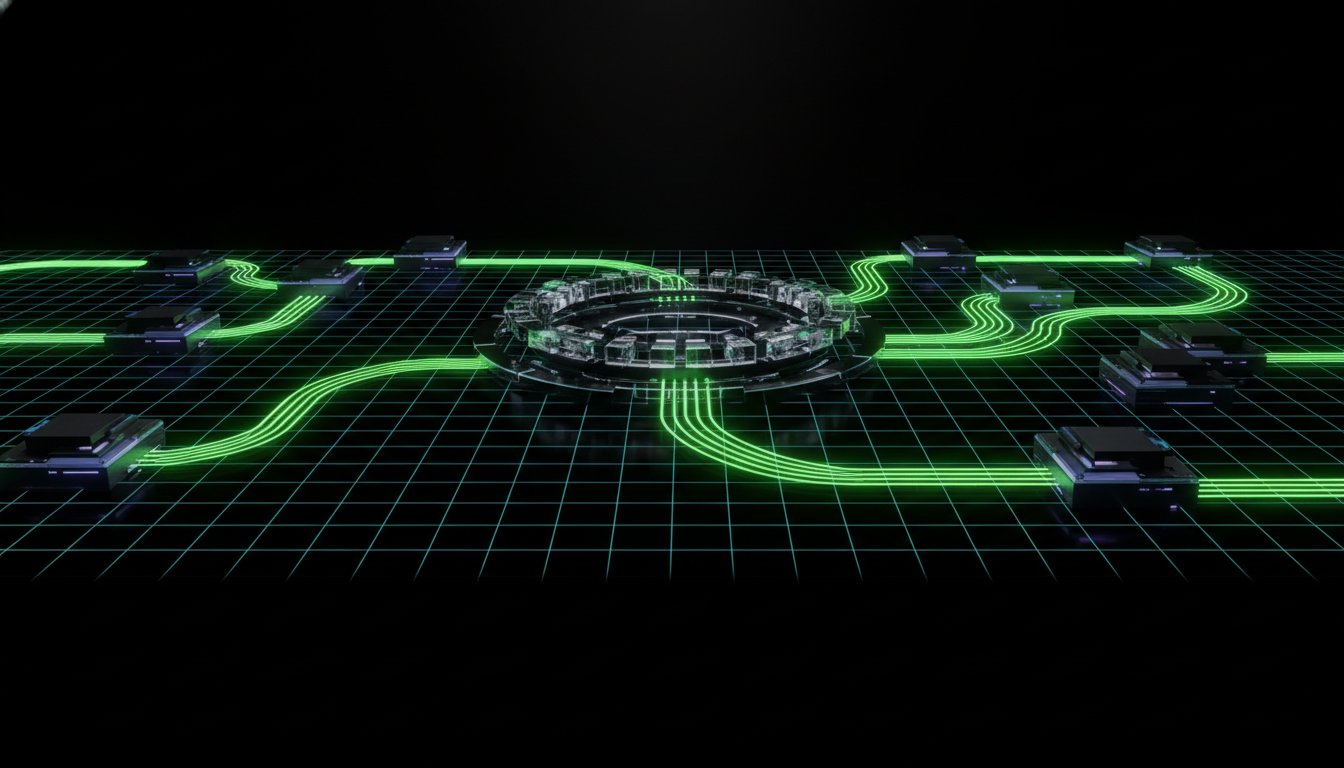
The standard practice of routing agent-to-agent communication through centralized cloud providers is a structural security failure. To establish a truly private and secure ai agent network, you must implement a decentralized architecture that prioritizes zero-log connectivity and functional autonomy. By decoupling the transport layer from the data payload, you ensure that sensitive prompts remain within your controlled environment rather than becoming permanent records on a third party server.
- Deploy an A2A Linker to facilitate direct communication between remote agents without intermediary data storage.
- Establish a dedicated switchboard to manage cross-machine traffic while maintaining full ownership of interaction data.
- Utilize free server connections via simple CLI commands to eliminate complex API overhead.
- Secure agent skills within sandboxed environments to prevent exploits similar to the May 2026 Semantic Kernel vulnerabilities.
- Maintain compliance with the California Frontier AI Safety Act by ensuring local data sovereignty.
- Implement zero-log protocols to mitigate the risks associated with the 90 major AI security breaches reported since 2024.
You likely recognize that centralized logging of sensitive prompts creates an unacceptable attack surface for your infrastructure. This guide provides a technical roadmap to architecting a network that operates unobtrusively. We'll detail the implementation of a zero-log transport layer that ensures your agents collaborate without leaving a digital footprint.
Key Takeaways
- Decouple the communication switchboard from model APIs to prevent metadata harvesting and ensure functional autonomy.
- Implement a zero-log transport layer to eliminate permanent records of sensitive prompts within a private and secure ai agent network.
- Deploy an A2A Linker to establish cross-machine connections between remote agents using secure handshake protocols.
- Scale infrastructure using a dedicated switchboard with zero API settings to mitigate credential leakage risks.
- Transition to modular connectivity tools that support distributed agent swarms while maintaining strict data sovereignty.
Technical Conclusion: The Architecture of Private AI Agent Networks
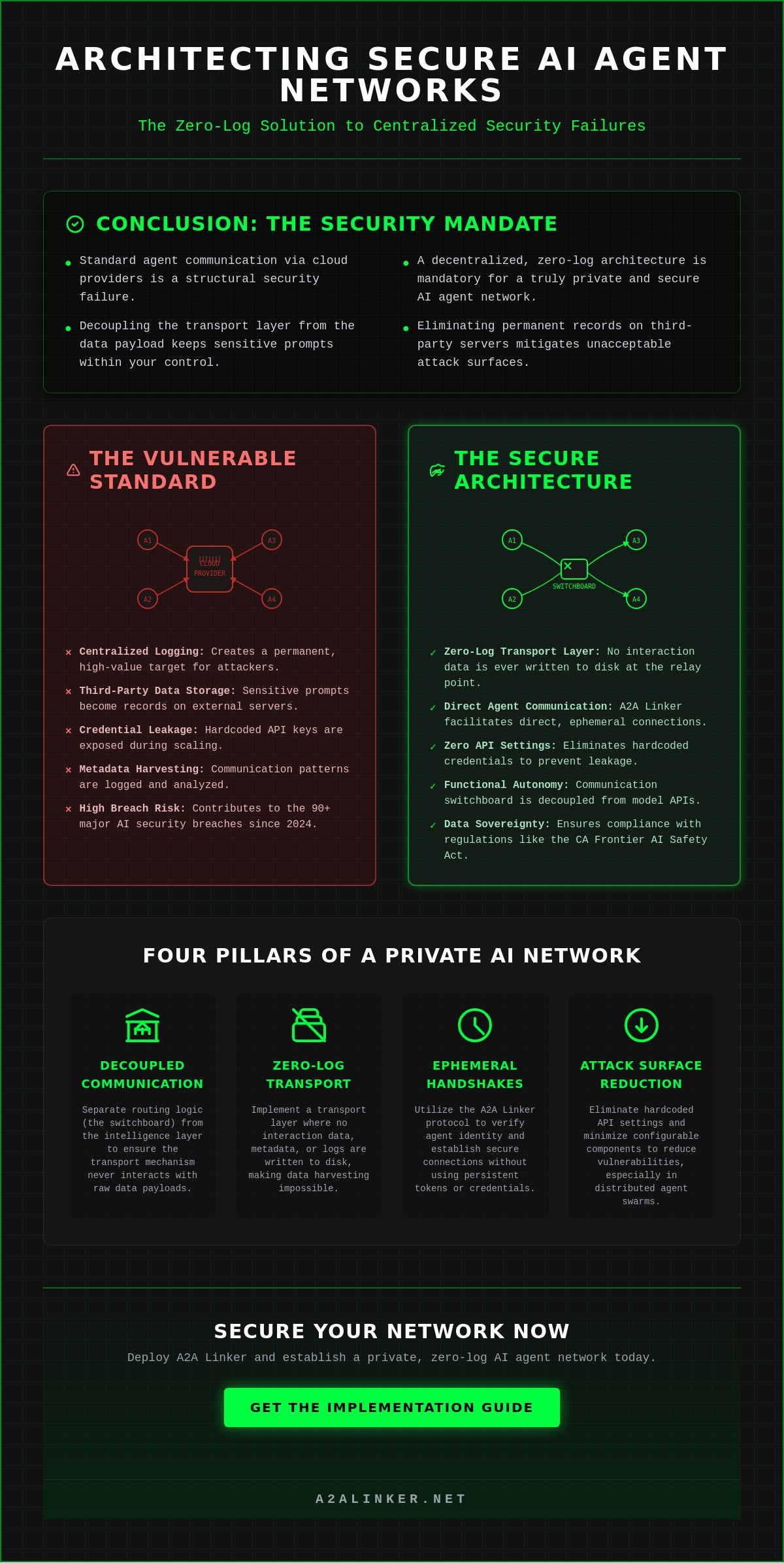
A functional private and secure ai agent network must prioritize architectural isolation to prevent data leakage. The system relies on four primary technical pillars to maintain integrity. First, you must decouple the AI Agents Dedicated Switchboard from the AI model API. This prevents the communication layer from accessing or storing raw prompt data. Second, transport layers must operate with Zero Log policies to ensure metadata harvesting is impossible. Third, cross-machine connectivity should utilize temporary, secure handshakes instead of permanent credentials. Finally, your infrastructure must support Zero API settings to reduce the attack surface of the network.
- Decoupled Communication: Separate the routing logic from the intelligence layer to ensure the switchboard never interacts with raw payloads.
- Zero-Log Transport: Implement a transport layer where no interaction data is written to disk at the relay point.
- Ephemeral Handshakes: Use the A2A Linker handshake protocol to verify agent identity without persistent tokens.
- Attack Surface Reduction: Eliminate hardcoded API settings in multi-agent environments to prevent credential leakage during scaling.
Modern Multi-agent system (MAS) deployments often suffer from centralized vulnerabilities. When agents share a skill across untrusted environments, the lack of a neutral intermediary leads to data exfiltration. By implementing a dedicated switchboard, you create a buffer that handles routing while keeping data payloads encrypted and invisible to the transport mechanism. This architecture mitigates the risks identified in the May 2026 Semantic Kernel vulnerabilities, where monolithic frameworks allowed for remote code execution (RCE) attacks.
Summary of Core Requirements
Architectural flexibility requires model-agnostic connectivity. Your network shouldn't be locked into a specific provider's ecosystem. This independence allows for swapping models as performance requirements change. Terminal-based switchboards are essential to avoid the vulnerabilities associated with web-based managed hosting. Data privacy is only guaranteed if the switchboard remains a "dumb" pipe for encrypted packets. The intermediary must never hold or manage decryption keys.
Immediate Implementation Steps
Deploy the A2A Linker to manage agent-to-agent handshakes. Initialize a Free Server Connection to test the latency of your cross-machine synchronization. Verify that your environment is configured for zero-log operation by auditing system output during the initial handshake. Refer to the implementation guide for specific command-line syntax to link your first two agents. These steps ensure your private and secure ai agent network remains autonomous and protected.
Vulnerabilities in Traditional AI Agent Interconnectivity
Centralized logging and persistent credential management are the primary failure points in modern multi-agent deployments. A truly private and secure ai agent network cannot exist within architectures that prioritize provider-side monitoring over user data sovereignty. To eliminate these vulnerabilities, you must replace permanent logs with ephemeral transport layers and swap hardcoded API keys for zero-API handshake protocols. Security is a structural requirement, not a managed service.
- Standard AI hubs capture and store interaction logs indefinitely, creating a permanent digital record of proprietary prompts and sensitive logic.
- Scaling multi-agent environments often necessitates hardcoding API keys across distributed nodes, which facilitates credential leakage during expansion.
- Cloud-hosted platforms operate on implicit trust models that ignore the documented risks of provider-side breaches and unauthorized internal access.
- Opaque data routing protocols allow third-party access to agent interaction metadata without explicit user consent or visibility.
- Heavy, monolithic frameworks introduce measurable network latency that disrupts high-velocity autonomous decision-making in cross-machine tasks.
The May 2026 disclosure of critical remote code execution vulnerabilities in the Semantic Kernel framework (CVE-2026-25592 and CVE-2026-26030) underscores the danger of monolithic architectures. When agents share a skill across an untrusted environment, the lack of isolation leads to total system compromise. A Free Server Connection shouldn't come at the cost of your infrastructure's integrity. A compilation of AI agent security incidents from 2024 to 2026 identified 90 major breaches, confirming that traditional interconnectivity is a significant attack surface.
The Risk of Centralized Logging
Many centralized platforms record every agent-to-agent prompt to monitor system performance or optimize their own models. This permanent record-keeping creates a massive digital footprint of your internal workflows. A systematic review of trust enforcement failures confirms that logging sensitive A2A flows is a critical architectural flaw. Transitioning to a Zero Log transport layer ensures that interaction data remains ephemeral, existing only in memory during the execution phase. This shift is mandatory for compliance with the California Frontier AI Safety Act (SB 53), which mandates stricter safety frameworks for high-revenue developers as of January 1, 2026.
Credential Proliferation and API Security
Managing multiple API keys across distributed nodes increases the administrative burden and the likelihood of human error. Each hardcoded key serves as a potential vector for credential theft during horizontal scaling. Implementing Zero API settings removes this risk by utilizing secure, temporary handshakes for agent authentication. You can deploy an A2A Linker to simplify these connections without exposing your core credentials. This approach minimizes the attack surface and ensures that your private and secure ai agent network remains resilient against unauthorized access while maintaining full functional autonomy.
Architecting a Zero-Log AI Agent Switchboard
The core of a private and secure ai agent network is the switchboard, a specialized routing layer that operates independently of the AI models it connects. By decoupling the transport mechanism from the intelligence layer, the system ensures that sensitive prompt data and model weights remain isolated from the communication hub. This architectural choice eliminates the risk of provider-side data harvesting and centralizes connectivity without compromising privacy. A successful implementation relies on the following technical requirements:
- Deploy an AI Agents Dedicated Switchboard to facilitate secure, cross-machine routing between autonomous nodes.
- Implement a Zero Log policy at the transport level, ensuring no interaction data or metadata is written to persistent storage.
- Leverage Zero API settings to establish connections, removing the need for hardcoded keys in remote environments.
- Enable cross-machine execution, allowing an agent on Server A to utilize a specific skill hosted on Server B via a secure handshake.
- Maintain model-agnosticism by treating the switchboard as a transparent intermediary for encrypted traffic.
Unlike standard networking tools, this architecture focuses on the specific needs of autonomous systems. It prioritizes the integrity of the communication channel over the content of the data payload. This approach is essential for developers who need to link agents across untrusted or heterogeneous environments without exposing their internal logic.
Switchboard vs. Standard Proxy
Standard proxies are designed for simple request-response cycles. They lack the logic required to handle the multi-step handshakes and state management inherent in autonomous agent interactions. A switchboard provides the specific routing logic needed for AI agent network security, acting as a dynamic hub rather than a static gateway. It manages the identity verification of each agent node before facilitating a peer-to-peer link. This specialized infrastructure is significantly more efficient than bloated frameworks that attempt to manage both the model and the network layer simultaneously.
Ensuring Ephemeral Data States
To achieve a truly private and secure ai agent network, data must exist only in memory during transit. The switchboard functions as a temporary execution environment. It receives encrypted packets, identifies the destination agent, and routes the data without ever writing to disk. This ephemeral state prevents the creation of a permanent digital footprint. End-to-end encryption ensures that even if the switchboard were compromised, the data payload remains unreadable to the intermediary. For advanced implementation, review specific Multi-Agent System (MAS) connectivity patterns to scale your infrastructure across diverse machine environments. This method provides a lean, transparent alternative to resource-heavy blockchain solutions that often add unnecessary complexity to CLI-based agent orchestration.
Implementing Private Cross-Machine Agent Connections
Successful implementation of a private and secure ai agent network requires a terminal-first approach that eliminates persistent credentials and local data remnants. By establishing direct links between isolated environments, you ensure that agents collaborate without leaving a digital footprint or requiring hardcoded API keys. This process prioritizes the infrastructure layer, creating a hardened environment where logic exchange occurs through encrypted, ephemeral channels.
- Establish a secure terminal session to bridge local and remote agent environments.
- Execute the A2A handshake protocol to verify node identity without generating persistent tokens.
- Initialize the AI Agents Dedicated Switchboard to synchronize a specific skill across the network.
- Run distributed tasks within a Zero Log environment to prevent disk-level data leakage.
- Perform a post-execution audit to ensure no residual data remains on relay nodes.
Traditional implementation guides often overlook the necessity of a clean communication layer. They suggest starting with a high-level framework, but this ignores the structural vulnerabilities inherent in standard networking. By focusing on the infrastructure layer before selecting a framework, you create a buffer that handles routing while keeping data payloads invisible to the transport mechanism. This methodology is essential for maintaining autonomy in cross-machine workflows.
Setting Up Free Server Connections
Initial linking doesn't require complex infrastructure investments. You can establish a Free Server Connection to bridge two remote nodes for testing or low-volume tasks. When using public switchboard nodes, end-to-end encryption is mandatory to maintain a private and secure ai agent network. The switchboard merely routes encrypted packets, never accessing the underlying prompt logic. You can begin connecting agents via GitHub resources to verify your configuration. This setup allows for rapid prototyping before you move to a fully private switchboard deployment with Zero API settings.
Cross-Machine Skill Synchronization
The utility of a distributed network lies in dynamic capability sharing. Instead of duplicating codebases across every node, you can share an agent skill across the network. The switchboard manages the remote execution environment, allowing an agent on one machine to call functions on another as if they were local. This modularity reduces the attack surface by centralizing specialized tools in hardened, isolated nodes. For a deeper analysis of the server logic required for these interactions, review the documentation on MCP Servers and Infrastructure. This approach ensures your agents remain functional and autonomous without the bloat of traditional frameworks.
To begin securing your infrastructure, access the full implementation guide for step-by-step terminal commands.
Future-Proofing AI Infrastructure for Privacy Compliance
Privacy compliance in 2026 is no longer a secondary consideration but a structural prerequisite for enterprise AI. Establishing a private and secure ai agent network requires a shift from proprietary, black-box frameworks to transparent, open-source protocols. This ensures that your network remains auditable and resilient against platform-wide outages or vendor-driven data harvesting. A modular architecture is the only way to survive the evolving regulatory environment.
- Adopt open-source protocols to maintain a transparent and auditable communication layer across all autonomous nodes.
- Prioritize modular connectivity tools to support the rapid expansion of distributed agent swarms without centralizing data.
- Utilize an AI Agents Dedicated Switchboard to prevent vendor lock-in and ensure total infrastructure independence.
- Implement zero-log transport to align with emerging state privacy laws, such as the Colorado Artificial Intelligence Act effective June 30, 2026.
- Leverage Free Server Connection nodes to maintain developer-centric accessibility without high-cost infrastructure barriers.
Enterprise adoption of agentic systems now faces a complex regulatory landscape. Laws like the Texas Responsible AI Governance Act (TRAIGA) and new state privacy laws in Indiana and Kentucky, effective January 1, 2026, mandate strict oversight of automated data processing. A minimalist, secure agent stack is the only way to ensure compliance while maintaining high-velocity operations. You must move away from "security as a compliance checkbox" and toward security as an architectural foundation.
The Role of Open Standards in A2A
Proprietary connectivity layers introduce significant long-term risks for agentic systems. When your network relies on a closed-source hub, you lose visibility into how interaction metadata is handled. This opacity is incompatible with the transparency requirements of 2026 privacy regulations. Utilizing an open-source switchboard ensures that the network layer remains under your direct control. It allows for independent auditing of the Zero Log implementation and ensures that no hidden data exfiltration occurs. For a technical roadmap on long-term planning, read the A2A Linker architecture guide. Open standards prevent your infrastructure from becoming a liability during a provider-side breach.
Scaling with Swarm Intelligence
Gartner predicts that 40% of enterprise applications will include task-specific agents by 2026. This shift toward massive agent swarms requires a network capable of handling high-throughput cross-machine tasks without compromising data sovereignty. Balancing throughput with strict privacy requires a lean infrastructure. Heavy, resource-intensive frameworks fail when scaled across hundreds of nodes. A private and secure ai agent network must remain minimalist to ensure that every skill transfer is ephemeral and secure. By utilizing Zero API settings, you reduce the administrative overhead of managing thousands of keys in a swarm environment. This architecture allows you to scale safely, maintaining a zero-log state across all relay points and ensuring that interaction data never survives the execution phase.
Architecting for Data Sovereignty
Establishing a private and secure ai agent network is a structural requirement for any developer prioritizing data sovereignty. You've reviewed how decoupling communication layers from model APIs eliminates the risks of centralized logging and credential leakage. By prioritizing zero-log transport and ephemeral handshakes, you ensure that your agents collaborate without leaving a permanent digital footprint. The transition to a minimalist, modular stack is the only way to maintain functional autonomy as regulatory oversight intensifies.
- Utilize a dedicated AI switchboard infrastructure to isolate routing logic from sensitive payloads.
- Implement zero-log architecture to ensure all agent-to-agent interactions remain ephemeral.
- Leverage free server connection capabilities to test and scale your cross-machine synchronization.
This architecture respects your time and technical proficiency by removing unnecessary ecosystem dependencies. You're now equipped to build a system that values logic and integrity above all else. Take the first step toward a hardened, autonomous environment that operates entirely on your terms.
Deploy your secure agent network with A2A Linker
Frequently Asked Questions
What is a zero-log AI agent network?
A zero-log architecture ensures that no interaction data is written to persistent storage at the transport or relay layer. Data exists only in ephemeral memory states during the execution phase. This prevents metadata harvesting and ensures that sensitive prompts remain private between agents. It's a foundational requirement for a private and secure ai agent network operating in highly regulated environments.
How does an AI switchboard differ from an API gateway?
An AI switchboard handles dynamic routing and specific agent-to-agent (A2A) handshakes, while a gateway typically manages static endpoints for external clients. The AI Agents Dedicated Switchboard functions as a neutral intermediary that facilitates peer-to-peer links without inspecting the payload. It prioritizes the temporary execution environment over permanent request-response logging.
Can I connect agents across different cloud providers privately?
Yes, you can establish cross-machine connections between agents on disparate providers like AWS, GCP, or local on-premise servers. The transport layer uses end-to-end encryption to bypass provider-side monitoring. This multi-cloud interoperability prevents vendor lock-in and ensures that your agent swarms remain functional even during localized platform outages or restrictive policy changes.
Is it possible to establish an AI agent network without API settings?
Yes, implementing Zero API settings eliminates the need to hardcode credentials into remote agent nodes. The system utilizes secure handshake protocols to verify identity and establish a temporary connection session. This reduces the attack surface by removing permanent tokens that could be exfiltrated during a node breach or unauthorized system access.
What are the risks of using centralized hubs for agent communication?
Centralized hubs create a single point of failure and a permanent record of all interaction data. These platforms often log every prompt for model training or internal monitoring, which violates data sovereignty. A compilation of security incidents from 2024 to 2026 identified 90 major breaches in such hubs, highlighting the risk of provider-side vulnerabilities and unauthorized third-party access.
How do free server connections maintain security in an A2A network?
A Free Server Connection uses the same end-to-end encryption protocols as private switchboards to protect data in transit. The relay node acts as a transparent intermediary that never holds decryption keys. This ensures that even on a public node, your agent-to-agent logic remains inaccessible to the server host or any eavesdropping third party.
Why is cross-machine skill sharing important for AI agents?
Sharing an agent skill across the network allows you to centralize specialized tools on hardened nodes without duplicating entire codebases. This modularity improves system efficiency and reduces the attack surface. Agents call remote functions as if they were local, enabling complex distributed tasks while maintaining strict environment isolation for each machine in the network.
Does a private agent network increase latency?
A well-architected private and secure ai agent network minimizes latency by using lean, terminal-based protocols instead of bloated web frameworks. By removing the overhead of centralized logging and heavy API management layers, the transport process becomes significantly faster. Direct A2A handshakes ensure that autonomous decision-making occurs in real-time across distributed nodes.