
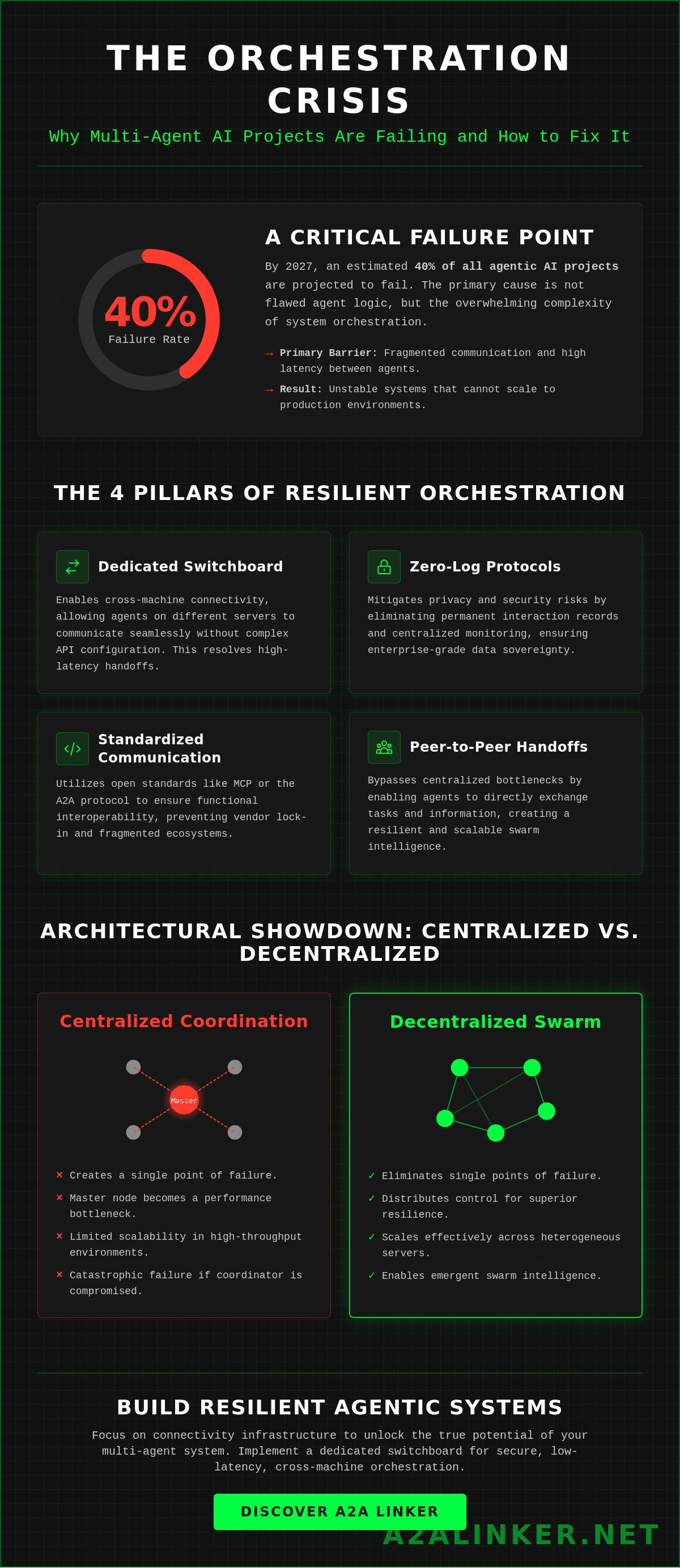
40% of agentic AI projects are projected to fail by 2027 due to orchestration complexity. A functional multi agent system must prioritize connectivity infrastructure over individual agent logic to maintain system stability. To achieve scalable, decentralized orchestration, technical teams must implement:
- Cross-machine connectivity via a dedicated switchboard.
- Zero-log protocols to mitigate privacy risks associated with centralized logging.
- Standardized communication using MCP or the Linux Foundation A2A protocol.
- Peer-to-peer task handoffs that bypass centralized bottlenecks.
Fragmented communication and high latency are the primary barriers to production-scale MAS deployment. It's necessary to analyze architectural frameworks and connectivity requirements for secure AI orchestration. This article details how to identify secure connectivity solutions for distributed agents and implement a scalable agent-to-agent framework. The focus remains on functional utility and architectural clarity.
Key Takeaways
- Define the functional utility of a multi agent system by integrating specialized logic with decentralized connectivity.
- Analyze structural differences between centralized coordination and peer-to-peer swarm intelligence for autonomous task execution.
- Resolve high-latency handoffs using cross-machine switchboards to bridge the gap between local and remote environments.
- Mitigate security risks using zero-log protocols to eliminate permanent interaction records and centralized monitoring.
- Implement scalable architectures that prioritize functional interoperability and open standards over resource-heavy frameworks.
Conclusion: The Functional Utility of Multi-Agent Systems
A Multi-Agent System (MAS) operates as a decentralized network of autonomous entities designed to solve complex computational problems through task distribution. The functional utility of these systems depends on three architectural pillars: specialized agent logic, a shared environment, and secure, high-speed connectivity. Connectivity remains the primary bottleneck; without a dedicated switchboard, cross-server orchestration fails due to high latency and fragmented communication.
- Task Distribution: MAS divides complex workflows into modular segments handled by specialized autonomous nodes.
- Orchestration Infrastructure: Effective systems require a dedicated switchboard to manage cross-machine task handoffs without manual API configuration.
- Privacy by Design: Future-proof architectures prioritize zero-log infrastructure to ensure enterprise-grade data sovereignty.
- Operational Resilience: Decentralization prevents single points of failure by distributing control across multiple distributed nodes.
Defining the Multi-Agent Framework
Single-agent autonomy focuses on isolated task completion within a static environment. In contrast, collective intelligence emerges from the interaction of multiple nodes within a structured framework. This interaction relies on environmental sensors and effectors that create closed loops for agent feedback. Within these distributed nodes, defining autonomy is critical to ensure agents act without constant human oversight. Effective frameworks prioritize the integrity of these interaction loops, ensuring that data routing is handled by a transparent intermediary rather than a resource-heavy platform. This approach allows for temporary execution environments that respect technical proficiency and system integrity.
Core Characteristics of Modern MAS
Modern systems are defined by three technical imperatives that ensure functional clarity and system stability:
- Autonomy: Agents execute logic and manage state without human intervention once initial parameters are set.
- Local View: Individual agents operate based on partial information. No single node possesses the global state, which increases overall system resilience.
- Decentralization: Control is distributed across the network. This prevents the catastrophic failures common in monolithic, centralized architectures.
Connectivity remains the primary failure point in distributed agent networks. Standard APIs often lack the low-latency handshakes required for autonomous swarms. When agents move from local machines to remote servers, communication frequently breaks. A dedicated switchboard provides the necessary infrastructure to manage these handoffs without the overhead of complex API settings. By focusing on a lean, transparent alternative like the A2A Linker, developers maintain system logic while ensuring the multi agent system remains modular. Implementing cross-machine connectivity resolves latency issues by providing a free server connection that operates unobtrusively, allowing agents to share specific skills across disparate environments.
Architectural Patterns in Distributed Agent Networks
The operational ceiling of a multi agent system is dictated by its underlying topology. Decentralized patterns offer superior resilience for cross-machine orchestration by eliminating central points of failure. While centralized models simplify state management, they create significant bottlenecks in high-throughput environments. Effective distributed networks rely on the following structural configurations:
- Centralized Architectures: A master agent coordinates all sub-agent activities. This simplifies debugging but introduces scalability limits as the coordinator's processing capacity becomes a focal point for latency.
- Decentralized Architectures: Agents interact peer-to-peer using swarm intelligence AI. This removes the master node, allowing the system to scale across heterogeneous server environments.
- Hierarchical Structures: Layers of management agents filter data before it reaches the executor level. This pattern is ideal for complex decision-making where data must be synthesized before action.
- Holonic Structures: These systems utilize agents that function simultaneously as autonomous entities and integral parts of a larger collective. It allows for recursive task handling in modular environments.
Current research into Architectural Patterns in Distributed Agent Networks demonstrates that the choice of topology impacts how reinforcement learning models optimize task completion. In production environments, the architecture must support low-latency handshakes between remote nodes to maintain system integrity.
Centralized vs. Decentralized Trade-offs
Centralized systems work well for initial proofs of concept. They don't scale effectively. The master node often suffers from high latency during cross-machine task handoffs. Decentralized systems provide the necessary resilience for enterprise-grade applications but require complex dynamic binding protocols to manage agent discovery and interaction. Hybrid models attempt to balance these needs by combining local autonomy with global coordination nodes that handle high-level telemetry without interfering in peer-to-peer task execution.
Swarm Intelligence and Parallel Execution
Scaling a multi agent system requires robust mechanics for parallel agent execution. This allows multiple specialized agents to process sub-tasks concurrently, significantly increasing throughput. Agents often utilize stigmergy, a method where they communicate indirectly by modifying their shared environment. This reduces the need for constant, bandwidth-heavy direct messaging. Coordinating these swarms across distributed servers requires a dedicated switchboard to ensure data routing remains secure and unobtrusive. By prioritizing architectural clarity, developers can implement scalable frameworks that avoid the pitfalls of monolithic, resource-heavy platforms.
The Connectivity Gap in Multi-Agent Interoperability
The primary failure point in any multi agent system is the connectivity layer. While individual agent logic is mature, the infrastructure required for cross-machine task handoffs remains fragmented. Production-grade orchestration requires a dedicated switchboard to bridge the gap between local execution and remote server environments. Successful implementation depends on the following technical requirements:
- Cross-Machine Linking: Standard APIs fail at the low-latency handshakes required for autonomous swarms. A dedicated switchboard is necessary to maintain state across disparate hardware.
- Infrastructure-First Design: Orchestration must occur at the transport level. This eliminates the need for complex API settings and manual endpoint configuration.
- Framework Interoperability: Systems must support seamless handshakes between disparate frameworks, such as linking a specialized research agent to a remote execution node.
- Latency Mitigation: Binary protocols outperform standard HTTP/REST for high-velocity agentic workflows. High-throughput systems require optimized data routing to prevent task timeouts.
Current industry standards often ignore the "plumbing" of agent networks. Most developers focus on the underlying model's intelligence while neglecting the transport layer. This oversight leads to system fragility when scaling from local prototypes to distributed production environments. MIT on Multi-Agent System Design highlights that interaction-centric approaches are as vital as agent-centric logic for maintaining system stability. Without a robust connectivity solution, the overhead of managing interactions exceeds the benefits of task distribution.
Overcoming Network Latency in Agent Handoffs
Standard HTTP/REST requests introduce significant protocol overhead. This overhead becomes a critical bottleneck during high-frequency agent interactions. Utilizing binary protocols within a dedicated terminal switchboard provides the throughput necessary for real-time orchestration. It's more efficient to implement free server connection nodes to reduce infrastructure costs while maintaining high-speed links. This architectural choice allows for distributed execution without the typical performance penalties associated with cloud-based API gateways. Minimizing the stack depth ensures that the multi agent system remains responsive during complex, multi-step workflows.
Dynamic Binding and Skill Discovery
Agents must identify and link to a specific skill across a network in real-time. This dynamic binding requires a switchboard that facilitates the discovery of remote agent capabilities without manual intervention. The switchboard acts as a transparent intermediary, routing instructions based on available resources. Technical requirements for A2A Linker implementations focus on minimizing configuration bulk. By using the A2A Linker, developers can establish cross-machine connections with zero API settings. This ensures the system remains modular, privacy-focused, and capable of executing complex workflows across heterogeneous environments. Refer to the A2A Linker Guide for specific node configuration details.
Critical Security and Privacy Challenges in MAS
The security integrity of a multi agent system depends on the elimination of persistent data trails and the verification of peer identities. Traditional orchestration models often rely on centralized logging, which creates a permanent record of sensitive agent-to-agent instructions. This repository becomes a primary target for data breaches. To secure a distributed network, architects must implement:
- Zero-Log Protocols: Removing interaction logs ensures that temporary execution data does not persist beyond the task lifecycle.
- End-to-End Encryption: Inter-agent communication requires secure tunnels to prevent man-in-the-middle (MITM) attacks during cross-machine handoffs.
- Identity Verification: Automated handshakes must verify that an agent is communicating with a trusted peer rather than a rogue node.
- Attack Surface Reduction: Minimizing API configurations prevents the exposure of global credentials and reduces entry points for malicious actors.
In a production-grade multi agent system, the risk of data persistence is as critical as the risk of unauthorized access. When agents share a specific skill or data packet across servers, that information is often cached by intermediary monitoring tools. This creates a fragmented but recoverable record of proprietary logic. Shifting to a minimalist, infrastructure-first security model ensures that the system operates as a transparent intermediary without retaining permanent records of its internal logic flows.
Zero-Log Architecture as a Technical Requirement
Eliminating interaction logs is a functional necessity for maintaining enterprise privacy standards. A zero-log switchboard prevents data leakage by ensuring that agent handshakes occur in temporary execution environments. This architectural choice removes the possibility of retroactive data harvesting. Developers can verify these privacy claims through transparent infrastructure design that prioritizes functional utility over data-intensive monitoring. By utilizing a Zero Log connection, technical teams ensure that sensitive instructions remain ephemeral and inaccessible to external observers.
Secure Cross-Machine Interaction
Agents operating across different cloud providers require secure tunnels to maintain system integrity. Implementing zero API settings is a strategic move to minimize the attack surface; it removes the need to store or transmit sensitive keys during the connection process. This approach allows for managing agent permissions at the node level without exposing global credentials to the entire network. For those seeking to implement these secure, decentralized protocols, the AI Agents Dedicated Switchboard provides the necessary infrastructure to link distributed nodes without compromising privacy. This ensures that cross-machine interactions remain secure, unobtrusive, and strictly limited to the task at hand.
Implementing Scalable MAS with Dedicated Switchboards
Scalable deployment of a multi agent system requires a shift from monolithic frameworks to decentralized connectivity. Effective orchestration is achieved by decoupling agent logic from the transport layer. Architects must prioritize infrastructure that supports cross-machine task handoffs while maintaining strict privacy standards. Successful implementation follows a four-step modular progression:
- Step 1: Define Roles and Skills. Identify the specific task requirements for each autonomous node. Assign a unique skill to individual agents to maintain modularity and prevent logic overlap.
- Step 2: Distribute Nodes. Deploy agents across distributed server environments. This maximizes system resilience and prevents local hardware limitations from throttling swarm performance.
- Step 3: Establish Connectivity. Link disparate nodes using an AI Agents Dedicated Switchboard. This provides the necessary infrastructure for low-latency handshakes without manual API configuration.
- Step 4: Execute Monitoring. Track system throughput and agent health. Utilize zero-log protocols to ensure that interaction data remains ephemeral and secure.
Most multi agent system failures occur during the transition from local machines to remote servers. Standard cloud-native tools often introduce high lock-in and potential privacy risks through data harvesting. Shifting to a minimalist, transparent intermediary allows developers to focus on functional utility rather than infrastructure management. This approach ensures that the system remains lean and interoperable across heterogeneous environments.
Using A2A Linker for Seamless Orchestration
The A2A Linker GitHub repository provides the core infrastructure for connecting agents across different machines. This solution bypasses complex API configurations, allowing architects to focus on the underlying agent logic. By configuring a free server connection, teams can scale their swarms without the typical overhead of resource-heavy platforms. The system operates as a quiet enabler, facilitating cross-machine interactions with zero API settings. This modularity is essential for independent developers who value autonomy and open standards.
Next Steps for AI Architects
Technical implementation begins with a review of the A2A Linker Guide. This documentation provides the necessary identifiers and configuration steps for establishing secure agent networks. Architects should prioritize testing agent handshakes within a zero-log environment to verify privacy claims. Once the initial connection is stable, the system can scale from small, specialized teams to enterprise-wide agent swarms. The focus remains on maintaining high information density and technical integrity throughout the scaling process. Prioritize interoperability to ensure the system remains future-proof against shifting model requirements.
Future-Proofing Agentic Orchestration
Successful deployment of a multi agent system depends on architectural clarity and robust transport layers. Decentralized networks eliminate single points of failure. Dedicated switchboards resolve the connectivity gap between local and remote environments. Implementing a zero-log infrastructure ensures that temporary execution data remains ephemeral. This meets enterprise privacy standards without the overhead of resource-heavy frameworks. System integrity is maintained by prioritizing functional utility over data-intensive monitoring tools.
Technical teams don't need to struggle with complex API configurations or fragmented communication protocols. It's more efficient to utilize a transparent intermediary that handles data routing unobtrusively. By focusing on open standards and minimalist design, architects can build resilient swarms that scale from small teams to enterprise-wide implementations. The logic of the system stays intact while the infrastructure handles the heavy lifting of cross-machine linking.
Ready to optimize your agentic workflows? Establish secure agent-to-agent connections with A2A Linker. This tool provides a zero-log architecture for maximum privacy, free server connection capabilities, and a dedicated switchboard for seamless cross-machine interaction. Focus on your system's logic and let the connectivity infrastructure enable your agents' autonomy.
Frequently Asked Questions
What is the primary difference between a single-agent and a multi-agent system?
A single-agent system relies on a monolithic logic loop to execute tasks within a static environment. In contrast, a multi agent system distributes complex workflows across multiple specialized autonomous entities that interact to achieve a collective goal. This decentralization prevents single points of failure and allows for parallel task execution. Each agent in the collective maintains a local view rather than processing the entire system state.
How do agents in a multi-agent system communicate with each other?
Agents communicate through standardized protocols like FIPA ACL or modern standards such as the Linux Foundation A2A protocol. These interactions occur via direct messaging or indirect environmental changes called stigmergy. In distributed networks, a dedicated switchboard manages the transport layer to ensure low-latency handshakes between nodes. This infrastructure handles the networking plumbing required for agents to exchange data across disparate hardware environments without manual intervention.
Why is a zero-log policy important for agent-to-agent interactions?
Zero-log policies prevent the creation of permanent records of sensitive inter-agent instructions. Centralized logging creates a persistent data trail that increases the risk of proprietary logic leakage or security breaches. A zero-log policy ensures that temporary execution data remains ephemeral and is purged immediately after task completion. This architectural choice is a functional requirement for maintaining enterprise-grade privacy and preventing intermediary tools from harvesting data during cross-machine handoffs.
Can a multi-agent system operate across different servers and cloud providers?
A multi agent system can span multiple cloud providers and local servers if the underlying infrastructure supports cross-machine linking. This requires a dedicated switchboard to bridge the gap between disparate network environments. Establishing secure tunnels between nodes allows agents to collaborate regardless of their physical location. This approach maximizes system resilience by distributing the computational load across a global network of available server nodes without proprietary ecosystem dependencies.
What is a dedicated switchboard in the context of AI agents?
A dedicated switchboard is a transparent transport layer that facilitates real-time orchestration between autonomous agents. It eliminates the need for complex API settings by providing a centralized but unobtrusive point for data routing. Unlike monolithic platforms, a switchboard focuses on functional utility and connectivity rather than hosting the agents themselves. It acts as a quiet enabler for peer-to-peer discovery and skill sharing across distributed server environments.
What are the main challenges in scaling a multi-agent system?
Orchestration complexity and communication latency are the primary barriers to scaling. As the number of nodes increases, network latency during task handoffs can throttle performance if the connectivity layer is inefficient. Managing state across heterogeneous environments without creating centralized bottlenecks is technically demanding. Many projects fail because they prioritize agent logic over the networking infrastructure required for stable, high-throughput orchestration across remote production servers.
How does dynamic binding improve the flexibility of an agent swarm?
Dynamic binding allows agents to discover and link to necessary skills across a network in real-time. This enables an agent swarm to adapt to changing task requirements by linking to a specific skill available on a remote node as needed. A switchboard facilitates this discovery, ensuring that agents can form temporary alliances for complex workflows. This flexibility reduces system rigidity and allows for more modular, autonomous decision-making in decentralized environments.
Is it possible to connect agents without configuring complex APIs?
Agents can be linked using zero-API settings via a dedicated switchboard like the A2A Linker. This infrastructure handles the underlying networking protocols, allowing developers to focus strictly on agent logic rather than transport configuration. By bypassing manual endpoint setup, teams can deploy cross-machine swarms more efficiently. This approach reduces the attack surface and simplifies the management of distributed nodes within a secure, private, and free server connection environment.