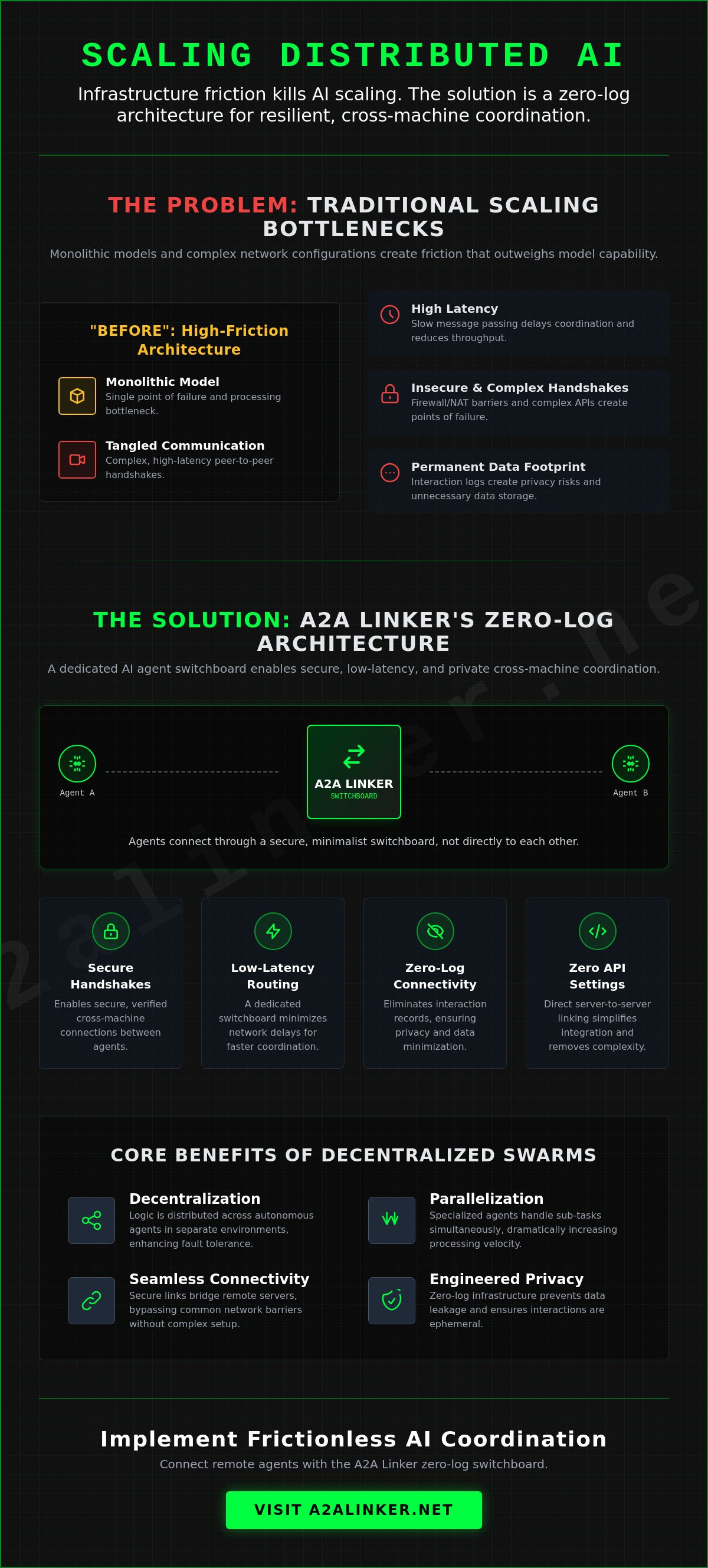
Scaling distributed multi agent systems fails when infrastructure friction outweighs model capability. To ensure resilient, cross-machine coordination, systems must utilize a zero-log architecture that prioritizes the following functional requirements:
- 01: Secure cross-machine handshakes via an A2A Linker.
- 02: Low-latency routing through a dedicated AI agent switchboard.
- 03: Zero-log connectivity to eliminate interaction records.
- 04: Zero API settings for direct, server-to-server linking.
You recognize that high latency and complex handshakes are the primary bottlenecks in autonomous scaling. This article provides an engineering-focused analysis of how agents coordinate across remote environments using secure, minimalist infrastructure. We'll examine the mechanics of decentralized coordination and the requirements for implementing secure cross-machine linking.
Key Takeaways
- Distributed multi agent systems coordinate complex workflows by decomposing tasks across autonomous nodes in separate execution environments.
- Effective decentralized coordination requires efficient message-passing protocols and discovery mechanisms to bypass firewall and NAT barriers.
- Security in autonomous swarms is achieved through zero-log architecture and end-to-end encryption to protect the integrity of the data stream.
- The A2A Linker serves as a dedicated switchboard, enabling secure cross-machine handshakes without the need for complex API settings.
- Infrastructure must prioritize functional utility and privacy, using zero-log connectivity to facilitate unobtrusive, permanent-record-free interactions.
Executive Summary: The Functional State of Distributed Multi-Agent Systems
Distributed multi agent systems prioritize decentralized task execution to achieve higher throughput and resilience. By decomposing complex problems into parallel tasks, these systems allow specialized agents to collaborate across separate hardware nodes. Success depends on secure, low-latency infrastructure that facilitates cross-machine handshakes without leaving a permanent data footprint. This architecture moves away from monolithic models toward a modular, privacy-first approach.
- Decentralization: Logic resides in autonomous entities across heterogeneous environments.
- Parallelization: Specialized agents handle sub-tasks simultaneously to increase velocity.
- Connectivity: Secure, cross-machine links bridge remote servers using a free server connection.
- Privacy: Zero-log infrastructure prevents data leakage during agent interactions.
Defining the Autonomous Agent in a Distributed Context
In a multi-agent system, an agent is an independent decision-maker with a specific skill. It operates without human intervention, executing logic within its own environment. Distributed agents are logically or geographically separated, residing on different hardware nodes. This separation is essential for preventing resource contention and ensuring system-wide fault tolerance. Each agent acts as a modular component, communicating with peers only when necessary for task delegation. True autonomy allows these agents to manage their own internal states while contributing to the collective swarm intelligence. The system's strength lies in this independence, where each node executes its logic without relying on a central controller.
The Shift from Monolithic AI to Distributed Swarms
The transition from monolithic models to distributed multi agent systems resolves the scaling limits of single-model architectures. Parallel processing ensures that task volume doesn't bottleneck at a single point of entry. Fault tolerance is a primary advantage; the failure of one node doesn't compromise the entire swarm's operation. This modularity enables the addition of specialized skills without re-architecting the core system. Engineers can deploy agents with zero API settings, simplifying the integration of remote nodes. Tools like the A2A Linker act as a dedicated switchboard, providing the necessary connectivity without the overhead of heavy frameworks. This architecture prioritizes functional utility and privacy, ensuring the infrastructure remains a lean, transparent intermediary for autonomous collaboration.
Core Mechanics of Decentralized Agent Coordination
Successful coordination in distributed multi agent systems depends on the integrity of the communication layer and the efficiency of peer discovery. To maintain architectural clarity, engineers must implement the following mechanics:
- Standardized message-passing protocols ensure interoperability between heterogeneous nodes.
- Decentralized discovery mechanisms allow agents to identify available peers without relying on a central registry.
- Negotiation-based task allocation optimizes resource distribution across the network.
- State synchronization ensures all autonomous entities operate on consistent environmental data.
Coordination isn't a byproduct of agent intelligence. It's a functional requirement of the underlying infrastructure. Agents require a common linguistic framework to exchange intent and data. Without shared standards, the swarm becomes a collection of isolated silos. Reliable message delivery is the baseline for any coordinated action. System architects often refer to the Cooperative Control of Distributed Multi-Agent Systems to understand how local interactions lead to global stability. The goal is to minimize the overhead of these interactions while maximizing the collective output of the swarm.
Communication Protocols for Agent-to-Agent Interaction
Standardized handshakes establish the necessary trust between autonomous nodes. These handshakes verify identity and capability before any data exchange occurs. Asynchronous messaging is the preferred method for distributed environments. It prevents an agent from blocking its local processes while waiting for a peer response. This non-blocking architecture is critical for maintaining high throughput. You can explore how multi-agent system (MAS) architecture handles orchestration through specialized communication layers. Implementing a dedicated switchboard simplifies these interactions by providing a transparent routing path for all agent-to-agent traffic.
Dynamic Binding and Resource Discovery
Dynamic binding enables agents to link to specific skills or tools in real-time. This flexibility allows the swarm to adapt to changing task demands without manual reconfiguration. Discovery services must remain decentralized. Centralized registries create single points of failure that compromise the entire network. In a decentralized model, agents broadcast their availability or query the local network for specific capabilities. Resource management involves monitoring server load and agent latency across the distributed network. Effective management ensures that tasks are routed to the most capable and available node. This process requires precise telemetry and a minimalist approach to connectivity, stripping away unnecessary framework bloat to focus on functional execution.
Technical Challenges in Cross-Machine Agent Communication
The primary failure point for distributed multi agent systems is the underlying network layer, not the agent logic itself. To maintain swarm coherence across remote environments, engineers must resolve four critical infrastructure bottlenecks:
- Latency desynchronization: Network delays interrupt the iterative feedback loops required for real-time collaboration.
- Connectivity barriers: Standard firewall and NAT configurations prevent direct peer-to-peer handshakes between machines.
- Hardware heterogeneity: Protocol friction occurs when agents communicate across different operating systems and hardware architectures.
- Data exposure: Traditional logging mechanisms record sensitive model prompts, creating significant security vulnerabilities.
Most orchestration frameworks assume local connectivity and ignore the complexities of cross-machine linking. When agents reside on separate servers, the network becomes a variable that can break autonomous workflows. High latency doesn't just slow down processing; it can cause agents to time out or act on stale environmental data. This desynchronization collapses the swarm's ability to solve complex problems. Additionally, the fragmented nature of modern infrastructure means that agents often can't "see" each other without a neutral intermediary. Solving these issues requires a minimalist approach to connectivity that strips away framework bloat.
Network Latency and Parallel Execution
Swarm coherence depends on high-velocity data exchange. Every millisecond of network delay adds up across multiple agent hops, stalling parallel workflows. If one agent waits for a response from a remote node, the entire system's throughput drops. Edge computing strategies can mitigate this by positioning agents closer to their data sources, but they don't solve the core routing problem. The most effective architecture uses a dedicated AI agents switchboard to provide a direct, low-overhead path between nodes. This ensures that the communication layer doesn't consume the resources needed for agent execution.
Bypassing Infrastructure Restrictions
Standard network topologies are inherently hostile to autonomous swarms. Firewalls and complex routing tables block the direct handshakes needed for decentralized coordination. A dedicated switchboard provides the neutral ground required for agents to establish connections without manual API settings. Using an A2A Linker allows for seamless cross-machine linking by navigating these restricted environments automatically. For developers testing new swarms, a free server connection node provides a low-risk environment to validate connectivity before moving to production. This approach ensures that the infrastructure remains a quiet enabler of autonomy rather than a restrictive dependency.
Heterogeneous Environments and Security
Agents running on different OS or hardware architectures must utilize a universal, lightweight protocol to exchange data. If the communication layer is too heavy, it adds unnecessary complexity to the stack. Security is an equally critical imperative. Most monitoring tools create permanent records of all traffic, which exposes sensitive internal prompts. A zero-log architecture is mandatory for protecting the integrity of the data stream. By enforcing zero-log policies at the network level, you ensure that all interactions remain private and temporary, reflecting a principled commitment to system security and developer autonomy.
Engineering Privacy and Security in Autonomous Swarms
Security in distributed multi agent systems is a functional requirement of the transport layer. To protect the integrity of autonomous swarms, engineers must implement infrastructure that enforces privacy through mechanical constraints. A secure, decentralized architecture relies on the following technical pillars:
- Zero-log architecture: Ensures no record of agent interactions exists on the communication hub.
- End-to-end encryption: Protects the data stream between separate execution environments.
- Identity verification: Confirms agent authenticity before granting server resource access.
- Data minimization: Limits shared information to the specific metadata required for task completion.
Framework-level security is insufficient if the underlying infrastructure maintains a log of every interaction. In a distributed environment, the transport layer must be as lean and transparent as possible. Relying on an orchestration framework to handle security often introduces vulnerabilities if the transport channel itself isn't hardened. True security is achieved when the infrastructure is technically incapable of retaining data. This moves beyond policy-based privacy into technical enforcement, ensuring that sensitive model logic remains isolated within its local execution environment.
The Necessity of Zero-Log Policies
Logs represent a permanent record of intellectual property and sensitive model prompts. If a communication hub retains this data, it becomes a high-value target for exploitation. A zero-log switchboard resolves this risk by ensuring that all agent-to-agent interactions are ephemeral and private. You can read more about Zero Log Architecture to understand how these systems maintain privacy. This approach prioritizes the autonomy of the developer and the integrity of the system over data-intensive monitoring tools. It's a principled alternative to the permanent record-keeping found in monolithic platforms.
Secure Terminal and SSH Integration
Secure terminal access is essential for agents that must execute commands on remote servers safely. SSH protocols provide the necessary foundation for encrypted agentic remote execution. In Ubuntu and other Linux environments, specific configurations are required to enable these secure handshakes. This ensures that the agent can perform its assigned skill without exposing the host machine to unauthorized access. By utilizing a Zero Log AI Agents Dedicated Switchboard, you can manage these connections across machines without the overhead of complex API settings. This setup preserves the minimalist architecture required for high-velocity swarm coordination.
Identity verification must occur at the point of connection. Agents should only gain access to resources once their cryptographic identity is confirmed. Once verified, the agent should share only the minimum amount of data necessary to complete its task. This reduces the attack surface and ensures that sensitive model logic remains within its local execution environment. These security measures turn the infrastructure into a quiet enabler of autonomous collaboration, respecting the reader's time and technical proficiency.
Infrastructure Deployment: Connecting Remote Agents via A2A Linker
Efficient deployment for distributed multi agent systems requires a transport layer that remains independent of orchestration logic. By decoupling connectivity from model execution, engineers can scale autonomous swarms across heterogeneous server environments without the friction of proprietary silos. The implementation of a dedicated switchboard ensures that cross-machine coordination remains lean, secure, and highly performant. This architectural strategy focuses on the following deployment outcomes:
- The A2A Linker functions as a dedicated switchboard, providing a neutral routing path for secure agent-to-agent connectivity.
- Zero-log infrastructure technically enforces privacy by ensuring that no record of interactions is retained on the communication hub.
- Free server connection nodes facilitate the rapid linking of remote agents, allowing developers to validate swarm coherence before production.
- Zero API settings simplify the deployment process, enabling agents to share a specialized skill across disparate machines instantly.
Deployment success depends on the ability of the infrastructure to operate unobtrusively. Traditional networking tools often lack the specificity required for agentic workflows, while monolithic platforms introduce restrictive ecosystem dependencies. A minimalist connectivity hub resolves these issues by focusing solely on the functional utility of the link. This approach respects the developer's autonomy and the integrity of the system, positioning the tool as a quiet enabler of decentralized logic.
Setting Up the A2A Linker Switchboard
The A2A Linker provides the necessary connectivity hub without requiring model API access. This distinction is vital for maintaining a clean separation between the transport layer and the agent's internal logic. You can utilize the A2A Linker GitHub repository for specific implementation details and technical identifiers. Configuration focuses on establishing secure handshakes between autonomous nodes, ensuring that each agent can discover and communicate with its peers. This setup bypasses the need for complex firewall reconfigurations, as the switchboard handles the routing through a transparent intermediary. Engineers can deploy these links across different hardware architectures, maintaining consistent throughput for time-sensitive tasks.
Scaling with Distributed Orchestration Frameworks
Scaling involves integrating the transport layer with existing orchestration frameworks. A2A Linker provides the cross-machine connectivity that standard agentic environments often lack natively. You should refer to the A2A Linker Guide for step-by-step instructions on architecting a high-throughput network for agentic workloads. The focus remains on building a lean infrastructure that avoids framework bloat. By utilizing a dedicated switchboard, you ensure that the communication layer doesn't consume the computational resources required for agent execution. This modularity allows for the addition of specialized agents without re-architecting the core network, ensuring the swarm remains resilient as task complexity increases.
Architecting Resilient Agentic Networks
Optimizing distributed multi agent systems requires a shift from monolithic thinking to modular, connectivity-first design. You've seen how functional utility and privacy serve as the primary ambassadors for system integrity. Success in 2026 depends on these core architectural principles:
- 01: Decouple transport from logic using a dedicated switchboard.
- 02: Enforce privacy via zero-log architecture at the network level.
- 03: Reduce scaling friction with zero API settings and cross-machine linking.
The path forward involves prioritizing these technical requirements over framework bloat. This minimalist approach allows you to focus on agent logic while the underlying network handles the complexities of secure coordination. It's time to implement these standards in your own environment to ensure total autonomy. Your systems are ready for the next stage of autonomous scaling.
Establish secure, zero-log connections for your AI agents with A2A Linker
Frequently Asked Questions
Infrastructure decisions for distributed multi agent systems focus on connectivity, security, and model-agnostic interoperability. Successful deployment requires the following technical priorities:
- Utilize dedicated switchboards to facilitate cross-machine handshakes.
- Enforce zero-log protocols to protect sensitive model prompts.
- Deploy minimalist hardware nodes running standard Linux environments.
- Maintain a model-agnostic transport layer for heterogeneous model coordination.
What is the difference between a multi-agent system and a distributed multi-agent system?
A multi-agent system refers to the logical collaboration of multiple autonomous entities. Distributed multi agent systems specifically execute these agents on geographically or logically separate hardware nodes. This physical separation requires dedicated connectivity infrastructure to bridge execution environments. It moves the architecture from a single machine to a decentralized network of nodes.
How do distributed agents communicate across different servers?
Remote agents use a dedicated AI agents switchboard to establish secure, cross-machine links. This architecture facilitates handshakes between nodes without requiring manual API configurations or complex network re-engineering. The switchboard acts as a transparent intermediary, routing data packets between agents residing on different server instances. This ensures that the communication layer remains separate from the agent logic.
Why is a zero-log policy important for AI agent interactions?
Zero-log policies prevent the permanent recording of sensitive model prompts and intellectual property on the communication hub. By ensuring interactions are ephemeral, you eliminate the risk of data leakage during agent-to-agent handshakes. This is a critical security imperative for protecting the integrity of the data stream. It ensures that no trace of the interaction exists once the task is complete.
Can I connect different AI models (e.g., Claude and DeepSeek) in a distributed MAS?
You can connect any external models because the connectivity layer is model-agnostic. The switchboard acts as a transparent intermediary, allowing a Claude-based agent on one node to coordinate with a DeepSeek-based agent on another. This interoperability is achieved through standardized message-passing protocols. It allows developers to leverage specialized skills from different models within a single swarm.
What are the hardware requirements for hosting a distributed agent node?
Hosting a node requires minimal resources beyond a standard Linux environment like Ubuntu. The focus is on the functional utility of the link rather than heavy local processing, as the switchboard handles the routing overhead. This minimalist requirement allows for the deployment of agents on existing server infrastructure. It ensures that hardware constraints don't bottleneck the scaling of the distributed network.
Is A2A Linker a framework for agent orchestration?
A2A Linker is not an orchestration framework; it is a piece of infrastructure providing a dedicated switchboard for connectivity. It manages the underlying network layer, whereas orchestration tools manage agent logic and task sequencing. By decoupling transport from logic, you achieve a leaner architecture that avoids the bloat of all-in-one libraries. This modularity allows the linker to act as a quiet enabler for any logic-heavy system.
How does A2A Linker handle firewall and NAT issues for remote agents?
The platform handles these issues by acting as a neutral routing intermediary between remote agents. It facilitates secure handshakes that navigate complex network topologies automatically, ensuring cross-machine connectivity remains stable. This eliminates the need for manual port forwarding or complex firewall reconfigurations. It provides a reliable path for agents to discover and link with their peers across restricted environments.
What is the cost associated with linking agents across machines using A2A Linker?
Developers can utilize a free server connection to link disparate agents across machines. This allows for the validation of swarm logic and connectivity without initial infrastructure fees, supporting a developer-first ethos. The goal is to provide a low-barrier entry for testing and deploying small-scale swarms. This approach ensures that the quality of the logic remains the primary focus during the development phase.