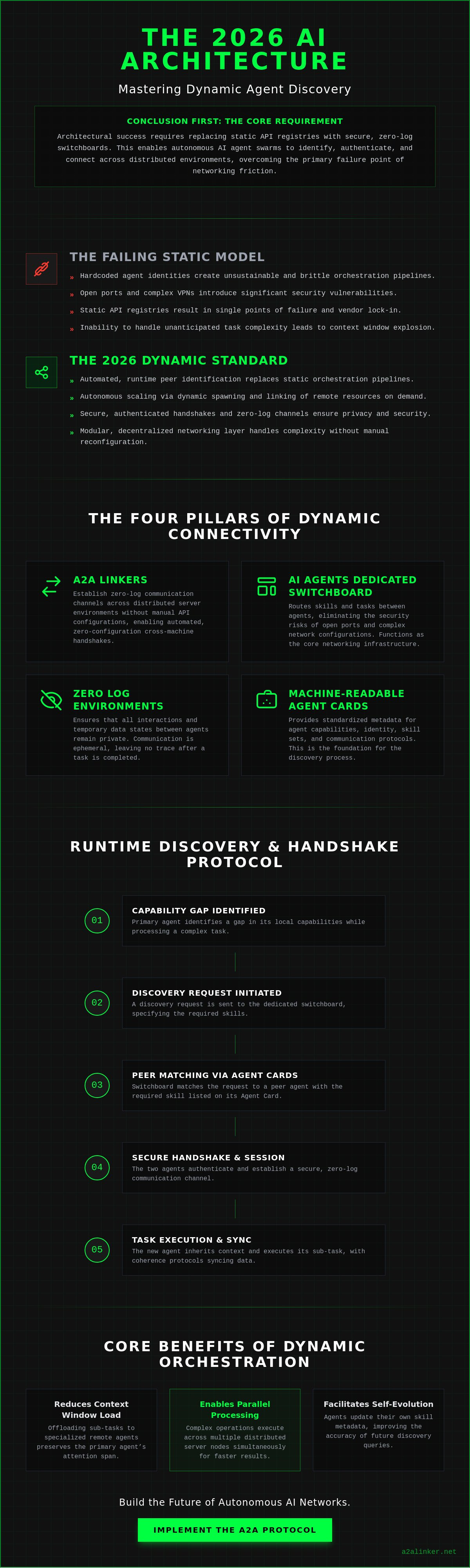
By 2026, 40% of enterprise applications will integrate AI agents, but dynamic agent discovery for multi-agent systems remains the primary failure point due to networking friction. Architectural success requires replacing static API registries with secure, zero-log switchboards to enable autonomous agent swarms. The following components define the current standard for distributed connectivity:
- A2A Linkers for automated, zero-configuration cross-machine handshakes.
- AI Agents Dedicated Switchboards to route skills without the security risks of open ports.
- Zero Log environments to ensure temporary data states remain private.
- Machine-readable Agent Cards for standardized capability and identity discovery.
Hardcoding agent identities across disparate environments is unsustainable and creates significant security vulnerabilities. You need a modular approach to manage context window explosion and secure agent-to-agent handshakes. This guide provides the technical roadmap to master the networking infrastructure required for autonomous AI agents to identify, authenticate, and connect across distributed server environments. We analyze the implementation of the A2A 1.0 protocol and the transition toward protocol-driven discovery for 2026 deployments.
Key Takeaways
- Implement dynamic agent discovery for multi-agent systems to replace static orchestration pipelines with automated, runtime peer identification.
- Standardize agent identities using machine-readable Agent Cards that declare specific skills and task boundaries for autonomous coordination.
- Secure cross-machine interactions via an AI Agents Dedicated Switchboard to eliminate the security risks of open ports and complex VPN configurations.
- Deploy an A2A Linker to establish zero-log communication channels across distributed server environments without manual API configurations.
Executive Summary: The Role of Dynamic Discovery in 2026 MAS
Dynamic agent discovery for multi-agent systems is the primary requirement for autonomous peer identification at runtime. It replaces static, hardcoded orchestration with a decentralized networking layer. The following architectural shifts define the 2026 landscape:
- Elimination of static API registries to prevent single points of failure and vendor lock-in.
- Autonomous scaling through dynamic spawning and linking of remote resources on demand.
- Secure handshakes that authenticate agent identities before granting task access.
- Zero-log routing to maintain privacy across distributed server nodes.
A functional multi-agent system relies on a discovery mechanism that operates independently of the underlying framework. Traditional monolithic agents struggle with context window explosion. Dynamic discovery solves this by allowing a lead agent to identify specialized peers across a network. This transition from hardcoded paths to runtime identification enables systems to handle unanticipated task complexity without manual reconfiguration. It's no longer efficient to map every possible interaction before execution begins.
Core Benefits of Dynamic Orchestration
- Reduces context window load. Offloading sub-tasks to specialized remote agents preserves the primary agent’s attention span.
- Enables parallel processing. Complex research operations execute across multiple distributed server nodes simultaneously.
- Facilitates self-evolution. Agents update their own skill metadata, improving the accuracy of future discovery queries.
The A2A Linker provides the necessary switchboard infrastructure for these interactions. It allows for cross-machine connectivity with zero API settings, ensuring that agents can link and collaborate without administrative overhead. This setup prioritizes functional utility and privacy over complex middleware.
The Shift from Static Workflows to Runtime Spawning
Static workflows fail when runtime analysis reveals hidden task requirements. In 2026, the architecture favors runtime spawning over pre-defined sequences. When a primary agent identifies a gap in its local capabilities, it initiates a discovery request. A dedicated switchboard matches the request to a peer with the required skill. The new agent then inherits the relevant memory and task state during the handshake process. Coherence protocols manage the resulting swarm, keeping data synced across all nodes. This approach ensures the system remains responsive to changing environmental variables without breaking the execution chain. It doesn't matter where the agent resides; the connection remains seamless.
Architectural Mechanisms: How Discovery Enables Autonomous Scaling
Autonomous scaling in distributed environments depends on dynamic agent discovery for multi-agent systems to identify and link specialized entities at runtime. This mechanism removes the requirement for static orchestration by utilizing standardized protocols to match task complexity with available remote resources.
- Agent Cards provide machine-readable metadata defining digital identities, specific skill sets, and tool access parameters.
- Discovery triggers activate based on real-time complexity metrics when local agent capabilities are insufficient for a query.
- Standardized A2A protocols facilitate the request-response cycle across machine boundaries without manual API configuration.
- Session establishment requires an authenticated handshake to ensure the discovered resource is the intended specialized entity.
Agent Cards and Digital Identity
Agent Cards serve as the foundational metadata layer for the discovery process. These cards declare an agent's functional boundaries, including supported output formats and latency requirements. Metadata within these cards also specifies preferred communication modes, such as synchronous or asynchronous execution. Identity verification is critical; it ensures that the discovered agent is indeed the specialized resource required for the task. Research into dynamic agent collaboration demonstrates that structured profiles allow for efficient spawning and resource allocation in high-density environments. This approach prioritizes architectural clarity over the overhead of managed hosting platforms.
Discovery Protocols and Handshake Logic
Standardized A2A protocols manage the initial request-response cycle between disparate nodes. When an agent encounters a task exceeding its local scope, it initiates a discovery request through a dedicated switchboard. Heuristics embedded within the prompt allow the system to match user intent with specific tool sets. This matching logic must be precise to scale computational effort according to query complexity. This process eliminates the need for deterministic execution orders, allowing the system to adapt to the operational reality at runtime. It's a technical solution for agents that need to operate across different server environments without hardcoded paths.
Implementing these connections effectively requires a lean networking layer. Utilizing an AI Agents Dedicated Switchboard allows for secure handshakes across machine boundaries with zero API settings. This setup facilitates cross-machine skill sharing while maintaining a zero-log policy for all session data. Once the handshake concludes, the session is established, and the task handoff occurs. This modularity ensures the system remains unobtrusive and focused on functional utility.
Cross-Machine Communication: Overcoming Network Latency and Security Gaps
Successful cross-machine communication in distributed environments depends on a secure routing layer that mitigates network latency and eliminates the vulnerabilities of direct peer-to-peer connections. Implementing dynamic agent discovery for multi-agent systems requires an architectural shift from open-port configurations to centralized, zero-log switchboards that handle task resumption automatically. This ensures system integrity without the overhead of complex VPN management or manual IP whitelisting.
- Network latency disrupts synchronous execution, requiring asynchronous handlers to manage distributed agent chains.
- Direct peer-to-peer links often necessitate insecure open ports, which increases the network attack surface.
- Dedicated switchboards provide a transparent intermediary for routing traffic without permanent data retention.
- Automated interruption recovery is essential for maintaining task continuity across disparate server nodes.
- Authentication must reside at the infrastructure layer to prevent unauthorized agent access during runtime discovery.
Agents operating across disparate servers face significant network latency challenges that can cause execution timeouts in synchronous workflows. When a primary agent initiates a discovery request, the response time from a remote node varies based on geographical distance and network congestion. Standardized protocols must account for these fluctuations by implementing robust retry logic and state persistence. This ensures that a multi-agent system remains functional even during temporary connectivity drops. Research into Distributed Model Identification for Multi-Agent Systems highlights how real-time adaptation is essential for maintaining coherence in distributed architectures where latency is a constant variable.
The Dedicated Switchboard Advantage
A dedicated switchboard acts as a transparent intermediary for various external models and agents. It simplifies connectivity by providing a single point of entry for all distributed nodes, which removes the requirement for manual API settings. This architecture allows for a free server connection that handles the complexity of cross-machine routing unobtrusively. By utilizing an AI Agents Dedicated Switchboard, developers can implement secure agent-to-agent networks without the risks of traditional port forwarding. This approach ensures that the focus remains on functional utility rather than networking maintenance. It’s an efficient way to link skills across machines while maintaining architectural clarity.
Security Requirements for Distributed MAS
Security in a distributed environment is a primary constraint. A zero-log architecture is mandatory to maintain enterprise data privacy and comply with strict security standards. Handshakes between agents must utilize temporary execution environments to limit data exposure during the initial connection phase. Authentication should be handled at the infrastructure layer to ensure that only verified agents participate in the swarm. This setup prevents the leakage of sensitive session data and restricts access to authorized entities only. By prioritizing cross-machine skill sharing within a secure framework, the system remains lean and resilient. It projects a sense of being a quiet enabler that solves specific networking problems without adding unnecessary complexity.
Implementation Framework: Establishing Secure Handshakes and Handlers
Implementing dynamic agent discovery for multi-agent systems requires a structured execution pipeline to move from initial request to secure task completion. The following steps define the architectural requirements for establishing connectivity across distributed nodes:
- Step 1: Define the Agent Card. Specify objectives, task boundaries, and required skills to ensure precise matching during discovery.
- Step 2: Initialize Discovery. Route the request through a dedicated switchboard node to identify available specialized resources.
- Step 3: Execute Handshake. Verify digital identity and confirm skill inheritance through a standardized protocol exchange.
- Step 4: Establish Secure Session. Open a temporary, encrypted channel for data exchange and remote task execution.
- Step 5: Deploy Fail-Fast Handlers. Configure the system to terminate or resume sessions immediately upon detecting network errors or latency spikes.
A primary failure in many distributed architectures is the lack of emphasis on zero-log privacy during the discovery and handshake phase. Most registries log agent identities and intent, creating a permanent record of internal operations. A secure framework must prioritize temporary data states. By utilizing an AI Agents Dedicated Switchboard, you ensure that handshakes occur in isolated, temporary environments. This approach eliminates the need for persistent logs while maintaining the integrity of the connection. It's a technical necessity for enterprise environments where data exposure is a critical risk.
Configuring Agent Handlers
Handlers manage memory continuity when a lead agent spawns a sub-agent. These components ensure that relevant task context transfers without inflating the context window. Use CLI tools to manage distributed server nodes and monitor handshake status in real time. For specific configuration parameters, consult the A2A Linker Guide. Proper handler configuration prevents memory leaks and ensures that cross-machine skill sharing remains efficient. It's about functional utility at the network level.
Optimizing for High-Throughput
High-throughput swarms require parallel processing to reduce total execution time. Selective memory slicing allows agents to transfer only the data required for a specific task, reducing the overhead of cross-machine transfers. This optimization is essential for dynamic agent discovery for multi-agent systems operating at scale. See our analysis on distributed multi-agent system orchestration for more on managing concurrent swarms. Efficient orchestration relies on these lean data states to maintain speed and reliability.
Ready to deploy a secure, zero-log networking layer for your agents? Configure your A2A Linker switchboard today to enable seamless cross-machine connectivity.
A2A Linker: A Switchboard for Zero-Log Agent Orchestration
Effective dynamic agent discovery for multi-agent systems requires a dedicated networking layer that operates independently of the AI models themselves. Infrastructure serves as the nervous system of the architecture. It facilitates the connections that allow decentralized agents to function as a coherent swarm. A2A Linker resolves the connectivity gap by providing a secure, zero-log switchboard for cross-machine orchestration. The following architectural principles define the platform’s utility:
- A2A Linker establishes the networking infrastructure required to link agents across disparate server environments without manual IP management.
- A strict zero-log policy ensures that all agent-to-agent interactions remain private and are never recorded on the switchboard.
- Free server connection capabilities allow for rapid scaling without the friction of API overhead or restrictive managed hosting fees.
- Zero API settings enable immediate integration with any existing agent framework, prioritizing functional utility over ecosystem lock-in.
- Cross-machine skill sharing becomes a native capability rather than a complex integration project.
Infrastructure Features for AI Developers
Developers implementing autonomous swarms require a reliable method for cross-machine connectivity that doesn't depend on specific hosting providers. A2A Linker acts as a dedicated hub for secure Handshakes, Handlers, and Skill discovery. This modularity ensures that when an agent discovers a peer, the connection is established via a transparent intermediary. This setup bypasses the security risks of open ports. For technical implementation details and code examples, check the A2A Linker GitHub repository. This resource provides the mechanical logic needed to deploy the switchboard in production environments. It supports the A2A 1.0 protocol standards for agent-to-agent coordination.
Why Infrastructure Matters More Than Models
AI models represent the cognitive capacity of a system, but the infrastructure defines its operational boundaries. While competitors often focus on model-specific tool access, A2A Linker focuses on the connectivity layer. This neutrality is essential for dynamic agent discovery for multi-agent systems where agents from different vendors must collaborate. A privacy-first design ensures that session data exists only in temporary execution environments. By removing the need for permanent record-keeping, the system remains lean and secure. It avoids the data-intensive monitoring typical of monolithic platforms.
True power lies in interoperability and open standards rather than proprietary features. A2A Linker provides the quiet enablement required for independent developers to build resilient, distributed AI systems. It allows the quality of the logic to serve as the primary driver of system performance. By offloading the networking burden to a dedicated switchboard, developers can focus on agent skill sets and task boundaries. This approach ensures that the multi-agent system remains scalable, secure, and entirely under the developer's control.
Deploying Scalable Agent Infrastructure
Success in 2026 depends on transitioning from static registries to dynamic agent discovery for multi-agent systems. This architectural shift resolves the friction of manual orchestration and enables true autonomous scaling. Implement these core components to finalize your stack:
- Deploy runtime skill identification via standardized Agent Cards to replace hardcoded paths and static pipelines.
- Utilize dedicated switchboards to secure cross-machine handshakes and eliminate the risks of open ports.
- Enforce temporary data states to ensure compliance with strict enterprise privacy requirements.
Infrastructure serves as the nervous system for distributed agents. It enables autonomous swarms to function without the bulk of monolithic platforms or restrictive ecosystem dependencies. You can now establish secure agent connections with A2A Linker. This dedicated AI agent switchboard provides free server connection capabilities and a principled zero-log architecture for complete privacy. Build your autonomous ecosystem on a foundation of architectural clarity and functional integrity. Your agents are ready to connect.
Frequently Asked Questions
What is dynamic agent discovery in multi-agent systems?
Dynamic agent discovery for multi-agent systems is the automated process of identifying specialized AI peers at runtime via standardized networking protocols. It removes the requirement for static, hardcoded orchestration pipelines by allowing lead agents to query a network for specific skills when local capabilities are insufficient. This mechanism ensures that autonomous swarms can scale and adapt to task complexity without manual reconfiguration.
How does an AI agent switchboard improve discovery?
An AI agent switchboard improves discovery by providing a transparent, centralized hub for routing traffic between distributed nodes. It facilitates secure agent-to-agent handshakes and removes the need for manual API settings or complex VPN management. This architecture allows agents to link across different server environments efficiently while maintaining a single point of entry for all discovery requests.
Why is zero-log architecture important for agent communication?
Zero-log architecture is essential to maintain enterprise data privacy and prevent the creation of permanent records of agent intent or session data. Most traditional registries log identity and task metadata, which increases the network attack surface. A zero-log environment ensures that all interaction data remains in a temporary state and is purged immediately after the task handoff concludes.
Can agents from different frameworks and libraries discover each other?
Framework-agnostic discovery is possible when the underlying networking layer follows open standards like the A2A protocol. Infrastructure neutrality allows for seamless collaboration between nodes regardless of their internal logic or the specific development library used to build them. By utilizing a switchboard that acts as a transparent intermediary, you can link disparate agents without writing custom integration code. This ensures the system remains modular and resilient across diverse technical stacks.
What are the main security risks in dynamic agent discovery?
The primary security risks include unauthorized agent access and the exposure of sensitive data through open ports during peer-to-peer handshakes. Dynamic agent discovery for multi-agent systems requires authenticated handshakes within isolated execution environments to mitigate these vulnerabilities. Implementing infrastructure-level authentication ensures that only verified agents can join a swarm or access remote skills.
How does dynamic discovery handle network latency?
Dynamic discovery manages network latency through asynchronous communication protocols and robust retry logic. Standardized handlers maintain task continuity by persisting the execution state during temporary connectivity drops or geographical delays. This approach prevents system timeouts and ensures that distributed agent chains remain functional across congested or distant server nodes.
What is the role of an Agent Card in the discovery process?
An Agent Card acts as a machine-readable profile that declares an agent's specific skills, output formats, and digital identity. During the discovery process, the switchboard utilizes this metadata to match task requirements with the most suitable remote resource. This ensures that the matching logic is precise and that the discovered agent possesses the necessary tools for the assigned objective.
How do I implement dynamic spawning for long-horizon tasks?
Implementing dynamic spawning requires a lead agent to monitor real-time complexity metrics and trigger a discovery request when local context is exceeded. The switchboard then identifies a specialized peer and establishes a cross-machine link for task delegation. The new agent inherits the relevant memory and state during the handshake, allowing the long-horizon task to continue across distributed resources.