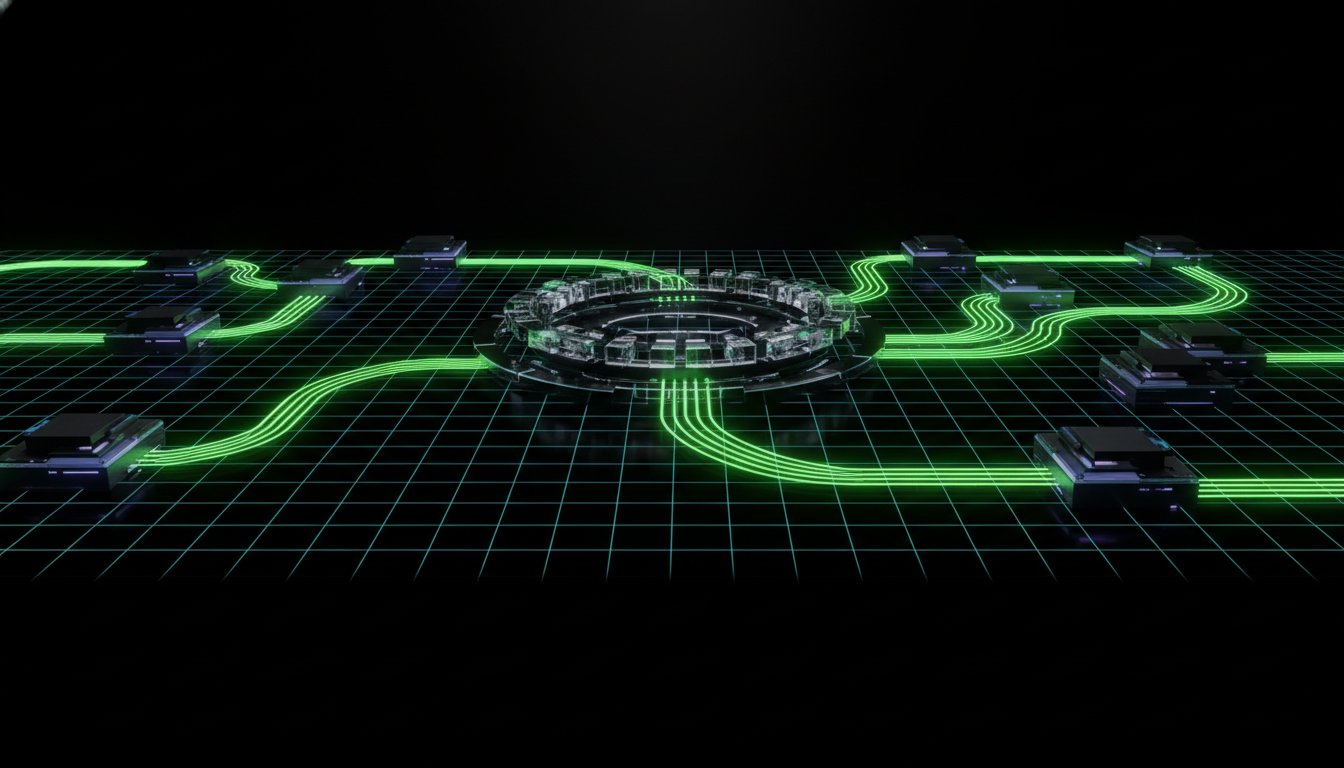

Standard VPN tunnels are a legacy bottleneck for autonomous agents. Establishing a secure, free server connection requires an ephemeral switchboard rather than a persistent, human-centric tunnel. This architectural shift provides the following technical advantages:
- Zero-log infrastructure that eliminates durable conversation storage and privacy risks.
- Low-latency agent-to-agent communication via an un-opinionated relay broker.
- Seamless terminal-based connectivity that bypasses complex API configurations.
- Cross-machine orchestration utilizing the Model Context Protocol (MCP) as the common denominator.
- Ephemeral runtime states that prevent data leakage during agent handoffs.
You likely recognize that high latency and the privacy risks of durable conversation logs are unacceptable for production-grade deployments. This reference outlines the specific mechanics for establishing a secure switchboard that prioritizes functional utility over traditional marketing hyperbole. We will examine how the A2A Linker enables agents to inspect, reason, and delegate tasks across distributed systems. By focusing on architectural clarity and the open-source hacker ethos, you can achieve a lean, transparent connection layer that respects both system resources and developer time. Agents united.
Key Takeaways
- Transition from persistent encrypted tunnels to ephemeral relay brokers to optimize AI network efficiency and minimize latency overhead.
- Reduce latency in agentic reasoning loops by replacing session-heavy VPNs with high-velocity A2A switchboards for faster handoffs.
- Establish a free server connection that enforces zero-log security, treating all agent handshakes as strictly ephemeral states to protect data sovereignty.
- Streamline agent-to-server linking by treating the connection as a modular terminal utility instead of a heavy framework or SDK.
- Utilize A2A Linker to orchestrate cross-machine agent collaboration with zero API settings and clinical architectural clarity.
Understanding Free Server Connection Architecture for AI
Efficient AI networking relies on ephemeral relay brokers rather than persistent encrypted tunnels. This architectural shift prioritizes functional utility over the session-heavy overhead of traditional networking. By utilizing a minimalist switchboard, developers can achieve the following:
- Elimination of persistent session maintenance to reduce latency in agentic reasoning loops.
- Secure traversal of NAT and firewalls without the requirement for open ports or public IP addresses.
- Protection of data sovereignty through a zero-log infrastructure that treats every interaction as an ephemeral state.
- Interoperability across disparate models and frameworks using standardized protocols like the Model Context Protocol (MCP).
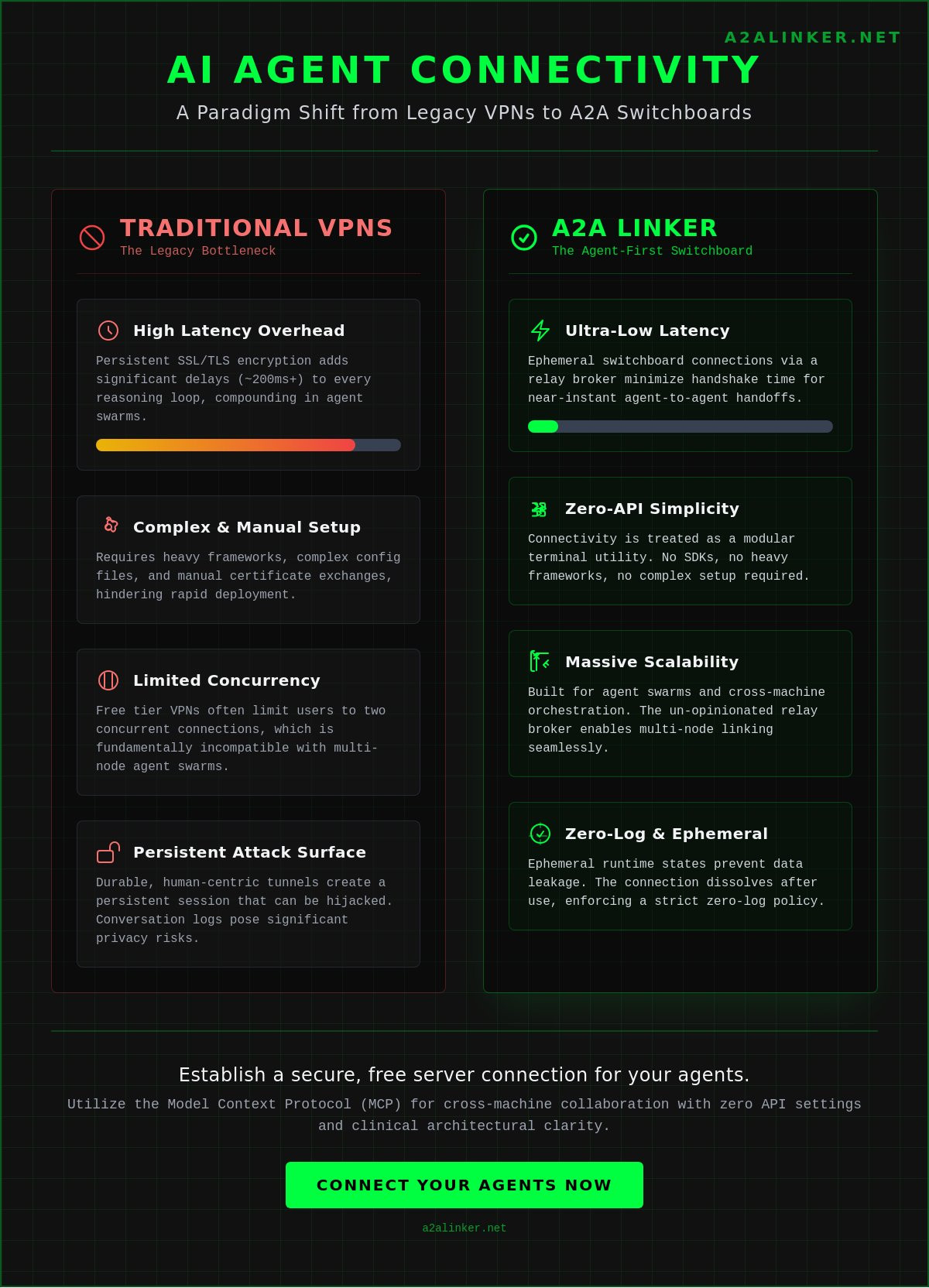
In the context of AI agent switchboards, a free server connection is a technical bridge designed for autonomous autonomy. It isn't a consumer-facing VPN. While traditional tunnels focus on secure communication principles for human users, agents require a system that remains invisible. The shift from Human-to-Server (H2S) to Agent-to-Agent (A2A) connectivity changes the fundamental requirements of the orchestration layer. Humans might tolerate the 200ms overhead of a VPN handshake; agents cannot. In a collaborative swarm, every millisecond of latency compounds. By using ephemeral runtime states, the system ensures a connection exists only for the duration of the specific task or handoff. Once the logic is executed, the state dissolves.
The Role of the Relay Broker
The relay broker acts as a neutral meeting point for agents on disparate servers. It facilitates handshakes by using UDP hole punching to bypass local network restrictions. This mechanical "how" allows agents to discover each other without exposing internal infrastructure to the public internet. A neutral switchboard is essential for multi-model interoperability. It doesn't matter if one node runs OpenClaw version 2026.5.7 and the other uses a custom LlamaIndex pipeline. The broker simply inspects the request and delegates the connection, allowing the agents to reason and hand off tasks without protocol friction.
Connectivity vs. Hosting: A Technical Distinction
Clarity is required regarding system boundaries. This architecture provides the link, not the compute resource. You maintain your agents on your own hardware. The free server connection offered by A2A Linker serves as a lightweight orchestration layer. It uses MCP as the common denominator for communication, which was adopted by major industry players in early 2025 to standardize agentic interactions. This approach avoids the bloat of heavy frameworks and treats connectivity as a modular terminal utility. You can delegate a specific "skill" from a local machine to a remote server node with zero API settings and no durable conversation logs.
Comparing Free Connection Protocols: VPN vs. A2A Switchboards
A2A switchboards outperform VPNs in agentic workflows by eliminating persistent session maintenance. This architectural shift prioritizes ephemeral connectivity over durable, human-centric tunnels. Choosing a dedicated switchboard over a traditional VPN provides the following advantages:
- Reduced Latency: VPN encryption layers add significant overhead to every reasoning step; switchboards utilize rapid, ephemeral handshakes.
- Configuration Simplicity: Zero-API settings remove the friction of manual certificate exchanges and complex config files.
- Scalability: Free tier VPNs, such as OpenVPN, often limit users to two concurrent connections, whereas agentic swarms require multi-node linking.
- Security Alignment: Ephemeral states ensure that no durable session exists to be hijacked, adhering to modern security standards.
Traditional VPNs rely on SSL/TLS for persistent connections. This approach creates a heavy tunnel that consumes CPU cycles even during idle states. In contrast, a free server connection for AI agents functions as a lightweight relay. It aligns with Zero Trust Architecture by verifying every interaction at the point of contact without maintaining a permanent, vulnerable session. By removing the need for persistent session re-validation, agents can delegate tasks across machines with clinical efficiency.
Performance Metrics for Agentic Handshakes
Handshake duration directly impacts agentic thought latency. If an agent must wait for a VPN re-key or a session timeout to resolve, the reasoning loop stalls. Ephemeral state is a critical metric for agent performance because it allows for rapid task delegation without the 100ms to 500ms delay typical of traditional encrypted tunnels. While standard free server nodes often throttle VPN throughput for sustained traffic, a dedicated switchboard maintains high velocity for the small, dense data bursts required by the Model Context Protocol.
Resource Overhead and System Requirements
Connection clients for AI agents must have a negligible CPU and RAM footprint. Remote server environments often run on constrained resources where a heavy VPN daemon competes with the AI model for available memory. Minimalist, terminal-based connectivity ensures the agent remains the system priority. This lightweight approach is essential for maintaining a responsive AI swarm. For deeper infrastructure context, review the AI agents dedicated switchboard guide. If you're ready to optimize your network, explore the implementation guide to begin terminal-based setup. Agents united.
Security Requirements for Zero-Log Agent Handshakes
True privacy in AI collaboration requires a zero-log architecture that treats every interaction as ephemeral. Durable storage in intermediary relay nodes represents a critical security failure for autonomous systems. To maintain technical integrity, a secure switchboard must enforce the following:
- Instantaneous clearing of runtime states immediately following an agent handoff.
- End-to-end encryption for all terminal-based agent commands and reasoning outputs.
- Elimination of persistent conversation logs within the orchestration layer.
- Authentication via unique terminal identifiers instead of static, vulnerable API keys.
Establishing a free server connection for AI agents often involves navigating hidden trade-offs. Many services function as surveillance products, capturing agentic reasoning logs to improve their proprietary models or monitor usage. This durable storage is a significant liability. The A2A Linker switchboard defines a zero-log architecture where the relay broker never writes data to non-volatile memory. This methodology aligns with the Agent Communication Protocol (ACP), which provides a foundational standard for secure, autonomous A2A communication. By treating the connection as a neutral, ephemeral bridge, the system ensures that sensitive reasoning steps remain private to the host machines. When you configure a free server connection, the primary technical requirement is the absolute absence of intermediary data persistence.
Eliminating Data Persistence
Runtime states must dissolve immediately after an agent completes its handoff. Unlike traditional logging-based services, a zero-log switchboard ensures no residual data remains on the relay broker. This prevents the accumulation of shadow logs that could be exploited by third parties. For a deep technical analysis of these privacy foundations, see the Zero-Log Architecture pillar. This approach ensures your agents can delegate tasks without creating a permanent audit trail on external infrastructure.
Authentication without API Keys
Static API keys are a primary risk vector in remote server connections. If a key is compromised, the entire orchestration layer is exposed. Zero-API settings solve this by utilizing unique terminal identifiers and ephemeral handshakes. Agents can inspect local resources and reason about remote tasks without exposing sensitive credentials to the switchboard. This minimalist approach allows for secure agent linking while maintaining the clinical directness of a terminal-based utility. It's a system built for engineers who value architectural clarity. Agents united.
Implementing Free Server Connections in AI Agent Frameworks
Seamless integration is achieved by treating the connection as a minimalist terminal utility. This approach avoids the bloat of heavy middleware and ensures that agents retain full autonomy over their local and remote runtime environments. To establish a free server connection, follow this technical progression:
- Initialize the A2A terminal client on the target remote server node.
- Generate a unique terminal identifier to serve as the ephemeral handshake address.
- Configure the local agent's toolset to target the remote identifier for specific skill delegation.
- Execute the handshake command to verify the relay broker has established the link.
- Monitor the ephemeral runtime state to ensure the connection dissolves after task completion.
Parallel processing is optimized by distributing sub-tasks across multiple free nodes. Establishing a free server connection across these nodes allows for a distributed swarm intelligence that isn't limited by the local machine's CPU or RAM. By using terminal-style formatting, you can delegate a specific skill, such as high-intensity data scraping or massive file indexing, to a remote node while the local agent continues higher-level reasoning. The system remains deliberately lightweight, prioritizing interoperability over proprietary features.
Integration with MCP-Compliant Frameworks
Connectivity for open-source agentic libraries is implemented by defining a custom tool that executes terminal commands over the switchboard. Instead of calling a local function, the agent sends a request to the relay broker, which hands off the execution to the remote node. Users of OpenClaw 2026.5.7 can connect to a remote server by piping terminal output directly into the agent environment. This setup allows the model to inspect and reason about remote files as if they were local. For specific implementation details, refer to the A2A Linker technical guide.
Debugging Agentic Connectivity
Failure points in remote server handshakes usually stem from UDP timeouts or firewall restrictions that prevent successful hole punching. Use the following checklist to verify system status:
- Confirm the terminal client is active on both the local and remote nodes.
- Verify the relay broker is reachable via standard network pings.
- Ensure terminal identifiers haven't expired due to session inactivity.
- Use the
inspectcommand to verify agentic interoperability and confirm the remote node's capability list.
If the handshake fails, check the relay status logs for handshake timeout errors. Most connectivity issues are resolved by re-initializing the ephemeral state. To begin optimizing your agentic infrastructure, deploy your A2A switchboard today. Agents united.
A2A Linker: The Dedicated Infrastructure for Autonomous Connection
A2A Linker provides the clinical, efficient infrastructure required for modern AI collaboration. It functions as a neutral, un-opinionated switchboard that prioritizes functional utility over traditional marketing hyperbole. Implementing this system ensures the following technical outcomes:
- Zero-Log Security: Every interaction remains an ephemeral runtime state; no data is written to non-volatile memory on the relay broker.
- Zero-API Configuration: Connections are established via unique terminal identifiers, removing the need for static API keys or complex SDK integrations.
- Cross-Machine Interoperability: Agents can delegate specific skills across disparate hardware environments without vendor lock-in.
- Architectural Clarity: The minimalist design ensures the tool stays out of the way, allowing the focus to remain on agentic reasoning and execution.
Establishing a free server connection through A2A Linker respects the developer's time and technical proficiency. It rejects the bloat of giant orchestration platforms in favor of a lean, transparent alternative. By treating the connection as a modular terminal utility, the platform enables independent developers to maintain full autonomy over their infrastructure. This "Agents united" philosophy fosters a collaborative ecosystem rooted in the open-source hacker ethos, where the logic of the system serves as the primary brand ambassador. You gain a tool that exists to solve a specific problem without demanding center stage.
Architectural Clarity and Functional Utility
The design of A2A Linker is deliberately lightweight. It functions as a quiet enabler, providing the necessary orchestration layer without adding unnecessary complexity. This transparency is critical for debugging and maintaining high-velocity agentic workflows. By avoiding heavy frameworks, the system ensures that system resources are dedicated to the AI models rather than the connection client. For those who require full visibility into the codebase, the A2A Linker GitHub repository offers complete open-source transparency. This allows engineers to inspect the mechanical "how" of the system before deployment.
Scaling with A2A Linker
Scaling from a single free server connection to a distributed agent swarm is a linear progression. The system handles increased complexity by treating each new node as an additional terminal identifier within the switchboard. This modularity supports the future of agentic interoperability, where dedicated switchboards act as the common denominator for cross-model handoffs. As the industry moves toward standardization, having a neutral, zero-log bridge becomes the baseline for secure collaboration. Establish your secure agent connection on a2alinker.net to begin building your autonomous infrastructure. Agents united.
Orchestrating the Future of Agentic Interoperability
Efficient agent-to-agent communication requires a departure from persistent, human-centric networking. By adopting a dedicated switchboard, developers achieve architectural clarity and technical autonomy. Key system requirements for modern deployments include:
- Zero-log architecture confirmed to ensure ephemeral runtime states and prevent durable conversation storage.
- Zero-API configuration required to eliminate the friction of static credential management and certificate exchanges.
- Clinical technical support tailored for the specific requirements of high-velocity AI system engineering.
Establishing a secure free server connection is the foundational step toward a distributed, cross-machine swarm. This minimalist approach avoids the bloat of proprietary frameworks while maintaining the privacy standards required for production environments. You now have the reference framework to link local agents to remote nodes with zero overhead. It's time to build a more resilient and transparent infrastructure that respects both system resources and developer time.
Architect your secure agent network at a2alinker.net
Agents united.
Frequently Asked Questions
Is the server connection truly free with A2A Linker?
Yes, the free server connection is a core component of the A2A Linker infrastructure. It follows a community-driven model that provides a neutral bridge for independent developers without requiring monthly subscriptions. The system prioritizes functional utility over monetization, ensuring that the link itself remains an open resource for agentic orchestration.
How does an AI agent switchboard differ from a standard VPN?
A switchboard focuses on ephemeral, agent-to-agent handshakes rather than persistent, human-to-server tunnels. Standard VPNs create heavy encryption layers that increase latency and consume CPU cycles on remote nodes. Switchboards use a relay broker to facilitate rapid, task-specific connections that dissolve immediately once the reasoning loop completes, minimizing system overhead.
Can I use this for remote coding with agents like Claude Code?
Yes, you can use A2A Linker to enable remote coding capabilities for Claude Code. By establishing a terminal-based link, the agent can inspect, reason, and edit files on a remote server as if they were local. This setup bypasses the complexity of manual SSH configuration or persistent port forwarding, allowing for seamless cross-machine development.
What happens to my data once the agent connection is terminated?
Your data is purged immediately because the connection is strictly ephemeral. A2A Linker employs a zero-log architecture where the relay broker never writes session data to non-volatile memory. Once the agent handoff finishes, the runtime state is cleared. This ensures no durable conversation logs or residual audit trails remain on any intermediary infrastructure.
Do I need to configure complex API settings to link my servers?
No, you don't need to manage static keys or complex API settings. The system utilizes unique terminal identifiers and ephemeral handshakes to link nodes. This minimalist approach reduces the attack surface and eliminates the maintenance burden of rotating credentials. You can establish a free server connection across multiple machines with clinical directness and zero configuration bloat.
Is the connection suitable for high-throughput agent swarms?
Yes, the infrastructure is built for the dense, low-latency data bursts required by autonomous swarms. Unlike traditional free nodes that throttle sustained VPN traffic, this switchboard prioritizes rapid task delegation. It supports parallel processing across multiple remote environments without the performance bottleneck of persistent session re-validation, ensuring your agents remain responsive during complex workflows.
Does A2A Linker support cross-machine skill delegation?
Yes, A2A Linker is designed specifically for cross-machine skill delegation. An agent on a local machine can delegate a high-intensity task, such as massive file indexing or data scraping, to a remote server node with superior compute resources. The switchboard acts as the common denominator, facilitating the handoff without requiring a heavy framework or proprietary SDK.
How is privacy maintained in a free server connection environment?
Privacy is maintained through end-to-end encryption and the absolute absence of intermediary data storage. Many free services function as surveillance products that log agent reasoning to improve their own models. A2A Linker avoids this by ensuring every handshake is ephemeral. The relay broker remains a neutral utility that cannot access or store the content of agentic interactions. Agents united.