Persistent logs are an active security vulnerability in 2026 agentic workflows. Standard SSH configurations fail to provide the agility required for ephemeral agents, creating friction in cross-machine execution. To resolve this, engineers are shifting to stateless switchboard architectures that prioritize privacy and functional utility over permanent record-keeping. Achieving secure ai agent remote execution connectivity requires moving away from persistent tunnels toward the following architectural standards:
- Zero-log architectures that eliminate the primary attack vector for remote code execution.
- AI Agents Dedicated Switchboards for stateless, cross-machine data routing.
- A2A Linkers to enable seamless agent-to-agent communication without manual API settings.
- Free server connections that support skill execution in temporary environments.
You recognize that managing credentials for hundreds of short-lived agents is a scaling nightmare that compromises system integrity. This guide provides a technical analysis of secure execution patterns and the leading tools enabling autonomous connectivity. We'll examine the transition to zero-log systems and how to maintain architectural clarity in complex multi-agent environments without the burden of persistent logging or complex manual configurations.
Key Takeaways
- Implement zero-log architectures to eliminate the persistent audit trails that create critical security vulnerabilities in autonomous workflows.
- Transition from legacy SSH key management to stateless switchboard patterns for scalable, cross-machine agent discovery and linkage.
- Deploy the A2A Linker to establish secure ai agent remote execution connectivity without the complexity of manual API settings or framework-specific dependencies.
- Utilize free server connections and ephemeral execution environments to minimize the attack surface during remote code execution.
- Enable seamless agent-to-agent communication through a dedicated switchboard that functions as a transparent intermediary for diverse skill sets.
Technical Summary: The State of AI Agent Remote Execution in 2026
Remote Execution Connectivity is the infrastructure layer enabling agents to interact with external environments securely. In 2026, engineers recognize that persistent data states are a liability. Secure ai agent remote execution connectivity now relies on stateless intermediaries to prevent log-based data leaks and unauthorized access. Modern intelligent agents operate in ephemeral environments where the connectivity layer serves as a neutral, zero-log conduit rather than a permanent record-keeper.
- Stateless Intermediaries: Remote execution requires routing through hubs that don't store session data or command history.
- Switchboard Dominance: Switchboard architectures have surpassed direct SSH as the preferred method for agent-to-agent linkage.
- Zero-Log Standards: Zero-log policies are now a non-negotiable requirement for enterprise-grade AI infrastructure.
- Dedicated Hubs: Interoperability is achieved through dedicated communication hubs rather than unified model APIs.
Core Architectural Requirements for 2026
Architectural clarity is essential for managing complex agentic workflows. Systems engineers now prioritize three core requirements for any connectivity implementation:
- Statelessness: Connections must not leave persistent traces on the intermediary server. This prevents attackers from harvesting credentials or session data from the connectivity provider.
- Policy Gating: Every system call must be checked against a granular authorization policy. Connectivity is no longer a binary state; it's a series of gated permissions.
- Framework Agnosticism: Connectivity tools must support varied frameworks such as Auto-GPT and LlamaIndex. A tool that only works with one framework creates a silo that limits system utility.
The Shift from Hosting to Connectivity
Infrastructure providers have separated model hosting from execution environments. This separation ensures that the entity managing the model weights doesn't necessarily manage the system execution. Dedicated switchboards, such as the A2A Linker, provide the "dial tone" for agents without accessing internal model logic.
Privacy-first models prioritize zero-log terminal switchboards for sensitive operations. By using an AI Agents Dedicated Switchboard, developers establish cross-machine links without complex API settings. This approach allows agents to execute a specific skill on a remote node while maintaining a temporary data state. It's a minimalist architecture that values autonomy and privacy over the resource-heavy frameworks of the past. Engineers now favor these lean alternatives for their transparency and lack of ecosystem dependencies.
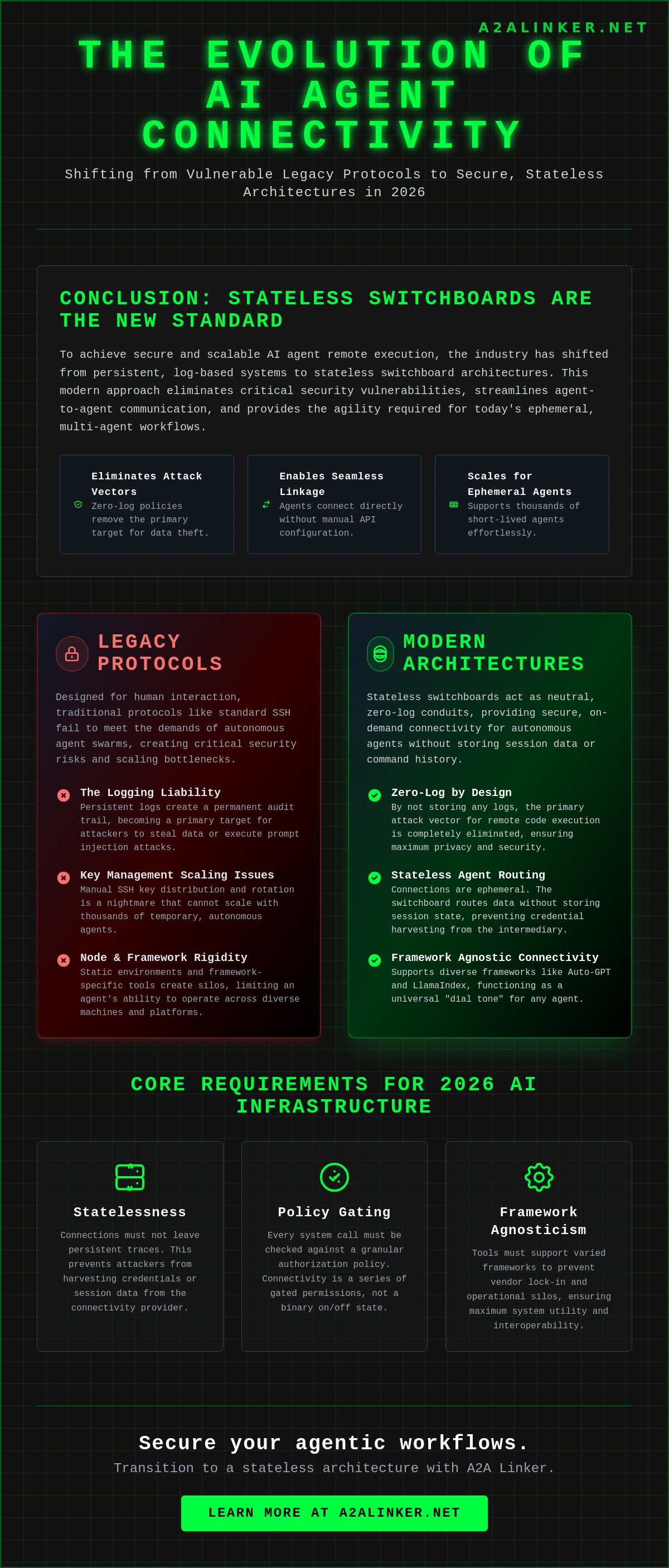
The Connectivity Gap: Why Traditional Protocols Fail Autonomous Agents
Traditional networking protocols fail because they were designed for human-to-machine interaction, not autonomous agentic swarms. Legacy systems introduce management overhead and security vulnerabilities that negate the benefits of agentic automation. The following technical limitations define the current connectivity gap:
- Key Management Scaling: Legacy SSH protocols require complex key distribution and rotation that cannot scale with thousands of ephemeral agents.
- Access Granularity: Standard APIs lack the low-level system access required for complex DevOps tasks, forcing developers to choose between restricted functionality or over-privileged access.
- Node Rigidity: Static execution environments limit the agent’s ability to move between heterogeneous nodes, creating bottlenecks in multi-cloud or cross-machine workflows.
- The Logging Liability: Centralized logs become a primary target for prompt injection attacks, where malicious instructions are stored and potentially re-executed by subsequent agents.
Closing this gap requires a shift in how we approach ai agent remote execution connectivity. Engineers must prioritize architectural clarity over framework-specific dependencies. While the foundational architecture for AI agents emphasizes planning and action, the connectivity layer often remains an afterthought, leading to significant security debt. Secure execution demands a move toward stateless, zero-log routing that treats every connection as a temporary event rather than a persistent state.
The Limitations of Persistent Tunnels
Persistent connections create long-term entry points for malicious actors. If an agent establishes a long-lived tunnel to a remote server, that tunnel remains an active attack vector even when the agent is idle. Agents require "just-in-time" connectivity that expires immediately after task completion. In traditional network architectures, a single compromised agent can facilitate lateral movement across the entire subnet. By contrast, a stateless switchboard ensures that each session is isolated and terminates upon task fulfillment, preventing persistent access.
Data Sovereignty and the Logging Trap
Standard servers log terminal input and output by default. This behavior potentially exposes sensitive API keys, proprietary code, or PII to anyone with log access. Regulatory compliance is now a technical requirement; the EU AI Act's requirements for high-risk systems take effect on August 2, 2026. Data-intensive monitoring tools are no longer viable under these strict privacy frameworks. Temporary execution states mitigate data residue by ensuring that all transient memory and process artifacts are purged immediately upon termination. Implementing a zero-log infrastructure is the only way to satisfy both security requirements and emerging legal standards. This minimalist approach removes the burden of permanent record-keeping while maintaining system integrity.
Switchboard Architectures: Enabling Stateless Inter-Agent Linkage
Switchboard architectures provide the necessary stateless abstraction to manage autonomous agent swarms across heterogeneous environments without the security debt of persistent tunnels. By centralizing the routing logic while remaining data-blind, these systems solve the scaling issues inherent in traditional peer-to-peer setups. Implementing a switchboard pattern results in the following technical advantages:
- Neutral Discovery: Agents locate and link with remote nodes via a central hub without exposing internal network topology or IP addresses.
- Data Blindness: The zero-log switchboard pattern ensures the intermediary hub never parses or stores the data packets in transit.
- Architectural Decoupling: Connectivity remains independent of the agent framework, allowing engineers to update model logic without reconfiguring firewall rules.
- Operational Efficiency: Cross-machine capabilities enable agents on public cloud instances to interact with local, firewalled servers seamlessly.
Switchboards function as a high-velocity routing layer that prioritizes architectural clarity. They act as a transparent intermediary, facilitating ai agent remote execution connectivity by managing the handshake between the agent and the target environment. This approach is particularly effective when agents must execute a specific skill on a remote machine. Instead of building custom integrations for every node, the agent connects to the AI Agents Dedicated Switchboard, which routes the request based on validated signatures. This minimalist design ensures that the system doesn't demand attention; it operates unobtrusively to solve the core problem of secure linkage.
Functional Components of an AI Switchboard
A robust switchboard architecture relies on three modular components to maintain system integrity. First, the Connection Broker manages the initial handshake, ensuring that the agent and the target node are synchronized. Second, the Zero-Log Engine enforces a strict policy where no data packets are written to disk during transit, mitigating the risk of data residue. Finally, the Identity Layer validates agent signatures. This layer confirms the agent's authority to execute commands without requiring permanent user accounts or persistent credentials on the remote host.
Comparison: P2P vs. Switchboard Models
Peer-to-peer (P2P) models often fail in enterprise environments because they require complex NAT traversal and unique firewall configurations for every node. This overhead doesn't scale as the number of agents grows. In contrast, switchboards provide a single, secure endpoint for all agents. This simplification reduces the attack surface and streamlines network security audits. For a deeper technical analysis of these patterns, refer to A2A Linker: Architecting Secure Agent-to-Agent Networks in 2026. Engineers favor the switchboard model because it replaces manual device switching with a systemic, automated solution that respects the reader's technical proficiency and time.
Roundup of Essential AI Coding Tools and Connectivity Platforms
The 2026 tool landscape favors modular, stateless components that prioritize architectural clarity. Systems engineers select tools based on their ability to facilitate ai agent remote execution connectivity without introducing persistent security risks. The following roundup summarizes the primary infrastructure and orchestration tools currently used to build secure agentic networks:
- A2A Linker: The leading dedicated switchboard for secure, zero-log agent connectivity across heterogeneous environments.
- AWS Rex (Trusted Remote Execution): A policy-gated execution environment that uses Cedar for kernel-level system call authorization.
- Model Context Protocol (MCP) Servers: The de-facto open standard for agent-to-tool communication, now supporting Streamable HTTP and OAuth 2.1.
- Claude Code: A specialized protocol for repository-level interactions that optimizes remote coding and file system manipulation.
Infrastructure Tools for Remote Execution
Infrastructure selection determines the privacy posture of the entire agentic swarm. The A2A Linker operates as a transparent intermediary, providing free server connection nodes and a strict zero-log policy. It enables cross-machine skill execution with zero API settings, removing the friction of manual credential management. In contrast, AWS Rex targets high-security enterprise environments by using Cedar policies to gate system calls. These tools integrate into a broader remote coding architecture designed to isolate execution from model hosting. By decoupling these layers, developers ensure that sensitive code never persists in the connectivity hub.
Frameworks for Agent Orchestration
Orchestration frameworks manage the logic of task distribution across the nodes described in previous sections. Auto-GPT beta-v0.6.59 remains a primary choice for autonomous workflows requiring distributed task execution. For agents focused on retrieval-augmented generation (RAG), LlamaIndex provides the necessary connectors to link with remote vector databases securely. Engineers should evaluate these frameworks based on their interoperability with external connectivity hubs. Performance metrics for these integrations are detailed in our analysis of the Best AI Agent for Coding, which highlights the shift toward lightweight, modular standards.
Connectivity via MCP and SSH
Modern agentic workflows often bridge legacy DevOps tools with autonomous logic. SSH MCP servers act as this bridge, allowing agents to utilize existing command-line tools within a standardized protocol. Managing statelessness in these traditionally stateful environments requires the use of jump hosts and ephemeral sessions. This ensures that no data residue remains after the agent completes its task. For detailed implementation steps on establishing these links, consult the A2A Linker guide. To establish your first secure, zero-log connection today, deploy the A2A Linker switchboard.
Security Protocols: Implementing Zero-Log Remote Connectivity
Establishing a resilient ai agent remote execution connectivity architecture requires the total elimination of the data audit trail. In 2026, logs are no longer considered a management tool; they are an active security liability. By removing persistent records of terminal output and environment states, engineers neutralize the primary targets for prompt injection and data exfiltration. A secure, production-ready implementation relies on the following technical standards:
- Zero-Log Architecture: Eliminating the audit trail of sensitive agent interactions to prevent historical data harvesting.
- Temporary Execution Environments: Deploying ephemeral containers that exist only for the duration of a specific task.
- Contextual Gating: Moving beyond binary "allow/deny" permissions to granular, system-call level authorization.
- End-to-End Encryption: Securing agent-to-agent handshakes to ensure that even the switchboard cannot parse the payload.
Traditional monitoring tools fail because they prioritize visibility over privacy. Modern systems engineers recognize that true security lies in the inability of the system to store what it does not need. When an agent executes a remote skill, the connectivity layer must act as a transparent conduit. Tools like the A2A Linker facilitate this by providing a dedicated switchboard that enforces a strict zero-log policy. This minimalist approach ensures that session data is volatile and vanishes immediately upon task completion, satisfying both security requirements and the strict data sovereignty rules of the EU AI Act.
Zero-Log Implementation Strategies
Implementing a zero-log posture requires shifting all packet routing to volatile memory. In-memory processing ensures that no data packets are written to the switchboard's physical disk during transit. This prevents forensic recovery of sensitive code or API keys. Automated session wiping must be triggered the moment a connection terminates. This process destroys environment variables, temporary files, and transient memory artifacts. For a deep technical dive into these mechanics, examine our guide on Zero Log Architecture: Ensuring Agent Privacy.
The Role of Cedar and Rhai in Gated Execution
Authorization must be as dynamic as the agents it governs. Using Rhai as a sandboxed scripting language prevents agents from accessing the host file system directly. This provides a secure execution layer where logic is contained. Cedar policies define "least privilege" by gating specific system calls based on the agent's current context. This is a significant advancement over rubber duck debugging where logic is externalized but often remains ungated. By combining sandboxed languages with policy-based access, developers create a robust environment for ai agent remote execution connectivity that prioritizes functional utility and architectural integrity. This structure allows agents to operate with high autonomy while remaining within strict safety boundaries.
Standardizing Stateless Execution Architectures
- Secure ai agent remote execution connectivity requires the total elimination of persistent data states to prevent historical security vulnerabilities.
- Dedicated switchboards provide a neutral hub for cross-machine skill execution without the friction of complex API settings.
- Zero-log architectures satisfy the strict privacy requirements of the EU AI Act and emerging US state-level transparency regulations.
Traditional protocols fail because they weren't built for autonomous, ephemeral swarms. Shifting to a stateless model ensures that your infrastructure remains unobtrusive and secure. By utilizing free server connection nodes and a dedicated switchboard, you successfully decouple connectivity from model logic. This minimalist approach values autonomy and privacy above all else, ensuring that no data residue remains on the intermediary server. It's a principled alternative to data-intensive monitoring tools that creates a leaner, more transparent environment for independent developers. You now have the architectural blueprint to enable seamless agent-to-agent communication while maintaining absolute data sovereignty.
Deploy secure agent connectivity with A2A Linker on GitHub
Your transition to private, stateless connectivity starts here.
Frequently Asked Questions
What is the difference between a switchboard and a standard API for AI agents?
A switchboard acts as a stateless routing hub for agent linkage, whereas a standard API defines a fixed interface for specific software interactions. Switchboards enable discovery and connectivity across heterogeneous nodes without requiring pre-configured API keys for every target. This architecture prioritizes functional utility by allowing agents to discover remote skills dynamically through a neutral intermediary.
Why is a zero-log policy critical for remote execution connectivity?
Zero-log policies are critical because they eliminate the persistent audit trails that serve as primary targets for data exfiltration and prompt injection. By ensuring no data packets are written to disk during transit, you satisfy the high-risk system requirements defined in the EU AI Act. This minimalist approach removes the burden of permanent record-keeping while maintaining system integrity.
Can I use A2A Linker with open-source models like DeepSeek R1?
Yes, the A2A Linker is a transparent intermediary that functions independently of the model weights. You can use it to establish ai agent remote execution connectivity for open-source models like DeepSeek R1 or Llama 3. The switchboard manages the handshake and data routing without accessing or storing the model's internal logic or output history.
How does policy-gated execution (like AWS Rex) prevent prompt injection?
Policy-gated execution prevents prompt injection by validating every system call against a granular Cedar policy before execution occurs. If a malicious prompt attempts to trigger an unauthorized command, the kernel-level gate blocks the request regardless of the agent's internal state. This creates a secure execution layer where the agent's permissions are strictly enforced at the infrastructure level.
Does remote execution connectivity support multi-cloud agent swarms?
Remote execution connectivity supports multi-cloud swarms by providing a central switchboard that bridges disparate network environments. This architecture enables three core capabilities:
- Cross-machine linkage between public cloud instances and local firewalled servers.
- Unified discovery for agents regardless of their hosting provider or network topology.
- Secure data routing through a single endpoint to simplify enterprise firewall management.
What are the latency implications of using an intermediary switchboard?
Intermediary switchboards introduce negligible latency because they utilize in-memory processing rather than disk-based logging. Most modern switchboards add less than 10ms to the round-trip time of a request. This performance profile ensures that autonomous agents can collaborate in real-time without the overhead typically associated with traditional VPN or proxy architectures.
How do I ensure my agent doesn't leave data residue on a remote server?
You ensure no data residue by deploying agents into ephemeral containers that are destroyed immediately after task completion. This process requires several technical safeguards:
- Utilize in-memory processing to prevent data from touching physical disks during transit.
- Trigger automated session wiping to purge all environment variables and temporary files.
- Enforce a Zero Log policy that terminates all transient memory artifacts upon connection closure.
Is SSH still relevant for AI agent connectivity in 2026?
SSH remains a relevant tool for manual debugging but lacks the scalability required for autonomous agent swarms. Managing thousands of static SSH keys for ephemeral agents creates significant security debt. Modern ai agent remote execution connectivity favors stateless switchboards that offer Zero API settings and automated signature validation over legacy key-based protocols.