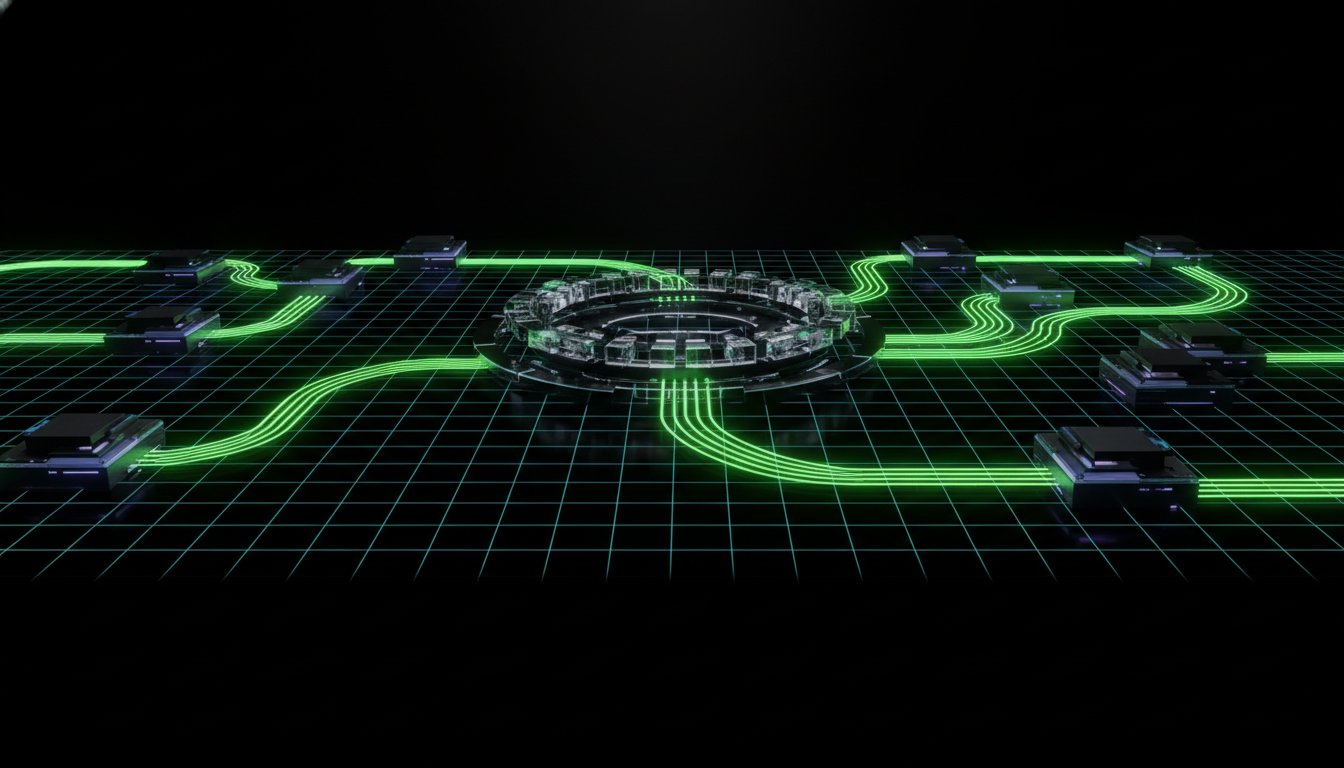
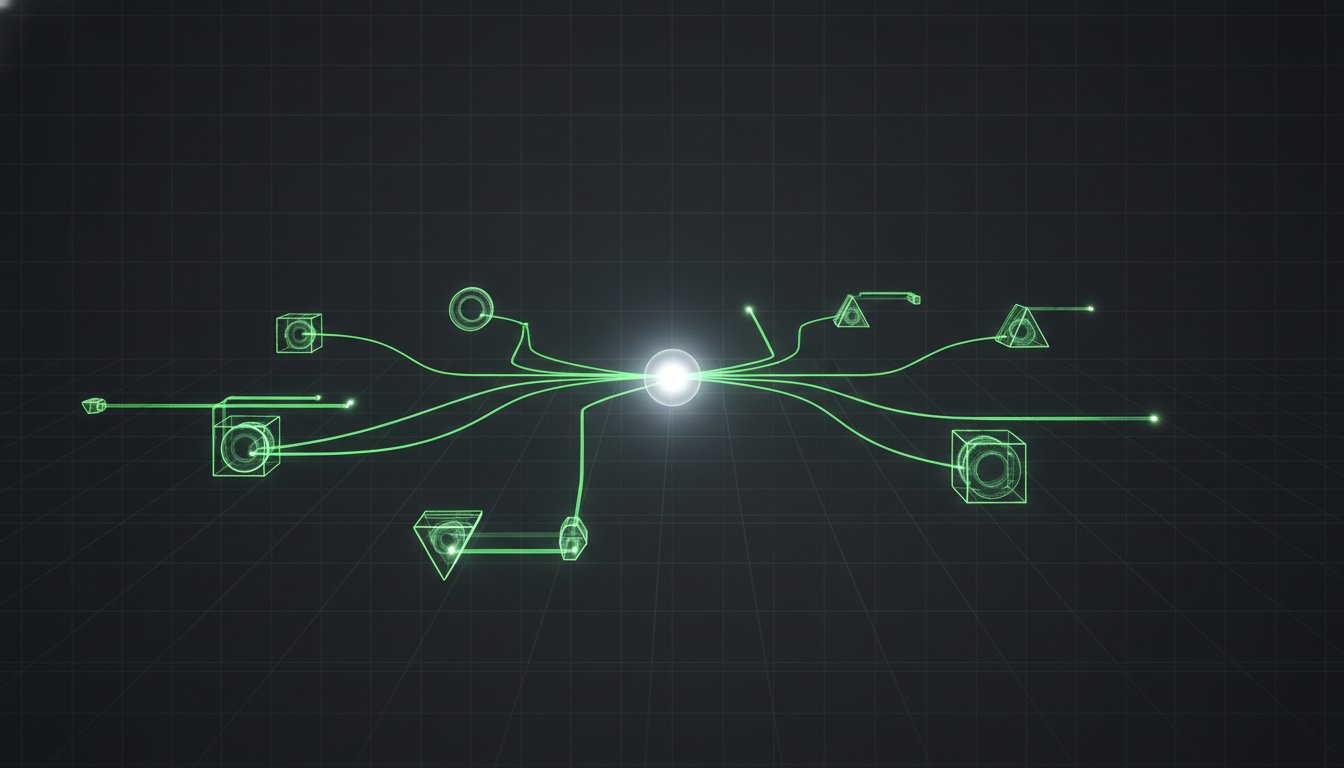
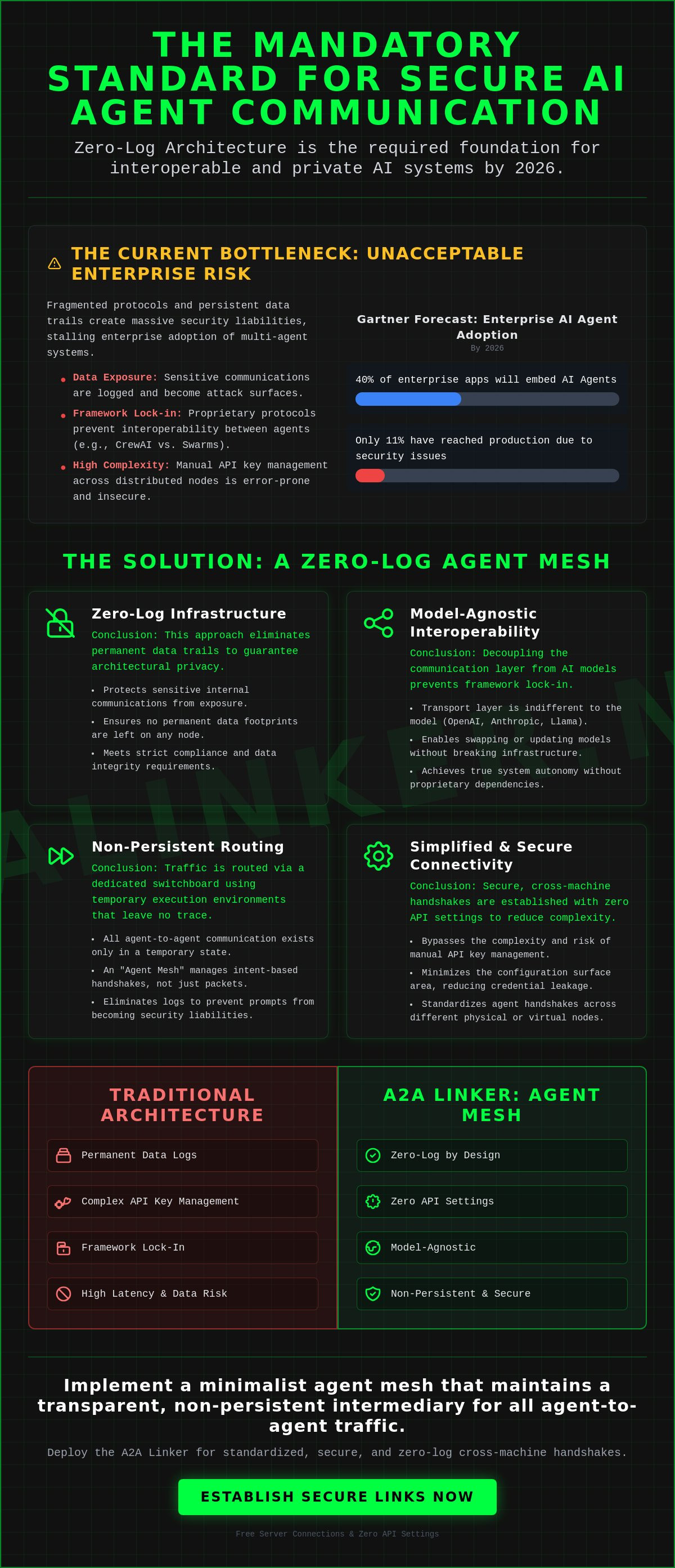
Establishing secure communication between ai agents requires a zero-log, model-agnostic switchboard that eliminates permanent data trails and protocol fragmentation. Gartner forecasts that 40% of enterprise applications will feature embedded AI agents by 2026, yet only 11% have reached production environments due to unresolved security bottlenecks. You likely find that fragmented protocols between frameworks like CrewAI and Swarms create unacceptable risks for sensitive enterprise data. This guide establishes a standardized, cross-machine infrastructure for secure agent handshakes without framework lock-in. We will examine the implementation of non-persistent routing and the elimination of complex API configurations.
Modern agent architecture must prioritize the following technical requirements to ensure operational integrity:
- Deployment of an A2A Linker for standardized cross-machine handshakes.
- Utilization of an AI Agents Dedicated Switchboard to route traffic without data retention.
- Implementation of zero-log infrastructure to protect sensitive internal communications.
- Activation of free server connections with zero API settings to reduce node-level complexity.
- Integration of NIST-aligned standards for secure, interoperable agent coordination.
- Focus on minimalist connectivity that avoids restrictive ecosystem dependencies.
Key Takeaways
- Zero-log architecture is the mandatory standard for secure communication between ai agents in 2026 to ensure architectural privacy and model-agnostic interoperability.
- Deploy an AI Agents Dedicated Switchboard to manage cross-machine coordination without permanent data footprints or framework lock-in.
- Establish a Free Server Connection using zero API settings to bypass the technical complexity of manual key management across distributed nodes.
- Integrate the A2A Linker to implement a minimalist agent mesh that maintains a transparent, non-persistent intermediary for all agent-to-agent traffic.
Technical Conclusion: The State of Secure AI Agent Communication
Zero-log architecture is the mandatory standard for secure communication between ai agents in 2026. Interoperability requires decoupling the communication layer from specific models to prevent framework lock-in. Traditional API gateways are insufficient; they introduce latency and persistent data risks that enterprise environments cannot tolerate. Effective coordination now relies on the following architectural pillars:
- Non-persistent routing: Communication must occur through temporary execution environments that leave no trace.
- Model-agnosticism: The transport layer must remain indifferent to whether it routes data for OpenAI, Anthropic, or local Llama instances.
- Transport-layer authentication: Identity must be bound to the protocol execution itself rather than external management tools.
- Cross-machine handshakes: Distributed swarms require standardized methods for agents to link across different physical or virtual nodes.
The evolution of Agent Communication Language (ACL) has shifted from theoretical frameworks to functional, low-latency switchboards. Modern systems move beyond the service mesh into a dedicated "Agent Mesh" where intent and context exchange happen without permanent record-keeping. This transition addresses the primary failure point of 2025 implementations: the reliance on centralized logging that created massive security liabilities.
Summary of Modern Security Requirements
Architects must eliminate permanent record-keeping through strict zero-log policies. This is a requirement for compliance and data integrity. Distributed agent swarms require robust cross-machine connectivity to function across cloud and edge environments. Using a model-agnostic switchboard ensures that your infrastructure remains functional even as underlying models are swapped or updated. This decoupling is the only way to achieve true system autonomy without the friction of proprietary ecosystem dependencies.
Recommended Implementation Path
System engineers should prioritize tools that offer zero API settings. This approach minimizes the configuration surface area and reduces the risk of credential leakage. Select infrastructure like the A2A Linker that supports remote server connections without requiring managed hosting. This preserves the developer's control over the execution environment. Audit every communication node to verify that data exists only in temporary states. You can find detailed configuration steps in the A2A Linker guide to begin establishing secure, non-persistent agent links immediately.
Architectural Requirements for Secure Agent-to-Agent Interaction
Secure communication between ai agents requires an "Agent Mesh" architecture that prioritizes zero-log persistence and delegated authority over traditional service mesh models. Traditional TLS/SSL protocols are insufficient for reasoning-based communication because they secure the transport pipe without validating the semantic intent of the payload. Effective A2A interaction depends on the following architectural standards:
- Agent Mesh implementation: Moving beyond L4/L7 routing to manage intent-based handshakes between disparate frameworks.
- Non-persistent intermediaries: Eliminating communication logs to prevent sensitive prompt data from becoming a permanent security liability.
- Contextual authorization: Implementing delegated authority that persists across cross-machine nodes without local API key storage.
- Semantic transport: Ensuring that the communication layer understands agent intent without compromising the privacy of the underlying model.
Traditional connectivity solutions focus on packet delivery, but autonomous agents require context-aware handshakes. In a multi-agent environment, the "intent" of a request is as critical as the identity of the sender. An Agent Mesh provides a layer of abstraction that allows for complex context exchange while maintaining a zero-log posture. This architecture prevents data leakage during the high-throughput coordination required for enterprise tasks. For a deeper analysis of how these protocols differ, refer to the IBM on Agent Communication Protocol documentation, which outlines the shift toward intent-based routing.
Identity and Delegated Authority
Delegated authorization allows an agent to act on behalf of a user or another system without direct access to root credentials. This is vital in distributed environments where agents span multiple server nodes. Permissions must be scoped to specific tasks and verified at the transport layer. You should ensure identity persistence through cryptographically signed tokens that don't store prompt data. This approach maintains a clear audit trail of authority without exposing the intellectual property contained within agent reasoning cycles.
Infrastructure vs. Protocol
It's necessary to distinguish between the communication protocol and the physical transport infrastructure. While a protocol defines the language of the handshake, the infrastructure determines the security of the execution environment. A dedicated AI Agents Dedicated Switchboard acts as a transparent intermediary, routing traffic without persistence. Zero-log architecture is a prerequisite for any enterprise-grade deployment involving secure communication between ai agents. It ensures that even if a node is compromised, historical data remains inaccessible. You can implement this minimalist approach by following the A2A Linker guide, which focuses on establishing secure, cross-machine links with zero API settings.
Protocol Comparison: MCP, ACP, and Zero-Log Switchboards
Zero-log switchboards provide the necessary architectural isolation to facilitate secure communication between ai agents without the data persistence risks inherent in traditional API hubs. While protocols like MCP and ACP define the logic of interaction, the physical transport layer requires a non-persistent intermediary to ensure enterprise-grade privacy. The following comparison highlights the functional differences in current standards:
- Model Context Protocol (MCP): Primary utility lies in tool-agent integration, though it frequently introduces model-specific dependencies that complicate multi-vendor environments.
- Agent Communication Protocol (ACP): Optimized for intent-based routing across diverse agent frameworks but lacks inherent protections against centralized logging.
- Zero-Log Switchboard: Acts as a transparent, non-persistent intermediary that eliminates centralized record-keeping by design.
- Framework Compatibility: Enables standardized handshakes between CrewAI, Swarms, and LlamaIndex nodes without requiring proprietary SDKs.
The current landscape of IETF AI agent security requirements highlights the necessity of decoupling identity from the application layer. Moving authentication to the transport layer allows systems to achieve higher resilience against credential exposure. This architectural shift is critical when managing high-throughput agent swarms that operate across disparate server environments.
MCP and A2A Protocol Performance
Standardized protocol handshakes often face latency bottlenecks when the communication layer is tightly coupled with a specific AI model. Benchmarks show that model-dependent layers increase the computational overhead for every handshake. You'll find detailed orchestration strategies in the Multi-Agent System (MAS) connectivity guide. Eliminating these bottlenecks requires a transport layer that prioritizes throughput over data collection. A minimalist approach ensures that reasoning cycles aren't delayed by heavy metadata processing or persistent state management.
Switchboard Architecture Benefits
An AI Agents Dedicated Switchboard removes the operational friction of managing complex API settings across multiple nodes. This infrastructure supports cross-machine execution, allowing parallel processing tasks to scale across disparate server environments without local data retention. Total privacy is achieved through a zero-log policy where communication states exist only during active execution. The A2A Linker facilitates these handshakes by providing a Free Server Connection that operates independently of the underlying agent framework. This decoupling allows developers to link agents running on different machines without exposing local environment variables or permanent API keys. Secure communication between ai agents remains unobtrusive and fully protected from external monitoring or historical data harvesting when you remove the logging layer entirely.
Implementing Secure Remote Connections for Autonomous Agents
Establishing secure communication between ai agents on remote nodes requires a departure from traditional, persistent server configurations. System engineers must prioritize temporary execution states and non-persistent links to mitigate the risks of credential leakage and unauthorized data harvesting. The implementation of a cross-machine agent link involves the following technical steps:
- Node Isolation: Configure remote server nodes to operate within sandboxed environments that reset after task completion.
- Switchboard Integration: Connect nodes to an AI Agents Dedicated Switchboard to route traffic without exposing internal API settings.
- CLI Orchestration: Use command-line interfaces to initiate handshakes, ensuring that no sensitive prompt data is written to local disk logs.
- Audit Verification: Perform a security audit on every node to confirm that communication intermediaries maintain a zero-log status.
Remote Execution and Connectivity
Enabling secure SSH for remote agent control is essential, but it must be configured to prevent persistent session logging. Standard SSH implementations often retain command histories that expose agent logic. You should disable .bash_history and redirect system logs to temporary memory buffers. For specific protocol benchmarks and latency data, refer to the AI agent remote execution connectivity roundup. Troubleshooting handshake failures in distributed systems usually reveals misconfigured port forwarding or mismatched encryption keys. A dedicated switchboard resolves these issues by providing a Free Server Connection that standardizes the transport layer across all machines. This setup allows for seamless cross-machine orchestration without the overhead of manual tunnel management.
Zero-Log Implementation Strategy
Verification of zero-log status is a critical component of secure communication between ai agents. You must inspect the intermediary's data handling policies to ensure no metadata or payload content is cached. Setting up temporary execution environments for sensitive tasks prevents long-term exposure of agent reasoning cycles. Automate the teardown of communication channels immediately after task completion to reduce the attack surface. This minimalist approach ensures that your infrastructure remains unobtrusive while maintaining maximum privacy. You can begin deploying these secure links by integrating the A2A Linker into your distributed environment today. Following the structured steps in the A2A Linker guide will help you maintain a clean, non-persistent transport layer for all autonomous agent interactions.
A2A Linker Infrastructure: A Minimalist Approach to Privacy
A2A Linker establishes a non-persistent, zero-log switchboard that serves as the definitive architecture for secure communication between ai agents in distributed environments. This infrastructure removes the need for centralized data collection and complex credential management. System engineers can achieve scalable agent coordination through the following functional features:
- AI Agents Dedicated Switchboard: A transparent intermediary that routes agent intent without inspecting or storing payload content.
- Zero Log Architecture: Mandatory data erasure policies that ensure communication states exist only in temporary memory buffers.
- Zero API Settings: Elimination of manual key rotation and complex gateway configurations at the individual node level.
- Cross-machine Connectivity: Standardized handshakes that link agents across disparate physical servers or cloud instances without VPN overhead.
- Free Server Connection: Accessible infrastructure that supports the rapid scaling of multi-agent swarms without restrictive hosting dependencies.
Core Capabilities of A2A Linker
The system operates as a quiet enabler; it provides the connectivity layer while remaining agnostic to the underlying models. It resolves the problem of framework fragmentation by allowing agents from different ecosystems to communicate through a unified switchboard. Secure communication between ai agents is maintained through cryptographically signed handshakes that verify authority without exposing sensitive prompt data. This minimalist design ensures that the system doesn't become a bottleneck or a point of data failure. Unlike proprietary platforms that create high architectural overhead, this switchboard model prioritizes functional utility. You can deploy this link to handle high-throughput parallel processing tasks across geographically distributed nodes while maintaining strict enterprise privacy standards. The system treats every interaction as a temporary state, ensuring that no historical data remains accessible for harvesting.
Deployment and Documentation
Integration into existing multi-agent frameworks requires minimal architectural changes. You should access the A2A Linker technical guide to review specific system requirements and initial setup procedures. Implementation examples for various server environments and CLI-based orchestration are available in the A2A Linker GitHub repository. These resources provide the necessary command-line instructions to initialize the switchboard and establish your first cross-machine link. By following these open-source standards, you ensure that your agent orchestration remains autonomous, private, and free from the constraints of proprietary monitoring platforms. The integrity of the system is sustained by its lack of bulk and its commitment to temporary data states. Use these tools to build a resilient agent mesh that respects the privacy requirements of 2026 enterprise environments.
Standardizing the Agent Mesh for 2026
Implementing secure communication between ai agents requires a shift from persistent logging to temporary, non-persistent execution environments. This architectural transition ensures that enterprise data remains private while enabling high-throughput coordination across distributed server nodes. Consider these foundational requirements for your deployment:
- Mandatory Zero-Log Architecture: Eliminates data persistence to mitigate long-term security liabilities and data harvesting risks.
- Dedicated Switchboard Routing: Facilitates cross-machine handshakes without requiring complex local API settings or manual key rotation.
- Model-Agnostic Interoperability: Ensures connectivity across frameworks like CrewAI and Swarms without incurring proprietary vendor lock-in.
A2A Linker provides the necessary infrastructure to bridge these gaps through a minimalist approach to network architecture. It enables a Free Server Connection and utilizes a dedicated switchboard for autonomous systems to maintain high operational integrity. You can start building a resilient, private agent mesh by integrating these standards into your current workflow. Deploy A2A Linker for Secure Agent Orchestration to establish your first zero-log connection. Secure coordination is an infrastructure solution that empowers your autonomous systems to operate with total technical autonomy.
Frequently Asked Questions
How does zero-log architecture improve agent communication security?
Zero-log architecture improves security by eliminating the creation of permanent data trails during agent handshakes. It ensures that sensitive reasoning cycles and prompt data exist only in temporary memory buffers. If a communication node is compromised; there's no historical record for an attacker to harvest. This non-persistent state is a mandatory requirement for enterprise-grade privacy in 2026.
What is the difference between an AI agent switchboard and an API gateway?
An AI agent switchboard functions as a transparent intermediary for intent-based routing; whereas an API gateway focuses on centralized management and persistent logging. Switchboards prioritize low-latency handshakes and zero-log execution. API gateways often introduce architectural overhead and data persistence risks that are incompatible with autonomous agent privacy. The switchboard model decouples the communication layer from the specific model framework.
Can I connect AI agents across different cloud providers using A2A Linker?
You can connect agents across disparate cloud providers using the cross-machine capabilities of the A2A Linker. The system is provider-agnostic and relies on standardized transport protocols to link nodes regardless of their physical or virtual location. This enables multi-cloud agent swarms to coordinate tasks without the complexity of manual VPN configurations or proprietary ecosystem lock-in.
Does secure communication between agents require specific model API access?
Secure communication between ai agents doesn't require specific model API access because the infrastructure is model-agnostic. The dedicated switchboard handles the transport of intent and context without interacting with the underlying model's proprietary API. This allows developers to swap models or use local instances without reconfiguring the communication layer. The focus remains on the integrity of the link rather than the specific model being utilized.
How is identity verified in a decentralized agent communication network?
Identity verification occurs at the transport layer using cryptographically signed tokens that bind authority to the protocol execution. This decentralized approach ensures that each agent node can validate the sender's identity without a centralized authority or persistent credential storage. Permissions are scoped to specific tasks and verified during the initial handshake. This method prevents unauthorized agents from entering the mesh while maintaining a zero-log posture.
What are the latency implications of using a dedicated switchboard for A2A?
Using a dedicated switchboard reduces latency by eliminating the heavy metadata processing and logging cycles typical of traditional gateways. The minimalist architecture prioritizes high-throughput routing for autonomous systems. Handshakes are optimized for speed; ensuring that agent reasoning cycles aren't delayed by architectural overhead. This efficiency is critical for real-time parallel processing tasks across distributed server nodes.
Is it possible to establish secure agent links without complex CLI configurations?
It's possible to establish secure links with zero API settings; removing the need for complex CLI configurations at the node level. A2A Linker automates the handshake process to reduce the configuration surface area. This approach minimizes the risk of human error during setup. You can initialize a secure link using basic command-line triggers that connect directly to the dedicated switchboard.
How does A2A Linker handle cross-machine agent handshakes?
A2A Linker handles cross-machine handshakes by providing a standardized transport layer that functions as a non-persistent intermediary. It establishes a direct link between agents running on different machines without requiring managed hosting. The system facilitates secure communication between ai agents to ensure the exchange of intent and context. This process is automated to ensure the connection is torn down immediately after the task is completed.