
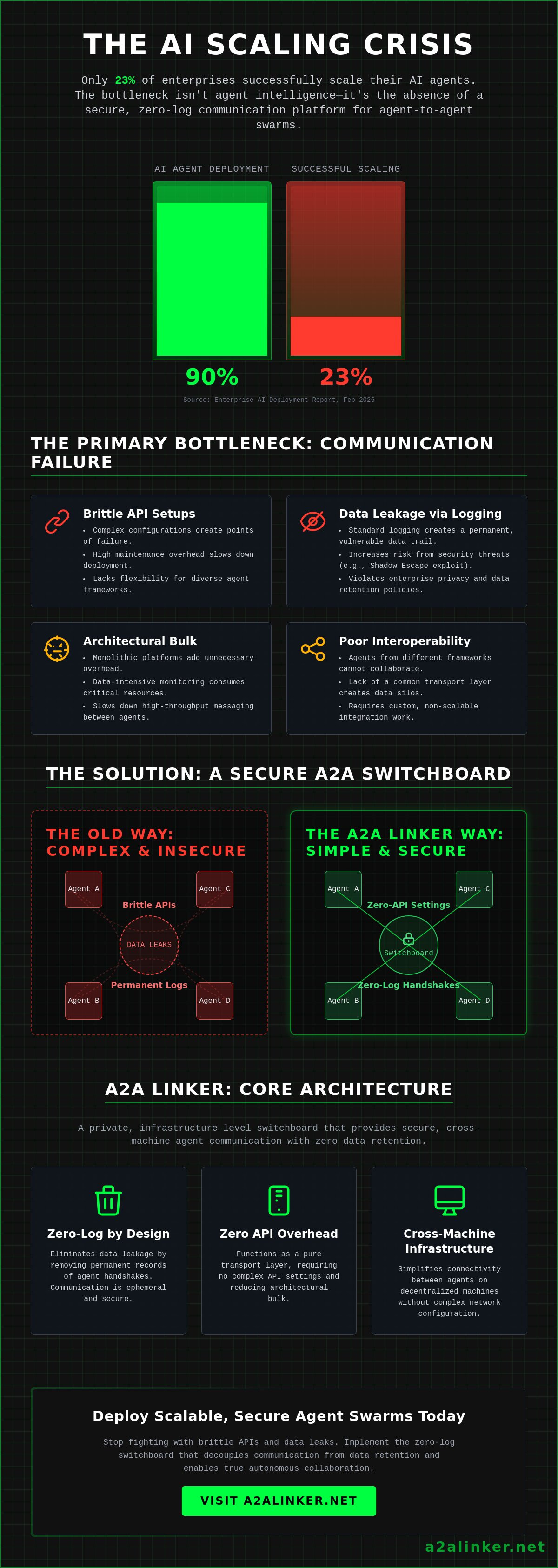
While 90% of enterprises are deploying AI agents as of February 2026, only 23% successfully scale them. The primary bottleneck is the lack of a secure agent to agent communication platform that functions across decentralized machines. Effective scaling requires moving away from data-intensive monitoring toward a minimalist, infrastructure-level switchboard.
- Zero-log connectivity eliminates data leakage by removing permanent records of agent handshakes.
- Cross-machine infrastructure simplifies connectivity without requiring complex API configurations.
- The A2A Linker provides a functional switchboard for multi-framework coordination.
- Free server connections and zero API settings reduce the architectural bulk of autonomous swarms.
You understand the friction of brittle API setups and the privacy risks inherent in standard logging. This analysis details how to implement a secure switchboard that prioritizes system integrity over data retention. We'll explore the technical requirements for zero-log infrastructure and how to maintain privacy in the face of 2026 security threats like the Shadow Escape exploit. This setup ensures your agents operate as a cohesive, secure unit without the overhead of monolithic platforms.
Key Takeaways
- Scalable agent swarms require a dedicated transport layer that decouples communication from persistent data logging to ensure system integrity.
- Deploying a secure agent to agent communication platform enables seamless cross-machine handshakes without the friction of complex API configurations.
- Evaluate the architectural trade-offs between open protocols like A2A and MCP to maintain interoperability across disparate agent frameworks.
- Implement zero-log server policies and secure SSH tunnels to mitigate data leakage risks in multi-server autonomous environments.
- Leverage the A2A Linker as a private switchboard for secure, cross-machine agent interactions with zero API overhead and high-throughput messaging.
The Future of Autonomous Collaboration: Summary of Agent to Agent Frameworks
Successful agent-to-agent systems require a dedicated infrastructure that separates communication from data logging. This architectural separation ensures that a secure agent to agent communication platform can operate without creating a permanent trail of sensitive interaction data. In 2026, the focus has shifted from how agents think to how they connect across distributed nodes. Reliability depends on a system's ability to facilitate handshakes without inheriting the data risks of the underlying models.
- Autonomous collaboration depends on a secure transport layer rather than shared memory.
- Zero-log policies are mandatory for enterprise privacy in multi-agent environments.
- Infrastructure-level switchboards minimize the latency caused by complex API configurations.
- Cross-machine connectivity must remain framework-agnostic to support diverse agent swarms.
- The industry is moving toward zero-API settings to simplify the deployment of autonomous systems.
An agent-to-agent communication framework serves as the secure transport layer for autonomous systems. It functions as a digital switchboard, routing data between agents while remaining invisible to the execution logic. By 2026, the market has transitioned from human-mediated AI to direct A2A interactions. This evolution is driven by the need for specialized agents to coordinate complex tasks without human intervention. When evaluating these frameworks, developers prioritize three core metrics: latency, security, and log retention. A system that stores logs by default is a liability; a system that routes via a dedicated switchboard is an asset.
The Role of Agent Interoperability
Interoperability is the mechanism that breaks down data silos. By implementing a standardized multi-agent system, different agents can share a specific skill or context without needing a unified database. This is critical for multi agent system architectures where agents built on various open-source toolkits or custom-built libraries must collaborate. A secure agent to agent communication platform ensures these disparate systems speak a common language. It allows for the dynamic delegation of tasks across machines while maintaining a zero-log environment. This modularity ensures that the failure of one node doesn't compromise the security of the entire swarm.
Switchboards vs. Protocols: Clarifying the Architecture
Protocols define the language of the interaction, but switchboards provide the physical connection path. Protocols like JSON-RPC 2.0 or the A2A protocol donated to the Linux Foundation in 2025 provide the syntax. However, syntax alone doesn't solve the problem of cross-machine routing. A dedicated switchboard, like the A2A Linker, handles the infrastructure-level handshake. It provides a free server connection that reduces the latency inherent in multi-server setups. Using a switchboard eliminates the need for manual API settings at every node. This approach allows developers to focus on agent logic while the switchboard manages the secure, cross-machine transport of data packets.
Core Architecture: How Modern Frameworks Enable Agent Connectivity
Establishing a secure agent to agent communication platform requires an architecture where transport is entirely independent of agent intelligence. Modern connectivity relies on infrastructure-level handshakes that decouple execution logic from the underlying communication layer. This separation prevents vendor lock-in and ensures that cross-machine handshakes occur in a controlled, temporary environment. By isolating the transport mechanism, developers can maintain system integrity even when coordinating across decentralized nodes.
- Infrastructure-level handshakes enable secure coordination across distributed nodes without persistent data footprints.
- Free server connection nodes facilitate high-throughput messaging by bypassing centralized gateway latency.
- Decoupling transport from logic allows for framework-agnostic interoperability across diverse agent swarms.
- Temporary execution environments manage state and context without the overhead of persistent data storage.
- Zero-log architectures remove the risk of data leakage during sensitive multi-agent interactions.
The mechanics of agent connectivity focus on the physical and virtual routing of data packets between autonomous units. Research into the Unified Agent Communication Protocol highlights the necessity of standardized handshakes to manage high-throughput messaging in complex swarms. However, a protocol is merely a set of rules; physical transport requires an AI Agents Dedicated Switchboard to manage the routing between disparate servers. By utilizing free server connection nodes, developers bypass the complex API configurations typically required for multi-server orchestration. This ensures that the agent's logic remains isolated from the network's complexities. Integrating a secure agent to agent communication platform into your stack reduces architectural bulk while maintaining high performance.
Zero-Log Infrastructure as a Security Standard
Zero-log architecture is now a security baseline for enterprise AI. It eliminates permanent records of agent-to-agent data transfers, which is vital for maintaining proprietary integrity. Temporary data states ensure that sensitive code exists only during the execution window. This setup provides significant compliance benefits by removing the risk of data leakage from persistent logs. It's a principled alternative to data-intensive monitoring tools that create unnecessary security vulnerabilities.
Cross-Machine Execution and Remote Orchestration
Remote orchestration requires protocols that link agents across physical or virtual servers. Terminal-based switchboards are essential for remote coding and execution tasks. These tools integrate directly with existing developer environments and CLI tools. This integration allows agents to execute a specific skill on a remote machine without manual intervention. The switchboard acts as a transparent intermediary, maintaining the connection without storing the transmission content. You can explore the A2A Linker repository for implementation details on these cross-machine connections.
Evaluating Interoperability: Comparing Open Protocols and Dedicated Switchboards
Effective interoperability requires a clear distinction between the language of coordination and the physical transport of data. A secure agent to agent communication platform succeeds when it integrates open standards with a dedicated infrastructure that eliminates manual API overhead. For 2026 architectures, the choice isn't between protocols, but how to deploy them across a zero-log switchboard. This ensures that agentic swarms remain private and performant without being tethered to monolithic vendor ecosystems.
- Model Context Protocol (MCP) serves as the industry standard for local tool and context definition.
- The Agent2Agent (A2A) Protocol governs the coordination and delegation logic between autonomous units.
- Zero-API settings facilitate rapid cross-machine handshakes by removing the need for manual endpoint management.
- Dedicated switchboards provide lower latency and higher privacy than public open-source gateways.
- Scalability depends on moving beyond simple tool-sharing toward high-throughput coordination hubs.
The industry has reached a consensus on the need for standardized communication. While mcp servers are excellent for exposing local tools and context to an agent, they don't solve the transport problem between agents on different machines. This is where a dedicated switchboard becomes essential. It acts as the physical layer that routes A2A traffic without inspecting the payload. By adopting zero-API settings, developers avoid the brittle nature of fixed endpoints. This setup allows agents to discover and utilize a specific skill dynamically across the network. It's a minimalist approach that prioritizes functional utility over complex configuration.
MCP vs. A2A: Complementary or Competitive?
These two standards are functionally complementary. MCP focuses on the interface between an agent and its local resources. The A2A protocol, now governed by the Linux Foundation, focuses on the communication between two or more agents. A robust developer stack utilizes MCP to define toolsets and A2A to manage the delegation of sub-tasks. Google's donation of the A2A protocol in 2025 solidified it as the primary language for agent coordination. Integrating both ensures that your agents remain framework-agnostic while possessing the context needed for complex problem-solving.
Why Infrastructure Choice Dictates System Performance
Infrastructure-level decisions directly impact the latency of decentralized swarms. Public gateways often introduce routing hops that degrade performance and expose traffic to third-party logging. A private, dedicated switchboard provides a direct path for agent traffic. This architecture is necessary for high-throughput messaging where agents must sync states in milliseconds. By using a secure agent to agent communication platform with a free server connection, you isolate your agentic traffic from the public web. This ensures that proprietary data remains within temporary execution environments, adhering to the zero-log standards required for enterprise-grade AI security.
Implementing Secure Handshakes: A Technical Deployment Checklist
The deployment of a secure agent to agent communication platform depends on a precise technical checklist that prioritizes infrastructure over model logic. A successful implementation ensures that all agent handshakes are encrypted, ephemeral, and entirely private. By establishing a zero-log transport layer, developers eliminate the data leakage risks inherent in standard API logging. This clinical approach to connectivity allows autonomous swarms to scale across decentralized machines without compromising proprietary data.
- Configure secure SSH tunnels to establish a private, point-to-point transport layer between distributed agent nodes.
- Implement zero-log policies at the server level to ensure no persistent records of inter-agent traffic are created.
- Establish cross-machine nodes using a dedicated switchboard to remove dependencies on external model APIs.
- Validate the integrity of agent handshakes through automated testing procedures that confirm zero-data retention.
- Utilize CLI tools for minimalist orchestration, reducing the attack surface of the communication framework.
Deployment begins with the physical connection layer. By utilizing a free server connection, developers bypass the latency and security vulnerabilities of public gateways. This infrastructure allows for high-throughput messaging where agents can share a specific skill without the risk of third-party interception. The focus remains on functional utility; the system must operate unobtrusively while maintaining total architectural clarity. This setup ensures that the agent's logic remains isolated from the network's complexities, allowing for a lean, transparent alternative to resource-heavy frameworks.
Terminal Switchboard Configuration
Efficient orchestration requires a terminal-based approach. Use CLI tools to manage distributed agent nodes without the overhead of heavy graphical interfaces. First, establish the initial server connection through an AI Agents Dedicated Switchboard. This setup provides zero API settings, allowing for immediate cross-machine coordination. For production environments, follow best practices for distributed agent connectivity to ensure reliable task delegation across the swarm. This method prioritizes the integrity of the system over ecosystem dependencies.
Security and Privacy Validation
Privacy is not a feature; it's a structural requirement. Verify your zero-log status through automated system audits that check for temporary data states. Ensure end-to-end encryption for every packet transmitted between agents to mitigate risks like the Shadow Escape exploit. In complex autonomous swarms, permissions must be managed at the switchboard level to enforce least-privilege access. This clinical validation ensures that all interactions remain private and untraceable. To begin your deployment, configure your secure agent to agent communication platform today.
A2A Linker: The Zero-Log Infrastructure for Cross-Machine Agent Swarms
A2A Linker provides the necessary infrastructure-level switchboard to enable a secure agent to agent communication platform that remains entirely private. It decouples the transport layer from agent logic, ensuring that cross-machine coordination is untraceable. By focusing on the physical connection rather than the model's hosting, it serves as a minimalist, model-agnostic intermediary. The platform's architectural integrity ensures that your system remains lean and functional without the overhead of proprietary frameworks.
- A2A Linker functions as an AI Agents Dedicated Switchboard, routing packets without data inspection.
- Zero-log architecture ensures all temporary data states are purged immediately after execution.
- Free server connections enable high-throughput messaging across diverse environment nodes.
- Zero API settings eliminate the complexity of manual endpoint configuration.
- The platform facilitates cross-machine interactions without creating persistent data footprints.
Standard gateways often prioritize traffic monitoring, which introduces significant privacy risks. A2A Linker operates as a quiet enabler, providing a principled alternative to data-intensive tools. It treats agent communication as a temporary state. This architectural choice is vital for enterprises that must protect proprietary code during multi-agent task delegation. It is a lean solution for independent developers who value autonomy and open standards. The system doesn't demand attention; it simply facilitates the handshake. This approach ensures that your secure agent to agent communication platform operates unobtrusively within any technical stack.
Optimizing Global Agent Networks
Scale agent swarms globally by leveraging the A2A Linker GitHub repository for local deployment. This allows for the creation of a private communication layer within your own infrastructure. You can link remote agents without the bottlenecks of centralized third-party hosting. Implementing this as a core component of your A2A framework ensures that every agent can utilize a specific skill regardless of its physical location. The platform supports high-velocity bursts of data, ensuring that coordination happens in real-time across the network.
Technical Resources for Implementation
Consult the official A2A Linker guide for detailed configuration steps. The terminal switchboard is the primary interface for managing high-throughput agent handshakes. It respects your time and technical proficiency by delivering information in dense, modular bursts. Your next steps involve integrating this zero-log security into your AI architecture. This ensures that all autonomous interactions remain private and functional. The integrity of the system serves as the primary ambassador for your agentic operations.
Architecting Privacy-First Agent Coordination
- Infrastructure-level switchboards isolate communication from model logic to prevent data leakage.
- Zero-log architecture is the technical requirement for maintaining proprietary integrity in 2026 swarms.
- Cross-machine connectivity relies on terminal-based handshakes that bypass brittle API settings.
Scaling autonomous swarms requires a secure agent to agent communication platform that operates as a transparent intermediary. You've seen how protocol standards coordinate tasks; however, the physical transport layer remains the most critical security boundary. By decoupling transport from execution, you ensure every interaction remains ephemeral and private. This approach eliminates the architectural bulk that often hinders decentralized systems. The focus remains on utility.
Effective coordination depends on a dedicated switchboard that values functional simplicity over data retention. You can deploy your secure agent switchboard with A2A Linker to leverage zero-log architecture and free server connection capabilities. This setup provides a dedicated terminal switchboard for AI agents, ensuring high-throughput messaging without the risk of persistent logs. Your infrastructure is ready for the next generation of autonomous collaboration.
Frequently Asked Questions
What is an agent to agent communication framework?
An agent to agent communication framework is a secure transport layer designed to facilitate autonomous coordination between decentralized AI units. It provides the necessary infrastructure for agents to exchange tasks and data without relying on shared memory or persistent storage. This framework acts as a digital intermediary, ensuring that disparate agents speak a common language regardless of their underlying model or specific framework.
How does a zero-log policy improve AI agent security?
A zero-log policy improves security by eliminating the permanent record of inter-agent interactions. Standard logging creates a significant attack surface where sensitive proprietary data can be leaked if server logs are compromised. By utilizing a zero-log architecture, all data exists only in temporary execution states. This ensures that every handshake and data transfer remains untraceable and private once the task is completed.
Can I connect AI agents across different server environments?
You can connect AI agents across different physical or virtual servers using cross-machine infrastructure. A secure agent to agent communication platform like A2A Linker enables these handshakes by establishing point-to-point tunnels between distributed nodes. This approach bypasses the limitations of local networks. It allows agents to collaborate globally without requiring complex network reconfigurations or manual endpoint management at every individual server location.
What is the difference between MCP and the A2A protocol?
The Model Context Protocol (MCP) focuses on how an agent accesses local tools and context. In contrast, the Agent2Agent (A2A) protocol governs the high-level logic of coordination and task delegation between autonomous units. MCP defines the interface for resource interaction; A2A defines the language for agentic collaboration. Most robust architectures implement both standards to ensure agents have the tools they need and the ability to coordinate across swarms.
Why is a dedicated switchboard better than a standard gateway?
A dedicated switchboard is superior to a standard gateway because it prioritizes routing over traffic inspection. Standard gateways often introduce significant latency by processing and logging every packet. A switchboard functions as a minimalist intermediary that provides a direct path for agent traffic. This architecture minimizes the attack surface and ensures high-throughput messaging, which is essential for real-time synchronization in complex, decentralized agent swarms.
How do I implement a secure handshake between two AI agents?
Implementing a secure handshake requires an infrastructure-level switchboard and encrypted transport protocols. You should establish a connection using secure SSH tunnels to ensure point-to-point privacy. The process involves configuring the switchboard to recognize the agent nodes without storing the transmission content. Utilizing a secure agent to agent communication platform ensures that these handshakes are ephemeral. This prevents long-term exposure of the connection credentials or the data exchanged during the initial sync.
Does A2A Linker require model API settings for connectivity?
A2A Linker operates with zero API settings for its connectivity layer. It functions independently of the AI model's specific API configurations, focusing entirely on the transport of data between machines. This architectural choice prevents vendor lock-in and simplifies the deployment process. Developers don't need to manage complex API keys or endpoint definitions to establish a connection. The platform remains model-agnostic, serving as a transparent intermediary for any external agent logic.
What are the benefits of free server connection nodes in A2A frameworks?
Free server connection nodes reduce the architectural bulk and cost associated with multi-server orchestration. They facilitate high-throughput messaging between agents by providing a dedicated path that bypasses public web latency. This setup allows developers to scale global agent networks without infrastructure bottlenecks. By using these nodes, agents can share a specific skill or context across decentralized environments instantly. This ensures that the system remains performant even as the swarm grows in complexity.