Multi-agent architecture is a networking problem as much as a logic problem. By 2026, the most effective multi agent system architecture patterns replace monolithic designs with specialized, cross-machine swarms to eliminate context window saturation and interaction latency.
- Prioritize Supervisor patterns for centralized routing and state management.
- Utilize Peer-to-Peer (P2P) connectivity via the Agent2Agent (A2A) protocol.
- Deploy zero-log execution environments to prevent persistent data leakage.
- Enable cross-machine handshakes using an AI Agents Dedicated Switchboard.
You likely recognize that managing cross-server handshakes and persistent logging creates significant security vulnerabilities. This article provides a clinical analysis of the structural and connectivity patterns required to orchestrate distributed AI agent swarms. We'll examine how to reduce architectural complexity using an A2A Linker and free server connections while maintaining the privacy standards expected in an $8.0 billion market. We'll also review the transition from legacy frameworks to Microsoft Agent Framework 1.0 to ensure your stack remains production-ready.
Key Takeaways
- Identify how to distribute cognitive load across specialized agents to maintain context integrity and system reliability.
- Evaluate orchestration and interaction models to manage task execution and minimize context drift during state transitions.
- Implement multi agent system architecture patterns that utilize a dedicated switchboard for secure, cross-machine communication.
- Eliminate security risks by adopting Zero Log connectivity and temporary data states for all agent-to-agent interactions.
- Apply modular deployment strategies that allow for independent agent upgrades without compromising global system uptime.
Executive Summary: The Taxonomy of Multi-Agent Architecture Patterns
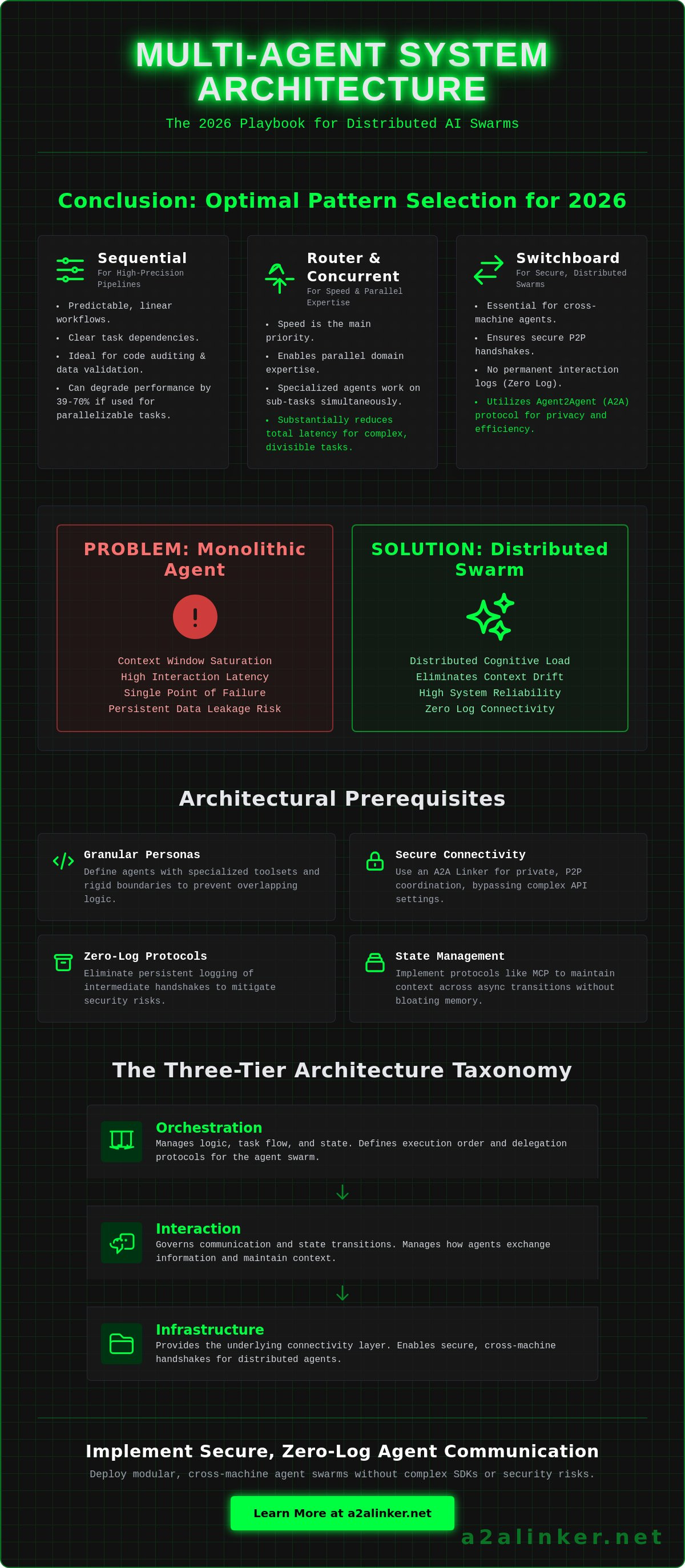
The Conclusion: Optimal Pattern Selection for 2026
- Sequential Patterns: Deploy these for predictable, high-precision pipelines where clear dependencies exist. Use these for tasks like automated code auditing or multi-stage data validation.
- Router and Concurrent Patterns: Execute these when speed and parallel domain expertise are the priority. These patterns allow specialized agents to work on sub-tasks simultaneously, reducing total latency.
- Switchboard Connectivity: Implement an AI Agents Dedicated Switchboard for all distributed, cross-machine agent swarms. This ensures secure handshakes without permanent interaction logs.
A Multi-agent system functions by distributing cognitive load across specialized nodes. This architectural shift prevents context window saturation, a common failure point in monolithic agents. By 2026, multi agent system architecture patterns have evolved into a three-tier taxonomy: Orchestration, Interaction, and Infrastructure. Orchestration manages the logic and task flow. Interaction governs communication and state transitions. Infrastructure provides the underlying connectivity layer. Each tier must operate with architectural clarity to ensure system reliability.
Selecting the correct pattern requires an analysis of task linearity and domain overlap. If a task requires sequential reasoning, a multi-agent setup can actually degrade performance by 39-70% due to coordination overhead. However, for parallelizable tasks, the efficiency gains are substantial. Systems engineers must evaluate if the workflow requires a central supervisor or a decentralized swarm. The goal remains context integrity. You don't want a specialized agent receiving irrelevant data from a previous step. Precision routing keeps the execution environment lean and focused.
Architectural Prerequisites for MAS
- Granular Personas: Define agents with specialized toolsets. Boundaries must be rigid to prevent overlapping execution logic.
- Secure Connectivity: Use an A2A Linker to establish peer-to-peer coordination. This bypasses the need for complex API settings and keeps communication private.
- Zero-Log Protocols: Adopt a Zero Log approach for agent-to-agent interactions. Persistent logging of intermediate handshakes introduces unnecessary security risks.
- State Management: Implement protocols like the Model Context Protocol (MCP) to maintain context across asynchronous transitions. This ensures the system retains state without bloating individual agent memory.
Infrastructure is the often-ignored pillar of MAS. Distributed agents frequently reside on different servers or execution environments. Traditional networking fails here because it wasn't designed for high-velocity agent handshakes. Successful 2026 deployments utilize cross-machine connectivity that operates unobtrusively. By using a dedicated switchboard, developers can link agents across different machines without managing complex SDKs or frameworks. This modularity allows for independent agent upgrades and maintains high system availability.
Orchestration Patterns: Managing Logic and Task Flow
- Orchestration serves as the state-management layer for multi agent system architecture patterns, defining execution order and delegation protocols.
- Sequential pipelines ensure high traceability for linear tasks but risk cumulative latency across multiple nodes.
- Hierarchical models utilize supervisor nodes to decompose tasks, necessitating high-bandwidth, low-latency connectivity for state tracking.
- Robust error recovery and formal state machine transitions replace traditional prompt engineering in production-grade agent swarms.
Orchestration determines the execution sequence and delegation protocols required to resolve complex objectives within multi agent system architecture patterns. It serves as the logic layer that governs the "who" and "when" of task execution. In a complex multi-agent system, architectural focus has shifted from simple instruction sets to formal state machine design. This transition ensures that the system handles edge cases and recovers from failures without human intervention. By 2026, developers prioritize modularity, moving away from monolithic designs toward specialized swarms that utilize deterministic routing logic to maintain system uptime.
Sequential and Pipeline Patterns
Sequential patterns operate on a linear execution model where the output of one agent serves as the direct input for the next. This pattern is ideal for data transformation pipelines, multi-stage code auditing, and document verification. Its primary strength is traceability; every step in the reasoning chain is clearly documented. However, it introduces a structural vulnerability where latency accumulates at every node. If a single agent in the chain fails or times out, the entire process stalls. Implementing timeout thresholds and automated retry logic at each node is a technical requirement for maintaining production stability in these pipelines.
Hierarchical (Supervisor/Manager) Patterns
The hierarchical pattern introduces a lead agent to act as a central orchestrator. This supervisor node decomposes high-level goals into manageable sub-tasks and delegates them to specialized worker agents. This architecture abstracts management away from the user, facilitating the resolution of complex, multi-domain problems. Effective delegation requires a reliable networking layer to track sub-agent states in real-time. While powerful, this pattern creates a centralized bottleneck. The supervisor node requires significant context overhead to manage feedback loops from multiple concurrent workers, which can lead to performance degradation if the task volume exceeds the supervisor's processing capacity.
Manage these complex logic flows across distributed environments by using an AI Agents Dedicated Switchboard to handle cross-machine handshakes with zero API configuration and maximum architectural clarity.
Interaction Patterns: Communication and State Transitions
- Standardize handshakes using secure, private channels to prevent data leakage during agent-to-agent coordination.
- Implement explicit handoff protocols to manage state transitions and maintain context integrity between specialized nodes.
- Utilize non-agentic routers to direct traffic, reducing latency and avoiding unnecessary LLM reasoning overhead.
- Prioritize high information density in communications to minimize context drift during complex, multi-turn dialogues.
Interaction patterns define the communication protocol within multi agent system architecture patterns. They govern how data moves and how control shifts between nodes. Unlike simple prompt-response loops, these patterns must handle asynchronous callbacks and complex multi-turn dialogues. The objective is to transfer the minimum necessary state to complete a sub-task. Excessive data transfer leads to context window bloat and increased error rates. You must ensure that every interaction serves a specific functional utility without adding noise to the agent's memory.
Handoff and State-Transfer Patterns
Handoff patterns involve the explicit transfer of control from one agent to another. A triage agent identifies the user's intent and hands the session to a billing specialist or a technical support agent. This requires a standardized handshake to ensure the successor agent understands the current state. Protocols like MCP servers provide the interoperability layer needed for these transitions. Without a clear state-transfer pattern, the receiving agent lacks the historical context needed to proceed. This failure often forces the system to restart the reasoning chain, wasting compute resources and increasing latency.
Router and Dispatcher Patterns
Router patterns use a dispatcher to direct queries to the best-fit specialist. This dispatcher is often non-agentic or uses a very light model to categorize the request. This architectural choice avoids the high latency of using a large model for basic routing tasks. It also supports parallel dispatch. For example, a single query might be split into three facets. One facet goes to a research agent, another to a formatting agent, and a third to a compliance agent. All three work simultaneously. A final aggregator agent then combines the results into a single output. This parallel execution is essential for high-velocity environments where sequential processing is too slow.
Security is the foundation of these interaction patterns. Every handshake must occur over an encrypted, private channel to prevent unauthorized access to intermediate data states. You can implement this by using an AI Agents Dedicated Switchboard to facilitate cross-machine interactions. This setup ensures Zero Log communication, meaning no permanent record of the agent-to-agent dialogue is kept. This approach aligns with a minimalist, privacy-first ethos, treating data as a temporary execution state rather than a permanent asset to be monitored.
The Infrastructure Gap: Connectivity and Networking Patterns
- Infrastructure provides the physical layer required to implement multi agent system architecture patterns across distributed server environments.
- Traditional API-based networking creates a permanent trail of agent-to-agent interactions, introducing significant security liabilities.
- Dedicated switchboard patterns enable cross-machine communication without the overhead of complex API settings or persistent logging.
- Secure, zero-log connectivity is a prerequisite for ai agent remote execution connectivity in production-grade swarms.
Most architectural guides focus on the logic of supervisors and workers. They assume agents exist within the same memory space. This is rarely the case in enterprise deployments. With cloud-based deployments accounting for 72.1% of the market share, agents are increasingly distributed across fragmented environments. Networking is not just a utility; it is the foundational security layer. Standard API calls are insufficient. They were designed for human-to-machine interaction, not high-velocity agent handshakes. When agents live on different servers, you need a dedicated networking layer that prioritizes functional utility over data retention.
The Dedicated Switchboard Pattern
The Dedicated Switchboard Pattern centralizes connectivity logic without centralizing data. It acts as a transparent intermediary for agent handshakes. This pattern allows a local agent to coordinate with a remote agent as if they were on the same machine. It eliminates the need for exposed endpoints or complex firewall configurations. By using an AI Agents Dedicated Switchboard, developers can link agents across different cloud providers or local servers with Zero API settings. This modularity ensures the networking layer remains unobtrusive. It speaks to the minimalist architect who values autonomy and interoperability.
Zero-Log Networking for Agent Swarms
Agent swarms generate massive volumes of intermediate execution data. Storing these interaction logs creates a permanent record of proprietary prompts and sensitive logic. Zero-log networking ensures these data states remain temporary. Once a handshake is finalized and the task is transferred, the communication channel is purged. This is critical for regulated industries like healthcare or finance where data residency and privacy are non-negotiable. It protects the integrity of the system. It ensures the communication layer does not become a data-intensive monitoring tool. Reliability comes from the quality of the logic, not the volume of the logs.
To secure your distributed swarms and maintain architectural clarity, implement an A2A Linker to establish private, cross-machine connections today.
Implementation Strategy: Deploying MAS Patterns Securely
- Prioritize modularity to ensure independent agent upgrades without inducing system-wide downtime.
- Execute secure, cross-machine handshakes using an A2A Linker to bridge fragmented server environments.
- Validate all multi agent system architecture patterns against zero-log standards to maintain data privacy.
- Implement framework-agnostic protocols to avoid vendor lock-in and preserve architectural flexibility.
Successful deployment requires balancing architectural elegance with functional utility. In a market projected to reach $8.0 billion by 2026, the delta between research and production lies in the networking layer. You must move beyond single-server setups that assume shared memory. Scalable swarms require a decoupled transport layer where agent logic remains independent of the connectivity hardware. This approach allows you to swap out models or update specific agent skills without reconfiguring the entire orchestration stack. It ensures the system remains lean and responsive even as complexity increases.
Step-by-Step MAS Deployment Framework
- Define Decomposition Logic: Determine if your task requires a Sequential pipeline for precision or a Hierarchical supervisor for complex delegation. Reference your task linearity to avoid the 39-70% performance degradation associated with unnecessary coordination.
- Select Communication Protocols: Use standardized protocols like MCP or JSON-RPC for interoperability. These provide the structure needed for consistent state transfers between specialized nodes.
- Establish Secure Transport: Deploy the A2A Linker switchboard to handle cross-machine connectivity. This ensures that handshakes occur over private channels with Zero API settings.
- Implement Evaluation: Set up monitoring nodes that verify agent outputs against success criteria. Ensure this process occurs in temporary execution environments to prevent persistent data logging.
Tooling and Resources
Infrastructure should never demand attention. It should operate unobtrusively in the background. For open-source connectivity tools that support this minimalist ethos, you can leverage A2A Linker on GitHub. These tools allow for rapid integration across different machines without the bulk of heavy frameworks. For specific configuration snippets and implementation details, consult the A2A Linker guide. Using these resources helps maintain a privacy-first posture while scaling multi agent system architecture patterns. By focusing on the integrity of the system and the quality of the logic, you position your infrastructure as a serious piece of enterprise-grade technology rather than a consumer-facing novelty.
Securing the Future of Distributed Agent Swarms
- Standardize on a Dedicated Switchboard to resolve cross-machine connectivity gaps.
- Prioritize Zero Log interaction protocols to ensure data privacy in regulated environments.
- Select multi agent system architecture patterns based on task linearity to optimize system performance and reduce coordination overhead.
The transition from monolithic agents to distributed swarms is an architectural necessity. Success in 2026 depends on the integrity of the networking layer as much as the logic of the orchestrator. You can eliminate architectural complexity by decoupling agent skills from their underlying infrastructure. This approach ensures your system remains modular, scalable, and secure. It positions your deployment as a robust piece of infrastructure rather than a fragile research project. Decoupling agent skills from their underlying infrastructure allows for high-velocity updates without inducing system downtime. This modularity is essential for maintaining a competitive edge in the evolving AI landscape.
Establish secure, zero-log connections for your AI agents with A2A Linker. Utilize a zero-log architecture and free server connection capabilities to link specialized nodes across any environment. Scale your agentic infrastructure with confidence.
Frequently Asked Questions
What are multi agent system architecture patterns?
multi agent system architecture patterns are structural templates that define how autonomous entities collaborate, communicate, and execute tasks. They provide the logic for task decomposition and the networking layer for agent-to-agent connectivity. By 2026, these patterns are categorized into orchestration logic, interaction protocols, and infrastructure layers. Implementing these patterns ensures that specialized agents maintain context integrity without saturating individual context windows.
When should I use a supervisor pattern over a sequential pipeline?
Select a supervisor pattern when a task requires dynamic decomposition and delegation to specialized sub-agents. This is ideal for complex, multi-domain problem solving where a lead agent must manage multiple workers. Use a sequential pipeline for linear tasks with predictable dependencies, such as data validation. Research indicates that using multi-agent systems for strictly sequential reasoning can degrade performance by 39-70% compared to single-agent execution.
How do multi-agent systems handle context window limits?
Multi-agent systems bypass context window limits by distributing cognitive load across specialized nodes. Each agent operates within a narrow, relevant context segment rather than processing the entire dataset. This modularity prevents context window saturation, which is a primary failure point in monolithic agents. Efficient state-transfer protocols ensure that only the necessary information moves between agents during a handshake, keeping the execution environment lean.
Why is a zero-log policy important for agent-to-agent communication?
A zero-log policy is essential to prevent the persistent storage of intermediate execution data and proprietary prompts. Storing agent-to-agent dialogues creates significant security vulnerabilities and data leakage risks. By adopting a zero-log approach, you ensure that communication remains a temporary execution state. This is a critical requirement for maintaining compliance in regulated industries like finance and healthcare where data residency is strictly monitored.
Can I connect agents running on different cloud providers?
You can link agents across different cloud providers, local servers, and remote environments using a cross-machine connectivity layer. This setup requires an AI Agents Dedicated Switchboard to manage the networking handshakes without complex firewall configurations. It allows for a heterogeneous agent swarm where each component resides in its optimal execution environment. Free server connection capabilities simplify this process by removing traditional infrastructure barriers to entry.
What is the difference between orchestration and interaction patterns?
Orchestration patterns define the logical sequence and delegation protocols of a workflow. They determine "who" executes a task and "when" it occurs. Interaction patterns govern the technical communication and state transitions between those agents. While orchestration focuses on the high-level task flow, interaction focuses on the mechanics of the handshake and information density. Both are necessary to implement robust multi agent system architecture patterns in production.
How does A2A Linker facilitate multi-agent architecture?
A2A Linker provides the physical networking layer required to link distributed agents securely. It utilizes an AI Agents Dedicated Switchboard to facilitate cross-machine handshakes with Zero API settings. This tool ensures that communication is private and follows a Zero Log protocol. It acts as a transparent intermediary, allowing developers to focus on agent logic and skill sets rather than managing complex networking infrastructure or SDK dependencies.
Are hierarchical patterns better for complex reasoning tasks?
Hierarchical patterns are superior for complex reasoning because they allow a supervisor agent to abstract sub-task management. This structure enables the system to handle objectives that exceed a single agent's reasoning chain. However, the supervisor agent must manage the coordination overhead effectively. You should only deploy this pattern when the task's complexity justifies the additional latency introduced by centralized orchestration and the supervisor's context window requirements.